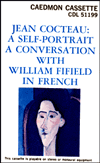
 The liner notes for the recording: The liner notes for the recording:
In 1955, some 46 years after he composed his first
book of verse (La lampe d'Aladin) Jean Cocteau donned the ceremonial costume and
sword and entered the porte cochère of the French Academy to become one of the
forty immortals of France. At that time many could scarcely believe that the veteran
experimenter in so many arts would accept membership in this ancient and conservative
institution. To others, looking at the unexpected event more judiciously, it seemed yet
another innovation to be attributed to an artist whose life had been devoted to breaking
with tradition. Thanks to the fortunate recording arranged by Mr. Fifield, we are given
two explanations viva voce why the trail-breaker associate of dadaists and
surrealists became an Academician. The first clue is afforded by his recalling here what
Erik Satie (his collaborator on the ballet Parade) once told him of Ravel:
"He refuses the Legion of Honor, but his entire production accepts it!" In other
words, the social gesture and intuitive aesthetics are not always in accord. By analogy,
Cocteau accepts the French Academy, whereas his entire production—his surrealistic
films and other avant-garde works which stirred up polemics with Mauriac and
others—rejects the Academy. In this recorded interchange Cocteau further explains his
accepting membership under the cupola as an act of fighting against the conformity of
anti-conformism.
How fortunate
we are that the American William Fifield was able to preserve this rich and varied
conversation shortly before Cocteau's death in 1963! Although the poet explains here that
his novel Le grand écart (1923) constituted an early autobiography of sorts,
although the Editions du Seuil have published a Cocteau par lui-même, the dating
of the remarks here recorded makes of them a last verbal testament. Let us not confuse
this recording with an interview. It is infinitely more. It is an intelligent discussion
subtly directed by a well-read younger friend who succeeded masterfully in keeping the
dialectic moving over a broad field of crucial topics. What a privilege to hear the old
leader, now so distant in time from the great cubists, surrealists, and dadaists whom he
knew and inspired, saying that when he now looks at their photographs he feels "like
the sole survivor of a disaster." But the memories are clearer than the photographs,
the flow of thoughts is articulate and rapid, the opinions are trenchant and often couched
in the old brilliant example and metaphor. The great humanity of the man shines through.
The eleventh-hour reminiscences of the old familiar faces are touching: Radiguet, Bunuel,
Picasso, Proust. The survey of artists who affected his life (Goya, Vermeer, Delacroix,
Ingres, Juan Gris, and others) thus parallels his fond recollections of a multitude of
writers of whom he gives unilinear portraits or concise impressions. Why, for example,
does he not like the great Voltaire? Because Voltaire joined the pack of literary hounds
who viewed Rousseau as their quarry. He is amused to find a parallel source of Proust's
Albertine in a transvestitism episode of Don Quijote.
As one
listens, the impression persists that Cocteau in his seventies was the youngest of all the
new writers and artists in France. It does not then surprise us then when he divulges that
the youngest of the film directors or writers show their productions to him first, and
even help him to finance one of his own films or plays. He shows that up to the end he is
an intuitive writer who "has no control over himself" and still believes, as he
had written earlier, in a muse or angel recalling Lorca's duende. Nevertheless he
feels that the greatest art is created against obstacles, the thesis which Gautier had
advanced so well years before in his Art. Beyond the intimate glimpses of Cocteau
as writer, artist, memorialist, and aesthetician, one notes still the nimble wit and
paradox of Cocteau the bel esprit: the man who became famous for such witticisms
as "It seems to me that mirrors ought to reflect more" and "Victor Hugo was
a madman who believed himself to be Victor Hugo" (here repeated). But I have no wish
to spoil your fun in advance. Listen for yourself.
—Robert J. Clement, Director
Comparative Literature, Graduate School, New York University
|


![[back arrow]](images/backarrow.gif)
