Integrating Technology into the Curriculum
Demonstration of Content Knowledge Essay.
The two preselected activities that I have chosen are from 7th and 8th grade history classes. The first activity involves 8th grade American history regarding the Intolerable Acts and the effects it had on the colonists. The purpose of this activity is explained in Texas state social studies 8.3a – “The student is expected to explain the reason for the growth of representative government and institutions during the colonial period” (Texas Education Agency, 2010). This activity was selected from Course number 6710, Understanding the Impact of Technology on Education, Work and Society and was completed in August of 2012. The professional standards tagged with this activity was
-
2a. Teachers will design or adapt relevant learning experiences that incorporates digital tools and resources to promote student learning and creativity:
-
2b. Teachers will develop technology-enriched learning environments that enable all students to pursue their individual curiosities and become active participants in setting their own educational goals, managing their own learning, and assessing their own progress.
In this activity, the students did research on the Internet to familiarize themselves with the Intolerable Acts (they could also read the textbook for this as well), a word-processor application, PowerPoint software, and the construction of a wiki which I helped to construct. What I gained from this activity was the ability to create a learner-centered classroom using the latest digital technologies in our school, use of technology to become an agent of social change, and help students become more adept in the use of technology to produce their work product.
The students had several tasks for them to perform, all of which were identified for them in their rubric. Information regarding the Intolerable Acts was gained from the Internet and passed on to the other members of their group using the wiki. Each member had an act to research on and report their finding to their group on the wiki. Images were allowed as long as it was in content with the text.
In closing, I believe this learning activity is authentic, engaging and challenging for my students. I think that using a wiki for this activity helped my students to collaborate with each other in a manner that was not present six months ago. I also believe that this is an exercise that is portable to other disciplines as well.
The second activity that I have chosen comes from my 7th grade Texas history class. All of my students are classified as special needs students and some are also English Language Learners. The activity concerns the arrival of Spanish conquistadors to Texas who were seeking wealth, adventure, and to expand Spain’s empire. The purpose of this activity was to explain why the Spanish conquistadors and friars explored Texas, and determine whether the expeditions to Texas succeeded or failed. As all of my students are Hispanic and male, I was sure that my students would be motivated for this project. This activity was selected from Course number 6711, Bridging Learning Theory, Instruction and Technology and was completed in October of 2012. The professional standards tagged with this activity was
-
2a. Teachers will design or adapt relevant learning experiences that incorporates digital tools and resources to promote student learning and creativity:
-
2b. Teachers will develop technology-enriched learning environments that enable all students to pursue their individual curiosities and become active participants in setting their own educational goals, managing their own learning, and assessing their own progress.
In this activity, the students’ prior knowledge was activated using a K-W-L chart. Most students already knew what a conquistador and friar were. Students were put in groups of three and each group had a conquistador to research on the Internet. Each member of each group was assigned a specific item to research, either background material on the conquistador, his travels in Texas, or what he accomplished in Texas. One group of students did research on the friars and their success in Texas. A rubric was provided for the students, as well as a model of what their presentation should look like.
This project took several class periods as students were busy constructing their own knowledge using resources from the Internet. Each group had its own name, the name of the conquistador they were working on. The information that was gleamed from the Internet was used in a PowerPoint presentation. Many of my students did not know how to use this software application in the beginning but after this project most of them felt comfortable about using PowerPoint. The students constructed a four slide PowerPoint presentation using images of conquistadors, friars, missions and Native Americans in Texas.
In closing, I believe that my students learned how to search the Internet for relevant information. They also learned how to use software in a manner to demonstrate what they had learned. The knowledge that was gained from this activity was authentic learning and it was portable as well.
Reference
Texas education Agency, 2010. Retrieved from: http://www.tea.state.tx.us/index2.aspx?id=3643.
Curriculum Design and Theories of Learning
An efficient curriculum design lays the groundwork for effective learning. As Dr. Jacob states. Curriculum is about choice making, it is about how you (teacher) choose to organize the way your students spend their time and you’re choosing about what is essential versus what is not essential” (Laureate Education, 2010). Curriculum answers the question on what kind of information, and skills are learned at the school but how do students learn? A contemporary theory of learning, as propounded by Dr. McTighe, is the cognitive or constructionist theory of learning. The constructionist theory states “that the learner has to construct meaning for himself” (Laureate Education, 2010). It is with these ideas in mind, curriculum design and theory of learning, which I will use to formulate my model of learning.
A valuable learning experience that helped shaped my model of learning occurred while I was still in grade school. I was taught how to play the game of chess from my fifth grade social studies teacher, Mr. Bede Watson. Mr. Watson did not show me how to move the pieces, or what strategy to employ; I learned how to play the game by playing my classmates. There were no endless drills, no memorization of openings or studying famous games but the sheer pleasure of the game being played for its own sake. Mr. Watson allowed me to explore on my own; to learn from my mistakes, and he assisted me only when I ask for his help. His assistance would come in replaying games that I lost. He would ask me questions over a particular move and then he would tell me what I needed to practice. As I look back over my learning experience, the specific learning theory that Mr. Watson utilize was closely align to Lev Vygotsky’s social learning theory. “Learning occurs most effectively when experts and novices work together for a common product or goal, and are therefore motivated to assist one another” (Gibbons, 2002). Mr. Watson’s support or scaffolding assisted the development of my learning the game of chess. Through Mr. Watson’s assistance, I was able to raise the level of my game which correlates perfectly with Vygotsky’s zone of proximal development. The learning experience that I shared with Mr. Watson, and the learning theory that he employed helped to shape my own theory of learning that I now use in my class.
My theory of learning is mostly influenced by the teachings of Lev Vygotsky. His concept of scaffolding implies that it is a special kind of help to assists learners to move toward new skills, concepts, or levels of understanding. “Scaffolding is thus the temporary assistance by which a teacher helps a learner know how to do something, so that the learner will later be able to complete a similar task alone” (Gibbons, 2002). Vygotsky’s zone of proximal development is natural. I have used this concept with my own children without knowing it. Teachers assist learners build upon what they already know. Similarly, my theory of learning has been influence by discovery learning. There are times when I have assigned a project to a group of students that build upon prior knowledge. The project will include resources to guide them, but it is not a step-by-step recipe. This type of learning is most narrowly associated with project based learning or discovery learning. Additionally, I was also interested in the learning theory of Albert Bandura. “Bandura’s social learning theory posits that people learn from one another via observation, imitation and modeling. The theory has often been called a bridge between behaviorist and cognitive learning theories because it encompasses attention, memory and motivation” (Learning Theories Knowledgebase, 2012). Bandura’s learning theory would work well with my middle grade English language learner students who have yet to master academic English. These students work well learning from each other, and it would help develop language competency. It is important to me that before I operationlize my theory of learning in my classroom that a learning environment is established by the teacher.
It is my opinion that even the most thought out learning theory is doomed if the teacher has not establish a classroom environment that is conducive to learning. The students that I teach all have learning disabilities; some of these disabilities are severe enough that they are exempt from taking state exams. Several of my students also are English language learners as well. A main part of my theory of learning is winning the heart of my students. I spend time building up their self-esteem and self-confidence. A student’s self-worth is directly proportional to his work product. My classroom does not have desks, but table are used instead. Students seated at tables enable the free flow of ideas, creativity. All of my students are Hispanics and I believe that working in groups is closer to their culture than working individually. The content that I teach is social studies which accurately lend it to group learning. The learning theory that most closely matches mine is Vygotsky’s social development theory.
Vygotsky’s social development theory has three major themes: social interaction plays a fundamental role in the process of cognitive development, the more knowledgeable other refers to anyone who has a better understanding than the learner, and zone of proximal development is the distance between a student’s ability to perform a task independently and with the assistance of a teacher or peer (Learning Theories Knowledgebase, 2012). The most recent task that our class worked on was the intolerable acts of 1774. As a group, we defined intolerable. We built upon prior knowledge to create our own intolerable acts against the school administrators. It was in this area that I assisted my students, as the more knowledgeable other in an effort to scaffold their learning development. For homework, they were given to write three intolerable acts against their parents without any assistance from me. The manner in which I currently incorporate various levels of Bloom’s Taxonomy is through questions, feedback on papers, graphic organizers, class discussion, and projects. The questions will start out with “What is” or “Who is” but they will ascend to “Where/when can/could” or “Which could” to finally “Why will” or “How might”. The feedback I give on papers is generally related to predicting what might have happen if this had occurred. I also ask them for examples that support their predictions. One of the most recent projects for the class was the creation of our own country, constitution, government and flag. For students with severe disabilities, I thought this was quite an accomplishment.
The importance of having a theory of learning as a prerequisite for effective curriculum design will guide the teacher to better understand the thought processes of students and thus develop lesson plans that will enable students to have a more meaningful learning experience. Dr. McTighe states that one of the factors that are fundamental to our profession is our evolving understanding of learning. He uses the failures of behaviorism as an example of how research has changed. Dr. McTighe states that a cognitive view of learning says that the learner has to construct meaning for himself. In order for a curriculum to be effective, teachers must take into account the way a student learns; teach the way that they learn.
In closing, I find that my learning theory to a large extent is predicated on a learning experience that occurred over thirty years ago. I am a strong believer in Vygotsky’s social development theory. I have used scaffolding in the zone of proximal development for many years without my knowing. I believe that the way I implement my theory of learning and the use of Bloom’s taxonomy contributes to a deeper learning experience for the students.
References
Gibbons, P. (2002). Scaffolding language and learning. In Scaffolding language, scaffolding learning: Teaching second language learners in the mainstream classroom (pp. 1–13). Portsmouth, NH: Heinemann.
Jacobs, H. H. (Ed.). (2010). Curriculum 21: Essential education for a changing world. Alexandria, VA: ASCD.
Marzano, R.J. (Ed.). (2010). On excellence in teaching. Bloomington, IN: Solution Tree Press.
Laureate Education, Inc. (Producer). (2008). Program number 1: Overview of Curriculum Design [DVD]. Curriculum Design for Learning. Baltimore, MD: Dr. Heidi Hayes Jacob.
Laureate Education, Inc. (Producer). (2008). Program number 2: Teaching and Learning [DVD]. Curriculum Design for Learning. Baltimore, MD: Dr. Patricia A. Alexander.
Laureate Education, Inc. (Producer). (2008). Program number 3: Research on Learning [DVD]. Curriculum Design for Learning. Baltimore, MD: Dr. Jay McTighe.
Learning Theories Knowledgebase (2012, March). at Learning-Theories.com. Retrieved March 3rd, 2012 from http://www.learning-theories.com
Participating in Professional Organizations and Associations
As a reflective teacher, I have often wondered where I am on my journey to becoming an expert teacher. What areas do I need to improve in the most? At the school that I am now teaching at, it is very difficult to get other teachers to sit in a class to observe you. Our school is short on staff at this time, and it seems that nobody is available for this task. Every year I am PDAS by the head of the special education department, but my score remains the same despite my best efforts. The feedback that I receive from the department head is almost the same from previous year. After studying Danielson’s Four Domains (Danielson,1996), I have come to the realization that I am about half-way through my journey to becoming an expert teacher and I have a better understanding of what areas are my strengths and where my gaps lie.
In Domain 1: Planning and Preparation, (Danielson, 1996), which is composed of six components and subdivided into eighteen elements, is an area of strength for me. I would not say that I am distinguish in any one area or even in one element, but compare to the other domains, I would say that I am proficient in this domain. My gaps would be in suitability for diverse students, clarity, value and balance under domain 1.
In Domain 2: The Classroom Environment, (Danielson, 1996), has little strength and more gaps than strengths. I need to improve in several areas, including expectations for learning and achievement, management of instructional groups, management of transitions, management of materials and supplies, and performance of non-instructional duties. My strengths would include teacher interaction with students and student interaction. I would also like to point out as a special education interventionist that some of these elements do not apply to me. My input is limited in the construction of lesson plan; this would include the classroom activities that learning is dependent on. I can modify lesson plans and assessments in accordance with each student’s individual education plan only after receiving the general education teacher’s lesson plan and assessment.
In Domain 3: Instruction is not one of my strengths. I would not say that it is completely dark, but as a whole I have much improvement in this area. My areas of strengths would be persistence, response to students and lesson adjustment. As for the rest, these would be the gaps where I would need to improve. Domain 4: Professional Responsibilities is probably my strongest area. I would rate myself proficient on every element in this domain. In the Service to the School element, I might be rated distinguish. I believe that I have given a complete account of my analysis based upon Danielson’s domains. I think that it is fair to say that I am neither a novice nor an expert, but somewhere between the two points.
The first article that I wished to share with you is called Tackling Classroom Fears by Rebecca Bright. What I learned from this article is that there are several ways to lessen a student’s fear in the classroom. The article indentifies a problem that I was having in my class, getting my students to speak in front of the class, without fear. I like the way the teacher in the article handles the problem by telling his students that everybody, including the teacher, is afraid of stuff, too. I feel that this honesty builds rapport with the students and encourages them to take risks that they otherwise might not take.
The second article that I wish to share with you is called Are You Being Fair? by Greg Saitz. The article is about teachers not treating all students equally. I found this article to be extremely informative and enjoyable. The article made me reflect that I may not be fair in my treatment of the students in my classroom. I do have a cadre of students that I like to call on, knowing that they will give the right answer most of the time. I have no doubt that the rest of the students know what is going on and it may make them angry. The suggestions to avoid the problem of favoritism were well thought out. The Popsicle sticks with each student’s name on one are a great tool to avoid favoritism. I feel that this will enable me to build up the trust that students have in me, and make for a better learning environment.
The two tasks that I selected were identifying books to add to my professional library and registering for a workshop at the region 10 website. Two of the books that I added to my professional library were historical in nature. The first book is titled Lies My Teacher Told Me by James W. Loewen and Guns, Germs and Steel by Jared Diamond. I have read both of these books already, but I felt the need to include them into my library because I do teach mostly history to my students and these two books are considered extremely well-written, especially Lies My Teacher Told Me. Dr. Loewen book is well researched and he has an extensive list of references for each chapter. Both these books will help me obtain a deeper knowledge about the disciplines I teach. The other two books that I added to my library were The Differentiated Classroom by Carol Ann Tomlinson and Classroom Management that Works by Robert J. Marzano. I had already read Marzano’s Classroom Management and gone to a few workshops that incorporated his research into teaching strategies. My department head has already stated that these were two books that should be included on every teacher’s short list. These two books will help me fill in the gaps I have in diverse learners and building a better learning environment. The workshop that I register for is Social Studies Grade 8 Academy with the Region X Education Service Center. It should help me with English Language Learners as well as to improve social studies instructions. I visited several websites including the American Federation of Teachers http://www.aft.org, the National Education Association http://www.nea.org, http://eduscapes.com/tap/topic41.htm, Teacher Tap: the Professional Development Resources for Educators and Librarians. What I learn from the American Federation of Teachers websites was welcomed news. I am glad that they support our president in his job bill and that they feel the same way that I do on Ohio’s rejection of anti-worker legislation. The National Education Association website reveals that now is not the time to slash funds that support education in America. Laying off teachers will only depress our economy further; America should be trying to put more teachers to work.
The values of participating in professional associations and organizations are many. I have read many articles from teachers that have helped me with problems that I was having in my classes. I have attended many workshops with other teachers that have given us new information or strategies that have a definite impact on the student’s learning. Generally, the professional associations are on the cutting edge in all the latest developments and trends. In my field, special education, the latest development is in being an interventionist.
In closing, the path to becoming an expert in teaching is to know where you are right now in the journey, to continue your education by reading articles, books and journals, and belonging to a professional association which will guide you the rest of the way in your journey. At this time, I see myself about half-way into my journey. I believe with the education that I am receiving at Walden University, it will enable me to continue my journey toward becoming an expert in the teaching field.
References:
Bright, R. (2011). Tackling Classroom Fear. Retrieved from http://www.nea.org/tools/48480.htm.
Danielson. (1996). The framework for professional teaching practice.
Garmston, R. J. (1998). Becoming expert teachers (Part one). Journal of Staff Development, 19(1).
Kottler, J.A., Zehm, S.J., & Kottler, E. (2005). On being a teacher: The human dimension 3rd.).Thousand Oaks, CA: Corwin Press.
Kramer, P. A. (2003, Fall). The ABCs of Professionalism. Kappa Delta Pi Record.
Laureate Education, Inc. (Producer). (2009). Program nine: Teacher as Professional [DVD].
In Teacher Expertise and Development. Baltimore, MD: Sonia Nieto.
Laureate Education, Inc.(Producer). (2009). Program ten: Teacher as Professional [DVD].
In The Power of Reaching Out to Students. Baltimore, MD: Lee Canter.
Phelps, P. H. (2006). The Three Rs of Professionalism. Kappa Delta Pi Record, 42(2), 69–71.
Saitz, G. (2011). Are You Being Fair?. Retrieved from
http://www.nea.org/tools/49345.htm
Field Experience Project: Part 3
Observation Summary Report: Part 1 – Feedback on the Lesson.
The teacher that I observed was a first year 8th grade American history teacher. The lesson was on the causes of the Civil War. The class period is forty-five minutes long of which twenty minutes was used by the teacher to lecture the students over the causes of the Civil War and the remaining time students spent doing individual seat work while the teacher was seated at the desk. The majorities (85%) of students in this classroom are Hispanics and most are English Language Learners.
The strength of the lesson was the information provided by the teacher reading the textbook and the accompanying handouts for the student. The teacher’s lecture gave the students information using primary documents as provided by the textbook regarding causes of the Civil War, lives lost, information regarding important battles, and financial comparison between the two sides.
During the class, it was hard to tell if the teacher was committed to students and their learning as there was little to no interaction between the teacher and the students. Neither the teacher nor the students asked questions during the class, I thought this most remarkable. The teacher simply read two pages of the textbook to the students concerning the causes of the Civil War was not an indication that the teacher knows the subject or how to teach the subject. I did not observe the teacher use formal and informal strategies to evaluate student progress. There was no integration of technology in the lesson plan. I did not observe any tapping into prior knowledge by the teacher, no adaptation to diverse learners; it was simply a one size-fits-all lesson plan. The over-all reaction by the students was to shut-down. I saw several students with their heads down on their desk, even after the hand-outs were passed out. The students were bored due to lack of interaction with the teacher and/or authentic learning.
I obtained a copy of the hand-out that was given to the students and it was void of any critical thinking on the part of the students. Again there was no taking into consideration the English Language Learners that were in the class or the special needs students as well. The learning styles that I observed were auditory and visuals. Most of the students wrote their name on the hand-out and put it in their back-pack. There was no formal or informal assessment over the lesson plan for that day. The learning environment created by the teacher was not student-centered, but was more akin to the teacher being the person dispensing knowledge to the students in drops. The lesson plan was built entirely around the textbook and its author.
Observation Summary Report: Part 2 – Recommendation for Professional Growth
One of the first recommendations I made was tapping into prior learning. Using learning tools such as K-W-L charts or Brain Drains, teacher would find out what students know and clear up any misconceptions early in the lesson plan. The rationale behind using a diagnostic assessment at the beginning of the lesson is to ascertain students that may need extra help, to clear up misconceptions about the content, and to enrich the learning experience of students that are further along. “Diagnostic assessments are used to discern student’s prior knowledge and skill level. Diagnostic assessments can also be used to identify student’s interests and level of individual learning preference or style” (Laureate Production, Inc., 2011). The learning model that I believe on how students learn would be Vygotsky’s social development theory. This theory uses collaboration and scaffolding which are ideal for classrooms where Hispanics are in the majority and there is a language barrier (Gibbons, 2002). The students that are being taught in this classroom are the digital natives that Marc Prensky speaks of in his articles Digital Natives, Digital Immigrants (Prensky, 2001). “Social studies classrooms have long been the home for gaming and role-playing activities. A logical choice for teachers who want to make their instruction interactive, digital simulations and simulation games can often capture the attention of less eager or uninvolved students” (Devlin-Scherer, & Sardone, 2010 p.138). The web resources showed that simulation software can provide engaging learning environments, resulting in increased motivation and retention in learning (Pitler, Hubbell, Kuhn, & Malenoski, 2007). I would recommend that the teacher finds ways to integrate technology into the curriculum through the use of virtual field trips, blogs, wikis, using presentation software, researching the Internet, and gaming. The integration of technology would also help with classroom management as the students will not be bored when they are creating authentic learning. Technology will also allow the teacher to reach and engage all learners through tier planning. The technology needed would be Internet research, database software, word processor, and presentation software (Cennamo, Ross, & Ertmer, 2009).
Another recommendation that I would make is to tie in local history to the curriculum as much as possible. Did any locals have ancestors that fought in the Civil War? Do they have any artifacts from the war that could be shared with the class such as diaries, newspaper articles, or pictures? Some of my students in past were able to bring these artifacts into the classroom to help create a learning environment. I would also advise this teacher to make inquiries into professional learning communities. I believe this would enhance professional growth in his discipline. Professional learning communities ensures that all students can learn, and achieve to their fullest capacity through the use of collaboration (DuFour, 2009).
In closing, I think that my teacher needs to become more learner-centered, needs to integrate technology into the curriculum, enhancing student learning and creating a learning environment for all his students. Joining professional learning communities will stimulate professional growth as well as help him reflect on his teaching.
References
Cennamo, K., Ross, J. & Ertmer, P. (2009). Technology integration for meaningful classroom use: A standards-based approach. (Laureate Education, Inc., Custom ed.). Belmont, CA: Wadsworth, Cengage Learning.
Devlin-Scherer, R., & Sardone, N. B. (2010). Digital Simulation Games for Social Studies Classrooms. Clearing House, 83(4), 138-144. doi:10.1080/00098651003774836.
Gibbons, P. (2002). Scaffolding language and learning. In Scaffolding language, scaffolding learning: Teaching second language learners in the mainstream classroom (pp. 1–13). Portsmouth, NH: Heinemann
Laureate Education, Inc.(Producer). (2011). Program one: Designing Curriculum, Instruction, and Assessment [DVD3]. Diagnostic Assessment. Baltimore, MD: Dr. Jay McTighe.
Pitler, H., Hubbell, E., Kuhn, M., & Malenoski, K. (2007). Using technology with classroom instruction that works. Alexandria, VA: ASCD.
Prensky, Marc. (2001). Digital Natives, Digital Immigrants. On the Horizon, Vol. 9(5).
Problem-Based Research Essay
An Inquiry into Integrating Technology into the Social Studies Classroom.
Introduction
I am a middle school teacher at a charter school located in rural southeast Texas. I am currently co-teaching four classes of social studies, two pull-outs for special education and one pull-out for a technology class. I have been teaching for ten years and I am currently on my fifth year at this school. My major in college was history with a minor in computer science. Before I became a teacher, I worked in the private sector as a computer programmer for fifteen years. Most of my programming experience was in the language of COmmon Business Oriented Language (COBOL). This language is seldom used today. For students to succeed after graduation, it is very important that they are taught the skills that they will need to become productive citizens. One of the skills necessary for today’s students is the fundamental understanding of current technology.
Over the past ten years of teaching history, I have seen many students who were bored by reading the textbooks and answering the questions at the end of the chapter. I have always felt that there must be another way to teach history. Technology seems to be the answer; it allows the students to develop skills that they will use in the 21st century and at the same time learn the concepts in the social studies curriculum. With technology, students can construct their own understanding of events in the past in a manner that was not available a generation earlier. As a teacher, I need to have a deep understanding of technology and how to employ it in my classroom in order to maximize its effect.
The school that I am currently teaching at has purchased several new computers and software applications. The computer laboratory can accommodate twenty students, and has a teacher monitoring work station as well. The question is how I can introduce technology into the classroom so that it improves student learning while at the same time helps the students develop necessary skills for the 21st century.
Literature Review
Research has shown that students recognize social studies as boring, that lectures and textbooks are a stagnant way of learning history, and digital natives, who are exposed to the Internet, blogs, podcasts, and YouTube more than students from any previous generation, need alternative sources of information to make history animated and relevant (Journell, 2009). The inquiry that I have chosen is to integrate technology into the social studies classroom in an effort to instill vibrancy and enthusiasm in the course. The authors of the studies that were researched demonstrate multiple ways of engaging learners in social studies through integrating technology, but the technology most often incorporated into the classroom were types of Web 2.0 and simulated games.
“Web 2.0 is an umbrella term used to describe a variety of online collaborative and interactive tools designed for the user to generate content, make changes to the content, and to share the content easily and in real time” (Wilson, Wright, Inman & Matherson, 2011 p.65). Using Web 2.0 tools that facilitate students to produce, control, and create knowledge, social studies teachers can promote the self-governing purposes of social studies through critical and active student learning (Holcomb, Beal & Lee, 2011). An example of integrating Web 2.0 into a social studies classroom is highlighted by the following Russia Project. At the nucleus of this project is the examination and exploration of the Russian governance over time. Learners explore St. Petersburg, Russia and identify structural design, prose, geography and famous individuals of that time period. Learners must explain the cause of the downfall of czarist rule and the implementation of communism. Different Web 2.0 tools, such as Voicethread, Gliffy, and Google Earth provide students with the tools to discover, work, and analyze information. No longer limited to the classroom and textbook, students are able to travel to St. Petersburg and view images of the city, including historic buildings, such as The Church on the Spilled Blood and the Hermitage. Students develop various Web 2.0 tools to share, and communicate their ideas and thoughts. This relation allows students to ponder on their learning, engage in discussions and collaborate with peers (Holcomb et al., 2011).
Another Web 2.0 tool is called the blog. It is a contraction of the two words web log. “A blog offers users opportunities to journal, make personal commentaries, and insert links, photos, and other media into one online location from which others can contribute and comment” (Wilson et al., 2011, p66). Some examples of how to integrate a blog into the social studies classroom were given by a high school American history teacher called Lisa. Lisa would use blogs for current events, podcasts, vodcasts and simple assignments. These assignments engage the students in critical thinking and are relevant to learning activities in the classroom. Most of the material used to develop assignments on the blog is taken from online papers such as New York Times, Washington Post, and from sources such as CNN, FoxNews among others. One of the favorable aspects of using a blog is that they can be built on collaboratively. Students will learn from each other, and build their intellect as a class. The down side on using a blog is that it takes some time to set up. Teachers must email an invitation to all students who they wish to participate. The next step is for students to set up their account. This may take some time as students need to create a user name, and password. Another possible down side is assessing student’s contribution to the weekly blog. Teacher will have to make sure that students follow instructions, and respond in a timely manner. Teacher will also need to check on grammar and punctuation. The final critique will be to ensure that the student is able to support his response from the resource materials (Wilson et al., 2011).
“Social studies classrooms have long been the home for gaming and role-playing activities. A logical choice for teachers who want to make their instruction interactive, digital simulations and simulation games can often capture the attention of less eager or uninvolved students” (Devlin-Scherer, & Sardone, 2010 p.138). Some of the benefits offered by simulations were improved content knowledge at the application and analysis levels of thinking. One teacher was surprised that he learned new content about World War II, a subject in which he thought he was well-versed, from Making History, a simulated game on World War II (Devlin-Scherer et al., 2010). Another simulated game called Peacemaker confines itself to a geographic area in the Middle East, Israeli-Palestinian border, and real-world issues in that area, while Secrets of Easter Island and Discover Babylon were exploration games. One game, Darfur is Dying, led gamers to learn more about the country of Darfur and gave them information concerning the atrocities that occurred in this country. The simulation creates a lasting effect upon the learners in that he can assist a young child to escape the militia, which is much more than any effect a lecture can have (Devlin-Scherer et al., 2010). Simulation games has the ability to augment social studies curriculum, and learners in middle and high school age are adept at running virtual worlds using games such as Making History I. Simulation games are similar to films in that learners attach events into ideas, simulated game helps students understand history in a more constructive way (Devlin-Scherer et al., 2010).
After reviewing the studies for this research paper, it is evident that technology can be integrated into the social studies classroom. The research confirmed that technology is a viable tool if properly used by the teacher. The question that I have now is how technology can be most effectively integrated into the social studies classroom. What learning theory and instructional strategies would most efficiently enhance student learning. These are now the questions that my research has led me to and which I need to answer.
Wonder Questions
In the beginning of my research, my wondering question was stated simply as integrating technology into my social studies classroom. My co-teacher and I have discussed this issue at great lengths for some time now. We both felt that integrating technology into the classroom would benefit the students in giving them 21st century skills and making the content more relevant to them. As my research has progressed, I realized that it is no longer a question on how to integrate technology but how to implement technology in a manner so that it supports the learning objectives.
The learning theory that I felt would support the integration of technology most effectively was the social learning theory as stated by Lev Vygotsky. The instructional strategy that I would employ would be cooperative learning. The skills that I would want my students to derive from the use of technology would be communication, collaboration, creativity, and individual responsibility.
Revised wonder question: How can I implement technology to enhance student learning in my social studies classroom without students becoming bored or frustrated?
Subquestions:
What technologies work best in a social learning environment to motivate students?
What instructional strategies should be implemented to enhance student learning?
Methodology: Collecting Data
Selecting the data collection strategies is most important. The data collection strategies that I have selected for my inquiry will supply a range of data concerning the implementation of technology into the social studies classroom as it effects classroom behavior and student motivation. The data strategies that I have decided to include in my inquiry are a reflective teacher journal, documents/artifacts/ student work, and weblog for students.
“Journals provide teachers a tool for reflecting on their own thought processes and can also serve as a tool for students to record their thinking related to the project at hand” (Dana-Yendol-Hoppey, 2010, p. 89). I have been recording my thoughts now for better than ten years now, and it has helped me with reflecting on my thought processes. For the four weeks of this inquiry, I will document the number of times my students are off-task in my journal on a daily basis. Students will be counted off-task if they are talking on a subject other than Texas history or have their head down on their desk. I am hoping that by implementing technology in learning activities will help to diminish the number of classroom misbehaviors from bored students.
As all of my students are special needs, it generates a tremendous paper trail that captures much of the daily classroom activity. The paper trail includes, but not limited to, daily grades, attitudes, social interactions, and classroom participation. A three week progress report is based on all of the components of the paper trail. The grade on the progress report is then entered into the student’s individualized educational program and depending on the grade it may trigger an automatic intervention meeting. Most of the works produced by my students are saved in portfolios. Using portfolios allows me to keep track of student productivity in the classroom; it also shows student progress throughout the school year. For the purpose of this four week inquiry, I will use students’ portfolios as a means of collecting data mainly because I will have a history of the students’ work to compare it to. It is my expectations that students’ grades should improve due to their engagement in learning activities involving the use of technology.
Weblogs are another way to capture student thinking, except instead of just text the students can use images, sounds, and links to other web pages. Students will be able to communicate with each other, collaborate on projects, and add to their knowledge. All of this data will be captured in a chronological order for the teacher. The reason why I chose Weblogs as a data gathering tool was its ability to allow a teacher to monitor student’s input. I could check to see if my students were motivated by the learning activity by counting the number of words each student used in their posts. It is my understanding that the number of words used by each student in their post will correlate with their grades.
Dan’s Implementation Timeline
Throughout my inquiry I have collaborated with several colleagues in the social studies department, special education department, and the English as a secondary language department. All of these teachers are veterans; some have more than twenty years in the profession. I generally met with them once a week during departmental meeting or a school meeting. It was at these meeting where we thrashed out the advancement of the inquiry and research policies that would be most favorable to the study.
The ESL teacher strongly suggested that I used the web log as a tool for collecting data. Some of her students are in my class and she thought it would prove beneficial to the students if they were to write their answers on a blog. Her advice proved to be very helpful; her students were among the most prolific writers in my class. The department head advise me not to technical with the software; she liked the idea of using multimedia (PowerPoint) for the project. The social studies department thought it would be best to begin the inquiry in May when our classes would be studying the Civil War in Texas. We agreed that the best strategies would involve cooperative learning. We also agreed on bringing in several computers from the computer lab into the classroom so that the students would not lose any time in transition. Digital Cameras were also used to document Civil War historical markers near the school. The development and implementation of the timeline allowed me to remain focused on my inquiry. The English teacher helped to clarify my inquiry by stating the premise of my inquiry is based upon the integration of technology into the classroom to reduce learners’ being off task, by motivating them using learning activities that are engaging and relevant which will produce higher scores.
Methodoloy: Analyzing and Graphing Data Using Triangulation
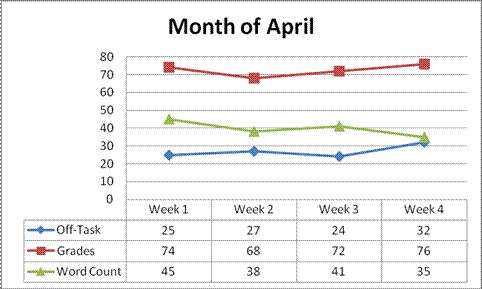
The data analysis plan I used involved weekly recording of off-tasks, grades, and word counts from the student blog. As the graph for the month of May shows, students being off-task dropped to a low of only eight times in one week; average student grade in this four week period was higher than in April before I began integrating technology into the classroom. Word count from the post on the student blog was also much higher than the writings the ESL teacher had for these students in her class. By using the data from triangulation in the month of May, which involved the use of technologies in the classroom, compared to the month of April which did not
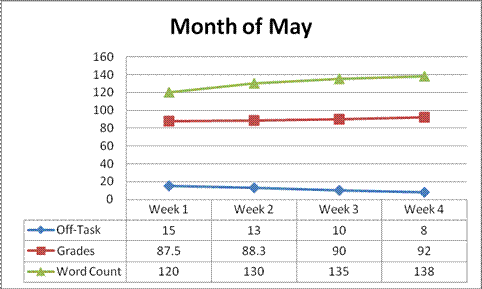
involve the use of technology, one can see the results from the data. The visual representations assisted in analyzing the data by showing the impact technology has in the classroom. In the month of May students had a weekly lower rate of being off task, they were motivated more in May than April as the data from the students’ blog indicated, and grades were significantly higher in May as well.
One of the most obvious revelation from the data collected was the high word count on the student blog. The ESL teacher was very pleased that her students were writing in complete sentences and writing for more than three paragraphs. She has decided for the next year that she will be using a blog to help students with their writings.
The data that I collected did answer my wondering. The data provided the proof that by integrating technology into the classroom for relevant learning activities, students would be highly motivated, on task more often, and as a result student would learn more.
The data revealed about teaching practice was the employment of technology into the lesson plan. Students learn best when they are enthusiastically engaged in learning activities that use 21st century skills.
The analysis of my research compares favorably to that of the findings used in my literature review. My research showed that social studies can become a more interesting subject to the students through the use of technology.
Implications for Practice, Dissemination of Results, and Contributions to the Field of Education
The changes that I am going to make based on the findings will be to integrate technology into the social studies classroom by first asking questions as to which technology will work best, model it for the students, continue to collect data, diagnose problems, search for solutions and monitor results.
My plan for sharing will commence with my fellow colleagues in our weekly departmental meetings. As I am a special education inclusion teacher in the social studies content area, I attend two departmental meetings. I intend to share my findings with them, although by this time I am sure they will be familiar with my action plan. The media format I intent to publish my action research plan is through a PowerPoint presentation, although a brochure is also in consideration.
The teacher inquiry process has helped me realize that I can resolve my problems on my own. It is a tool that should be in every teacher’s toolbox. Although my research is modest, I believe that through practice I will be able to resolve most of my “nagging” problems.
The general education teacher that I work with will be the first teacher that I share my findings with. I share a Wiki with some of them and I intend to publish it on this forum. I also have a personal blog where it will be open to the public on the Internet. In addition, I can also publish it on my own person domain.
In closing, I could also try and see if I could publish it on a teacher professional website. I believe this would be the ultimate publication. Teachers from all over the world would be able to learn from the action research plan that I created.
Timeline for Implementation
At my school the months of March and April are used either in preparation of the standardize tests or the actual implementation of these tests. I believe that the month of May would be a good time to implement my inquiry.
References
Devlin-Scherer, R., & Sardone, N. B. (2010). Digital Simulation Games for Social Studies Classrooms. Clearing House, 83(4), 138-144. doi:10.1080/00098651003774836.
Holcomb, L., Beal, C., & Lee, J. K. (2011). Supersizing Social Studies Through the Use of Web 2.0 Technologies. Social Studies Research & Practice, 6(3), 102-111.
Journell, W. (2009). Maximizing the Potential of Computer-Based Technology in Secondary Social Studies Education. Social Studies Research & Practice, 4(1), 56-70.
Rice, M. L., & Wilson, E. K. (1999). How technology aids constructivism in the social studies classroom. The Social Studies, 90(1), 28-33. Retrieved from
http://search.proquest.com/docview/274840296?accountid=14872.
Wilson, E. K., Wright, V. H., Inman, C. T., & Matherson, L. H. (2011). Retooling the Social Studies Classroom for the Current Generation. Social Studies, 102(2), 65-72.
Individual Learning Plan 2
Part 1: Accomplishments
One of the accomplishments that I have made is revising my lesson plans to include diverse student learning, research-based instructional strategies, and a learning theory (Lev Vygotsky), that compliments my teaching style. Using tier learning and collaborating with colleagues in the special education department as well as the English as a second language department, I am now better able to respond to the needs of all my students. Vygotsky’s learning theory helped me better understand the process of scaffolding and how to implement it. Scaffolding can be accomplished by a teacher, a peer or a computer. Scaffolding can also be used on an individual or in groups as well. Through scaffolding, I was able to integrate technology into my lesson plans. Students were able to work in groups, collaborating through the use of blogs and software applications, regarding the problems faced by the early settlers in America.
I have maintained my passion for the discipline that I teach by keeping abreast of the latest works in my area (history). I attend workshops and seminars throughout the state of Texas orchestrated by Texas Education Agency for continuing education in teaching history. I am also a member of several professional learning communities. Some of these communities are local such as parents, community leaders and pastors, while others are national in scope such as American Historical Society. I have also become a member of a Texas teacher association for history teachers. I have acquired an immense sum of knowledge due to my association with these groups which I have used to create a history club at my school. I have been able to obtain historical artifacts such as a Clovis arrowhead, Civil War field plans, Roman coins, Egyptian inscriptions, and copies of photographs on World War II donated from individuals in my community. As a result of the history club, the community has become more aware of the part they played in World War II and the Civil War.
I am more skilled at using rubrics for assessing students’ learning. Students are shown from the beginning of a project what is expected from them. The implementation of the rubric has allowed students a clarity that was missing before its usage. The rubric also acts as a guide for me as to what I want to assess students on. Sometimes, my lesson plan begins with the construction of the rubric first.
One of the tools that help me reflect on my day-to-day teaching experience is the journal. I have recorded what went right as well as what needs improvement. It has allowed me to spot classroom management issues in certain classes and instructional strategies that could have been better prepared.
Part 2: Plan for Continual Improvement
According to the latest Texas Star chart, one of the improvements my school needs to make is the integration of technology into the curriculum. At this point, I have made modest implementation of integrating technology into the classroom. I would like my students to be able to create their work product with the tools that are available on the Internet. Using the concept of the mnemonic S.M.A.R.T. (specific, measurable, attainable, realistic, and timely) my goal for August, 2014, is to create a plan with my history colleagues to increase by 50% the number of learning activities where students can integrate technology into the content area (history) that we teach. “Experimental work has shown that performance is higher when a specific goal is set rather than when the goal is more general” (Reed & Turco, 2012). Evaluation of the progress (measurable) would be recorded by the number of assignments using technology compared to previous year assignments in each six week cycle by each teacher. “Results goals are measured by a test score, rubric system, or some other quantifiable tool or method” (O’Neill, 2000). The goal is attainable due to the attitude, abilities and skill set of the teachers involved and the fact that the school is also receiving thirty new laptops for a computer laboratory in March of 2014. The goal is realistic because the school must meet the objectives set out by the Texas Star Chart regarding integrating technology across the content area. The history department is both willing and able to make this happen. I believe that my goal is grounded in a timeframe of six week cycles. At the beginning of every six week, the history department would review the content, and decide what learning activities could be integrated using available technologies. A few learning activities in eighth grade American history that could be enhance using technologies would be the virtual field trip on the underground railroad, or using presentation software depicting the travels of the Lewis & Clark expedition.
References
O’Neill, J. (2000). SMART Goals, SMART Schools. Educational Leadership, 57(5), 46.
Reed, V. A., Schifferdecker, K. E., & Turco, M. G.(2012). Motivating Learning and Assessing Outcomes in Continuing Medical Education Using a Personal Learning Plan. Journal of Continuimg Education in The Health Professions, 32(4), 287-294. Doi: 10. 1002/chp.21158
Reflecting on Linguistic and Cultural Diversity
As I look back on what I have learned about linguistic and cultural diversity in the classroom over the past seven weeks, I have gained new insight on what it is to be an English language learner in the United States. I teach at a school that is about 90% Hispanic, our school employs some of the strategies that I have studied, but there is much room for improvement. Dr. Stritikus mentions the acceptance of race and diversity in the school as well as the technical capacity and skills to teach them
(Laureate Education, Inc, 2010). The essence of this course is defined in his statement as well as in my classroom practices.
At the beginning of this course, one of my classroom practices was not having high expectations for Ells. As Dr. Garcia points out in his 5 Rs and 1 T, I felt sorry for them and did not expect much from them. Ms. Jody Salazar illustrates the use of high expectation and what it can accomplish (Pearson Education, Inc. 2008). I have since become a more positive teacher with higher expectations for my Ells. I was also trying to assimilate or “Americanize” my Ells, to strip them of their cultural background instead of building on it. As Dr. Garcia exemplify in his story regarding his sister, I was not showing respect to them. I was also unaware of the effects that poverty has on some of my students. A few of my students lack the necessary resources at home to complete the assignments, and they were too embarrassed to admit it to me. Every take home assignment I give now, I make sure the students are equipped to do it. I was really oblivious to the fact that it takes an Ell student on average 4-6 years before they can acquire the use of academic English. I was under the mistaken belief that after two years they were at grade level. I can now see why they were confused at some of the homework assignments that I gave them; it was not their reading ability at fault but my ignorance.
One of the ways that I have deepened my knowledge and understanding of the needs of diverse population is by reading the articles published by the Center for Research on Education, Diversity and Excellence. “The CREDE five standards for effective pedagogy and learning were established through research and through an extensive analysis of the research and development literature in education and diversity” (Laureate Education, Inc. 2010). The analysis by Dr. Tharp of each principle has led me to believe that these practices are effective with students of different linguistic culture. Another way that I have deepened my knowledge and understanding of the needs of diverse population is watching the video on Dr. Garcia’s 5 Rs and 1 T (Laureate Education, Inc. 2010). To me, Dr. Garcia speaks to the heart. I love the way that he can roll his r’s. I also liked hearing his childhood stories. They were interesting and always with a point. I understand the reasoning behind his placing respect as the first R. Without respect, nothing will happen. I learned more about instructional methods and program models for serving Ells. I was especially interested by the bilingual program known as late-exit. It is a “developmental program typically last throughout elementary school and students may continue to receive up to 40 percent of their instruction in their native language even after they have been reclassified as English proficient” (Reed & Railsback, 2003). The content-based instruction method that I feel is the most effective for Ells and that I have 30 hours in training is Sheltered Instruction Observation Protocol (SIOP). This method works well with the CREDE five standards for effective pedagogy and development literature in education. Perhaps the most effective way that deepened my knowledge and understanding for diverse population was observing the teachers as they implemented teaching strategies. It was a visual culmination of everything that I had previously learned in the preceding weeks. These were excellent teachers and they were able to implement the CREDE five standards as well as Dr. Garcia’s principles.
I have already mentioned several ways that the content of this course has help me to make my classroom more meaningful and effective for all students. I have high expectation for my students; I also have more respect for them and their culture. I am aware of how poverty can play a role in their life, and the length of time it takes to acquire academic English. As a teacher, I can also build bridges to the community (Trumbull & Greenfield, 2000). To empower community leaders to talk to our students, to help them grow and become productive members in our society. To foster a teacher network that works to understand the problems of Ells in our school, and to make our school more inviting to the community.
In summary, I have learned more in this course in the last seven weeks than I have over my entire teaching career regarding Ells. This is course is only the beginning; I will continue to learn from teachers like Dr. Garcia and CREDE. Dr. Stritikus’ vision on the characteristics of an effective school is my goal and I have shared his message with the department head of English language learners. I have become a link between the special education department and the bilingual department due to my studies at Walden University. Several teachers have read articles that I gave them from this course and are hungry for more. I think our school is on the right path now.
References:
Bainbridge, W.L., & Lasley, T.J. (2002, July 28). Poverty, not race, holds back urban students.
Columbus Dispatch. Retrieved from http://www.schoolmatch.com/articles/poverty.htm
Herrell, A. L., & Jordan, M. (2008). 50 strategies for Teaching English Language
Learners. (2nd ed.) Upper Saddle River: Pearson Education, Inc.
Laureate Education, Inc. (Executive Producer). (2010). Program three: ELLs in today’s schools
[DVD]. Enhancing Learning through Linguistic and Cultural Diversity. Baltimore, MD:
Dr. Tom Stritikus.
Laureate Education, Inc. (Executive Producer). (2010). Program four: English language learners
[DVD]. Enhancing Learning through Linguistic and Cultural Diversity. Baltimore, MD:
Dr. Eugene Garcia & Dr. Kenji Hakuta.
Laureate Education, Inc. (Executive Producer). (2010). Program five: Second-language
Acquisition [DVD]. Enhancing Learning through Linguistic and Cultural Diversity.
Baltimore, MD: Dr. Kenji Hakuta.
Laureate Education, Inc. (Executive Producer). (2010). Program seven: CREDE Standards
[DVD]. Enhancing Learning through Linguistic and Cultural Diversity. Baltimore, MD:
Dr. Roland Tharp.
Parrett, W., & Budge, K. (2009). Tough Questions for Tough Times. Educational Leadership,
67(2), 22-27.
Pearson Education, Inc. (2008). Program eight: 50 strategies for Teaching English Language Learners [DVD]. Cooperative Learning (Strategy 18). Baltimore, MD. Herrell, A, Jordan, Michael, & Harris, R.
Reed, B., & Railsback, J. (2003). Overview of Second Language Acquisition Theory.Strategies and resources for mainstream teachers of English language learners.
Portland, OR: Northwest Regional Educational Laboratory.
Richardson, M. (2007, July 23). The effects of poverty on education.
Retrieved from associatedcontent.com/article/312919/the_effects_of_poverty
Trumbull, E., Rothstein_Fish. C, & Greenfield, P.M. (2000). Bridging cultures in our schools:New approaches that work. San Francisco: WestEd.