Did you know that the…..
-Arabic script reads from right to left.
-Arabic script contains 28 characters (see alphabet below).
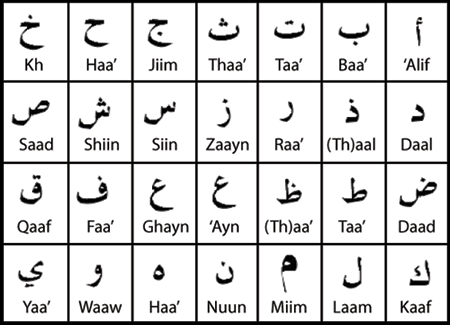
-Arabic does not have capital letters. However, Arabic letters
differ in shape depending on whether the letter comes in the beginning,
middle
or end of the word.
-Arabic words have dashes and curves written above or below the letters
to indicate the sound of short vowels.
-Arabic has many different local dialects. Yet the Arabs can understand
nearby dialects easily, and some of the other dialects. Although,
they can communicate easily if they use the Standard Arabic language.
Back to top
SAMPLE OF DIFFERENCES IN ARABIC DIALECTS
English |
Standard Arabic |
Local dialect
in Baghdad (Iraq) |
Local dialect
in Damascus (Syria) |
Local dialect in Cairo (Egypt) |
Milk |
Haliib |
Haliib |
Haliib |
Laban |
Many |
Kathir |
hwaaya |
Ktiir |
Ktiir |
Tomorrow |
Ghadan |
Baachir |
Bikra |
Burka |
Who |
Man |
Minu |
Miin |
Miin |
-190 million inhabitants of the Arab world speak and write the Arabic
language.
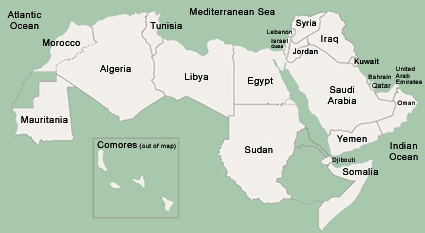
-It is the official language in 22 countries (see map below).
-It is one of the official languages of the United Nations.
-It is a significant language to one billion Muslim people world-wide.
-Persian (Iran), Urdu (Pakistan), Afghanistan, Indonesia, Malaysia,
and some Muslim areas of India, China, Philippines and the USSR
use the Arabic Alphabets.
-Arabic remains the primary means of prayer in Islam, since the
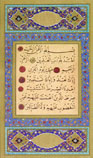
Holy Book of Islam – The Quran – was revealed to the
Prophet Muhammad and consequently recorded in Arabic.
-The Arabic belongs to the Semitic family of languages that include
Arabic, Hebrew, Aramaic, Akkadian,
Amharic, and Phoenician.
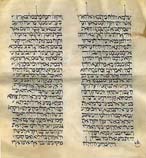
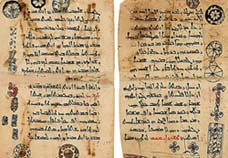
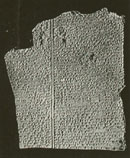
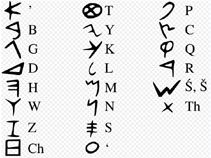
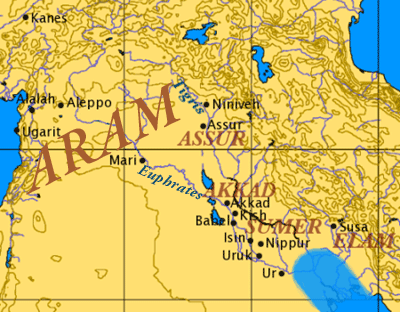
-Both the Arabic and Hebrew languages derive from the Aramaic language,
which was spoken at the time of Christ and still spoken in parts
of Syria, and Iraq.
-Between the 8th and 12th centuries, Arabic was the universal
language of culture, diplomacy and science, similarly to the
Latin that
became such a language later in the middle ages.
Back to top
ENGLISH WORDS FROM ARABIC
Many modern European languages borrow from Arabic a long list of words;
| Name |
Origin in Arabic |
Meaning of word |
| Admiral |
amir-ar-rahl |
chief of the transport |
| Alchemy |
al-kimiya |
chemistry |
| Alcohol |
al-kuhul. |
Stain or fine metallic powder used to darken
the eyelids. |
| Algebra |
al jebr |
"reunion of broken parts" as in computation. |
| Algorism |
al gorisme |
a mangled transliteration of Arabic al-Khwarizmi "native
of Khwarazm" and a mathematician. |
| Alkali |
al-qaliy |
the ashes of saltwort, a plant growing in alkaline
soils. |
| Almanac |
al-manakh |
climate |
| Carafe |
ghurruf |
drinking cup |
| Caraway |
al-karawiya |
Caraway seeds |
| Coffee |
qahwah |
Coffee |
| Cotton |
qutn |
Cotton |
| Damask |
Dimashq |
the Syrian city, famous for silk |
| Elixir |
al-iksir |
believed by alchemists to transform metals into
gold and/or to cure diseases and prolong life. |
| Ghoul |
ghul |
an evil spirit that robs graves and feeds on corpses |
| Gypsum |
jibs |
plaster |
| Jar |
jarrah |
earthen water vessel |
| Muslin |
Mosul |
City in northern Mesopotamia (modern Iraq) where
muslin was made. |
| Saffron |
za'faran |
Aromatic plant used in cooking |
| Satin |
Zaitun |
Olive |
| Sherbet |
sharbat |
a drink |
| Sofa |
Suffah |
Pad |
| Sugar |
sukkar |
sugar |
| Sumac |
summaq |
from Syrian summaq "red." |
| Syrup |
sharab |
beverage |
| Tambourine |
tunbur |
drum |
| Tariff |
ta'rif |
information, notification, inventory of fees to
be paid |
Back to top
Names of places, rivers, mountains and other natural features
| Name |
Original Arabic Name |
Name Meaning |
| Alhambra |
al-Hamara |
The Red |
| Almaden |
al-Maydan |
The Field |
| Alqazar |
al-Qasr |
The Palace |
| Alcantara |
al-Qantarah |
The Bridge |
| Almenara |
al-Manarah |
The Mosque Tower |
| Alborg |
al-Burj |
The Tower |
| Alcove |
al-Qubbah |
Dome |
| Almansil |
al-Manzil |
The Stopping Place |
| Alqueria |
al-Qariyah |
The Village |
| Almeria |
al-Mirayah |
The Mirror |
| Guadalquivir |
Wadi al-Kabir |
Great Valley |
| Guadalajara |
Wadi al-Hijarah |
Stony Valley |
| Taifa |
Ta'ifah |
Party or Faction |
| Azulejo |
az-Zulayj |
Burnished Pebble |
| Alcaids |
al-Qa'ids |
Warden |
CALLIGRAPHY
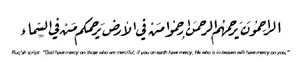
-Calligraphy is merely hand-writing, but in the Arab world, it is
visual art, with remarkable history and traditions. It is a "spiritual
technique" with flowing patterns and intricate geometry. True
Arabic calligraphy balances between meaning and beauty.
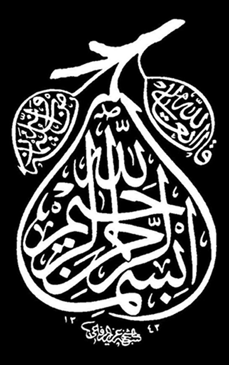
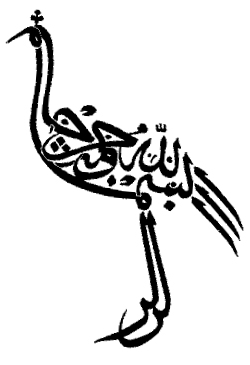
Basmalah in the shape of an pear. |
Basmalah in the shape of a Ostrich. |
-Historians disagree on the date and place of the birth of Arabic
writing, but most agree on the fact that the origin is Aramaic which
was the international language of the Middle East from about 400 B.C.
until 700 A.D. Calligraphy started as a means to convey language and
thought. It developed to be an art filling palaces, mosques, clothes,
rugs and books, to please the eye and mind.
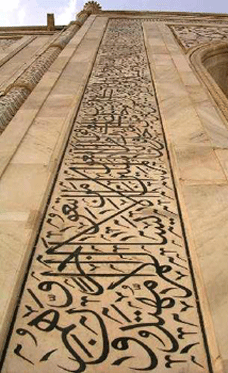
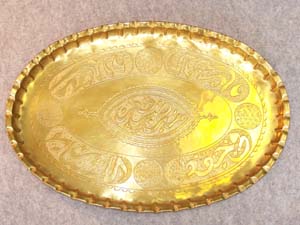
Brass tray with calligraphy |
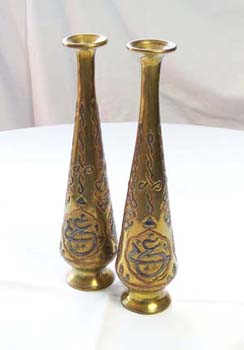
Brass vases adorned with calligraphy |
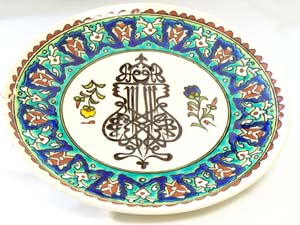
Embellished plate with calligraphy |
-Some of the great Arabic calligraphers are held in
high esteem. Story is told that Sultan Mahmud II (Ottoman Empire) would
stand before
Mustafa Rakim (the great 17th century calligrapher) as a pupil before
his teacher, to hold the inkstand for this calligrapher while he writes.
Samples of Calligraphy:
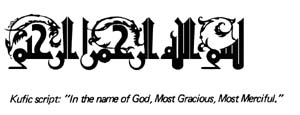
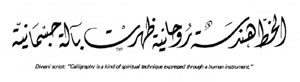
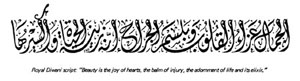
The Arabic Calligraphy has different styles including:
Training of Calligraphers
Training periods were, and still are, long and arduous. Calligraphers
start as apprentices and continue to journeymen and master ranks.
Calligraphers were hired by Caliphs to draw up official documents,
write diplomatic correspondence and design official signatures.
Current schools for teaching calligraphy are in Egypt. Two schools
exist, in Cairo and Alexandria.
Back to top