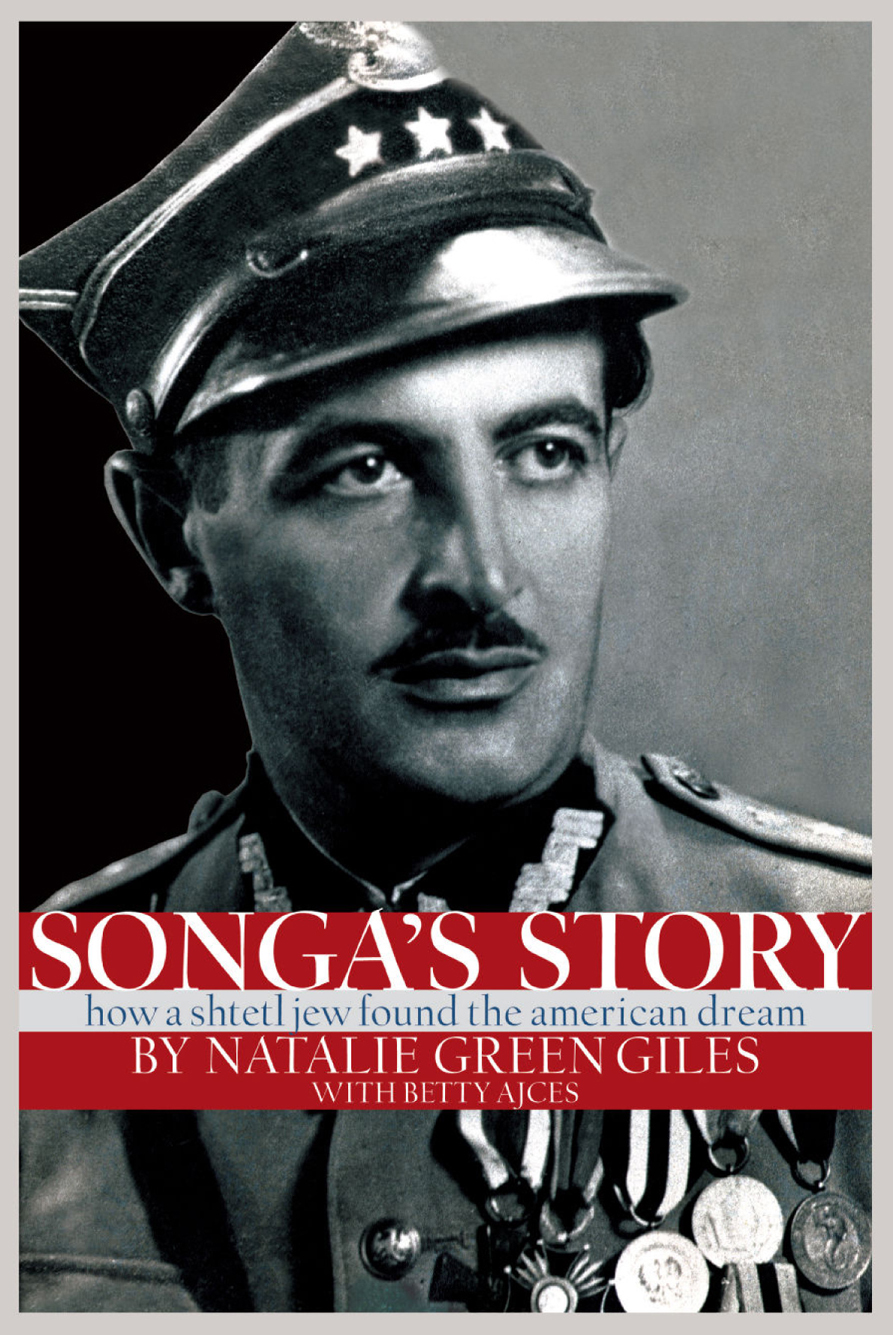
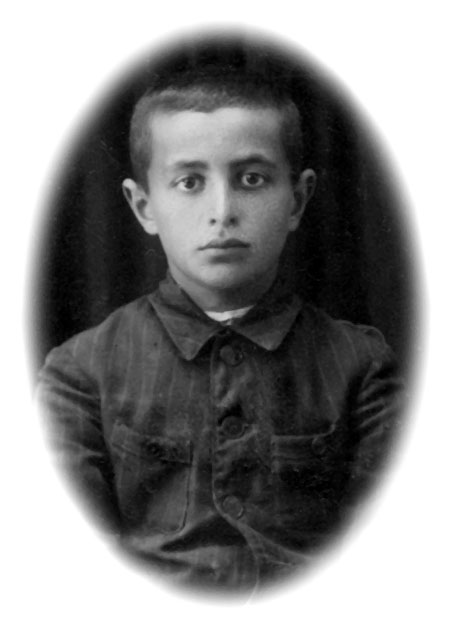
Leon Ajces "Songa"
as a young boy.
|
Rebecca Brown interviews
Natalie Green Giles about Songa's Story
Rebecca:
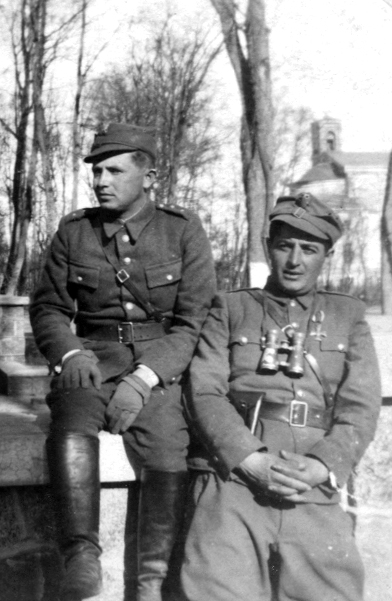
Songa's Story starts out as he gallops homewards on a few hours' leave during World War II. He is an officer in the Red Army, fighting Hitler's invasion into the breadbasket of Europe on the border between Poland & Ukraine in what had been for almost a century under Czarist rule, the Pale of Russia.
It's hard for us modern Americans to realize what life must have been like then. How did Leon Ajces get his nickname & in what ways do you think his childhood prepared him for what was to come?
Natalie:
It's funny that you ask about the origins of his nickname -- I spent countless hours interviewing people who knew Leon his whole life, & no one could give a translation or a definitive explanation for his nickname of “Songa”.
The best we could figure out was that it was an endearment his mother adopted for him when he was a baby which stuck throughout his life. He was born at an extremely tumultuous time, in Ukraine in 1916, amidst the first World War & the Russian Revolution. Even so, ironically, his childhood was the opposite: peaceful & idyllic, offering no portend of what was to come.
At the end of World War I, the European boundaries were redrawn & the area of the western Ukraine, where Songa & his family lived, became part of Poland (it had been part of Czarist Russia). The Soviet Union's territory began just to the east of his hometown, but just far enough away to allow for a reasonably free & carefree childhood. People in the Soviet Union suffered terribly under the Bolsheviks. People in the Second Republic of Poland, as Poland was known in those “interwar” years, were allowed to prosper. The Ajces family was free to practice religion, engage in commerce, obtain “Western” educations & so forth. Their neighbors to the east were not so fortunate.
Rebecca:
You write that your Uncle would tell you only amusing stories from his life. How many languages did he speak & what were they? From reading Songa's Story I know why you had to tell it, what I'm wondering is how & when? Who did you find to tell you of this time?
Natalie:
He spoke Yiddish, Russian, Polish, Ukrainian, White Russian, & Hebrew. Yiddish was the primary language spoken at home. He learned English once he came to America, in 1948 when he was already 33 years old.
Many people encouraged my Uncle to record his story. He never rejected the idea, but he never fully pursued it either. I think there were many very painful memories tucked away that he, perhaps unconsciously, did not want to revisit. When he died, in August 1999, everyone lamented that his story had died with him. I approached my aunt about 8 months after his death, & proposed that we at least try to reconstruct his remarkable life. One thing led to another, & through my aunt, I was able to interview many people who represented different chapters of Songa's life. It was amazing who I had access to -- people from his childhood village, people who arranged for his defection to this country, retired officials from the Pentagon who worked with him in the early 1950s.
What's even more amazing to me now is the fact that most of these interviews were conducted in 2000 & 2001 -- now, only 3 years later, many of those people who provided such rich data for the book are no longer alive. There was a definite urgency in getting the story written. I'm very thankful that we did it when we did.
Rebecca:
When Germany invades his homeland Songa joins the Red Army. He is wounded & recovers, & then in 1942 is sent to Stalingrad. Could you tell us what (I know you can't tell us why -- noone in their right mind could!) the Soviet military had been doing to its officers that sent this survivor of the siege of Stalingrad to a gulag in Uzbekistan?
Natalie:
It is difficult to put this in perspective as Americans, as it requires us to take a dramatic departure from our basic democratic values. It wasn't just the Soviet military that engaged in such horrendous acts against its officers. Ordinary citizens of the Soviet Union lived in constant fear of arrest by the NKVD (the Soviet secret police, which later became the KGB).
What happened to Songa during the war, as an army officer, was no more heinous that what had been happening for the past decade in the Soviet Union. Stalin ruled through fear & terror, paranoia & suspicion. Every so often, for absolutely no reason, the NKVD, through Stalin's command, would arrest people to reinforce the fear & paranoia, & to make an example to ensure unquestioning compliance. People were almost randomly branded “traitors” & “enemies of the people.” Songa was arrested under accusations of spying for the Nazis. The charge was absurd & completely fabricated. & the fact that he had been fighting heroically at the front lines for the “Motherland” for two years at that point didn't make any difference.
Some speculate that Red Army officers in particular were being “tested”, to determine who had the right stuff to be future leaders. They were tortured & forced to confess to their crimes. Songa would not confess to a crime he did not commit. He withstood the psychological abuse, the sleep deprivation, the interrogations, & meager food rations for months & months. When he did not crack, they released him to an ordinary prison (as opposed to a political prison). That, by the way, was unusual. Many people either died in the gulags or stayed in confinement for years & years. To give you a sense of how bad conditions in the political prison were, when Songa arrived at the ordinary prison -- with murderers & thieves -- he said he felt like a free man.
Rebecca:
& then, at long last, the war is over & Songa finds himself a Major in the Polish Army. What was his peacetime work?
Natalie:
His “peacetime” work -- if you can call it that, was to rebuild Poland. He was assigned to the city of Lublin. But the catch is that by making the decision to stay in the army (which, to be clear, was the Communist Polish Army, a satellite of the Red Army & fully under Stalin's command), he was now working on rebuilding Poland as a Communist country under Stalin's control. It was all very unsettling. Songa was rising quickly in his military career, but only because he was effective at putting down any potential threats to the Communist takeover -- that meant fighting Polish nationalist partisans & employing Stalin's tactics to ensure against insurrections & anti-Communist hostilities. Songa, remember, had experienced a remarkably peaceful childhood in pre-World War II Poland. Now, despite his own disaffection with Communism & his fond memories of pre-war Poland, he had to transform Poland into a Soviet territory. The Poles could hardly celebrate the defeat of the Germans, knowing their future & fate lay in the hands of the Communists.
Rebecca:
Songa already knows his family has been massacred on Hitler's orders in a mass grave outside his hometown of Ozeryany, however, one member has survived. Who is it & how do they find each other in the post-war chaos of Eastern Europe?
Natalie:
He discovers that his aunt, Ruchel, & her husband & three-year-old daughter have survived by hiding in a hole in the dirt (euphemistically referred to as a “room”) on the property of Czech farmer. They lived in that dug out space -- maybe 6 ft. by 6 ft., for 16 months. They are Songa's only relatives left of a large extended family (his mother was one of 8 children). It is unthinkable for us, today, to imagine living in the darkness, in a hole, for so long. By the way, that three-year-old child, Songa's first cousin, is now a successful woman in her early 60's, living in Maryland, with five grandchildren to carry on her family's legacy.
Songa & Ruchel found each other the way most of the dispersed family members reconnected in the post-liberation chaos. Ruchel & her family were liberated in early 1944, so that's almost a full year before the end of the war. She made her way to a hotel in the neighboring town that had been set up to receive Jewish survivors. Slowly people from the same villages reconnected, learning of the fates of their loved ones, discovering all that had been lost. Songa found out about Ruchel through that network of survivors. This was all word of mouth at this point. Later things got more organized, with people registering through various agencies & records being kept at displaced persons camps. But the haze & chaos of those early post-liberation days must have been incredible.
Rebecca:
In 1948 with a three month attache's visa, Songa makes it to America. It is a time when the Cold War is heating up & anti-Communism grips the country. His first years here are heartbreaking as he cannot speak English; cannot find work; cannot adjust to the way of life &, since he has defected, cannot go back to Soviet-controlled Poland.
In these days of grief counselors & political correctness, it is terribly hard to read of his struggles for a new life, to become a citizen. Were your parents immigrants & can you tell us about your experiences as you gathered Songa's American stories?
Natalie:
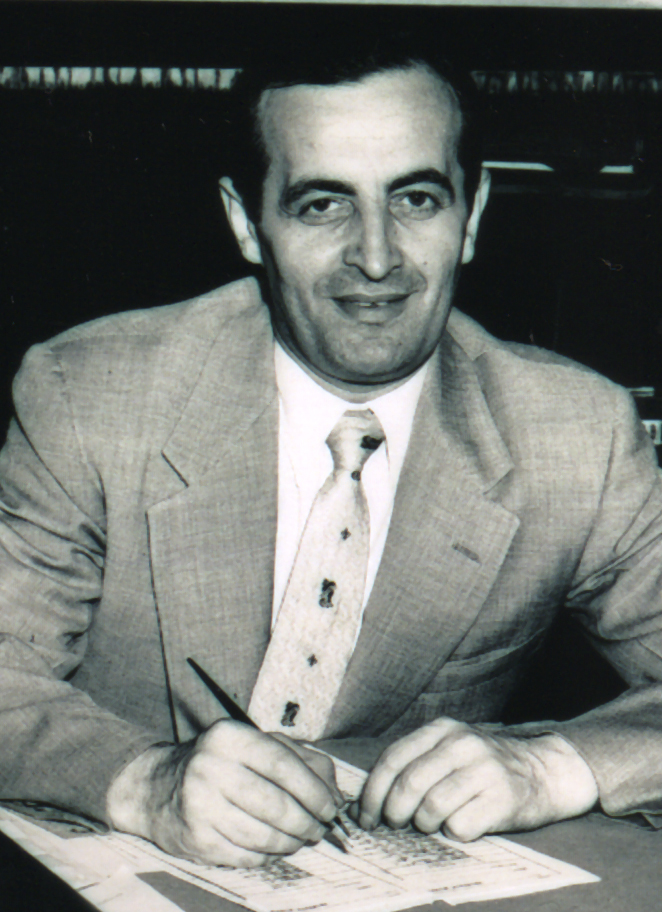
It was very hard to learn of his struggles in those early years of America, & particularly to learn that from the American perspective, Songa was an unwelcome enemy alien. I only knew him as a very successful businessman, living in a beautiful home with all the trimmings of the American dream. Those early days in America represent the time of his life that he would have least liked to revisit -- he had gambled everything to stay in this country, & he had the FBI trailing his every move. If the U.S. had sent him back to Poland, he surely would have been executed. & yet, in Poland he was a truly important man, with tremendous power -- in America, by contrast, he was nothing, a non-English speaking immigrant at the bottom of the labor pool.
My parents were not immigrants, but my maternal grandparents were. They were German Jews -- refugees from Nazi Germany. Their experiences were very different from Songa's -- they came over before the war started, just before Kristallnacht. They endured discrimination, but did not face the overwhelming hardships that Songa & his family faced in Eastern Europe. & to them, America was an extremely welcoming safe haven.
Rebecca:
In the end Songa does triumph, does make a good life for himself with his American wife. Would you tell us about the partnership you must have made with Betty Acjes, your Aunt, in the writing of Songa's Story.
Natalie:
Betty was extremely courageous, & generous, to agree to do this project. It required her to learn things she did not know, & compelled her to share very personal memories of her recently deceased husband. It could not have been done without her. For her, it was the ultimate gift of love for Songa -- to honor him by preserving his story for future generations.
Rebecca:
What would you say to people who have thought about setting down their Elders' stories?
Natalie:
First & foremost, don't delay! As I said earlier, many of the people who were critical to my ability to write Songa's Story are now no longer alive. Also, don't underestimate the impact of these stories on children. My own, who are still quite young, have been fascinated by the snippets I have shared with them. It is our duty to preserve history -- I think this kind of anecdotal history that you get from memoirs is so rich & so helpful in putting a human face on what we learn in the history books.
Rebecca:
What do you hope your Readers will take away from Songa's Story?
Natalie:
A deeper understanding & appreciation for the amazing struggles ordinary people can overcome, & how fortunate we are to live in a democracy that provides the opportunities for these kind of success stories. Also, I think Songa's Story illuminates a not-well-known aspect of the Second World War -- the fact that so many Jews fought in Stalin's army (more than half a million). We are constantly bombarded with Holocaust images of Jews as victims, but rarely do we see Jews in uniform, fighting back against the Nazis, & participating in a significant way in the victory.
Rebecca:
Do catch my review of Natalie Green Giles's insightful memoir Songa's Story, I know you're going to be enthralled - I hope it makes you go out & buy yourself a copy!.
Rebecca Brown

|



