Use these navigation links to move between the Year 2023 pages. Specific
pages can be accessed at the bottom of this page



March 2023
(Part 02)
Spring Break
in Cancun, Mexico:
Day 3: Chichén Itzá
We had arranged for a private tour of Chichén Itzá, the nearby
Mayan ruins. The private tour was only a bit more than a group tour, and
turned out to be infinitely worth any extra cost. First, our guide Primo
and driver Flavio, were simply wonderful. Second, the crowds at the site
and line to get tickets, which we breezed right past, provided a distinct
advantage. We could go at our own pace (important to Lexi), stop for water
or rest as needed, and were always close enough to actually hear any insight
Primo had to offer, of which there were many. Primo began a discussion on
the geography and culture of the Yucatan region shortly after we started on our
trip, then delved into a number of interesting insights into the Mayan culture,
covering their religion, science, social structure and hierarchy, interaction
and integration with the Toltecs, conflict and war with the Aztecs and Spanish,
and ultimately their collapse. He had several images and diagrams to
highlight the discussion, which I wish we had taken pictures of, even if I did
find some similar images shown below to support the discussion/explanation.
Primo began by explaining that the Mayan culture is one of the
oldest, and the longest lasting, cultures in Mesoamerica. He then
emphasized the Mayans are still around, as Mexico recognizes 10 Mayan dialects
(mostly in southeastern region) within the 69 official recognized languages in
Mexico, of which 63 of which are indigenous, including around 350 dialects of
those languages. In all there are 33 Mayan languages still spoken across
Mexico, Belize, and Guatemala, with Yucatec Maya being the most common in the
area we visited. These are among the oldest languages in the modern world.
Yet, today's Maya cannot read the ancient Mayan writings, showing the language
has continued to evolve and is vastly different from the Mayan culture of the
past. Primo also emphasized that you can still visually identify someone
of Mayan ancestry by distinctive short necks, high foreheads, round faces, and
generally short, stocky statures. To emphasize this, he showed us pictures
of two of his five children, with one boy inheriting distinctive Mayan features
from his mom. The Yucatan state has the fifth-highest percentage of
indigenous language speakers of the Mexican states, although the number is
decreasing and is now around 30% of the people. Many of the current Maya
continue to honor the gods of rain, wind and agriculture as their ancestors did
before them.
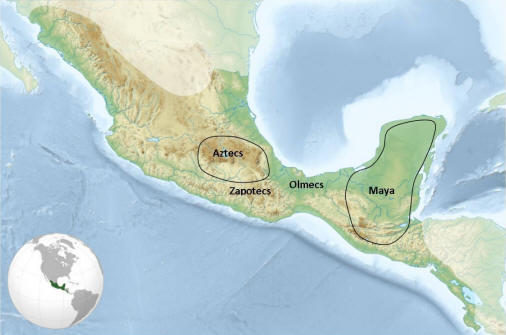
The Mayan civilization was one of the largest ethnolinguistic
group of indigenous peoples of Mesoamerica (one of five ancient cradles of
civilization where civilization arose independently: Mesopotamia, Ancient
Egypt, Indus Valley (India), Ancient China Caral-Supe (coastal Peru), and
Mesoamerica (beginning with the Olmec civilization but including seven or more
distinct groups). However, the Mayans didn't consider themselves as one
group until post-colonization, as there was no common sense of identity,
political unity, or even common language among the distinct populations which
existed as separate city-states and never became an empire. One of the
largest groups of Maya live in the Yucatan Peninsula, which includes the Mexican
states of Yucatán State, Campeche, and Quintana Roo as well as the nation
of Belize. These people identify themselves as "Maya" with no further ethnic
subdivision (unlike in the Highlands of Western Guatemala). Mayan
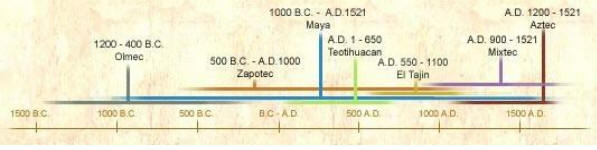
civilization is traced back to before 1000 BCE. They somewhat integrated
with the Toltecs who came into some of the region and while also managing to
co-exist with the Aztecs, who conquered many of the groups around them.
According to Primo, this was not because they were strong warriors, but because
the Aztecs valued their intelligence, culture and science, adopting some of the
religion. When the Spanish came in 1493, they quickly conquered societies
that had flourished for more than 3,000 years; the Aztecs were defeated within
two years, but it took ten to conquer the Mayans. Again, this was likely
not because they were fierce warriors, but because they lacked the gold and
precious metals and gems the Aztecs possessed, and they lived in a more barren
area without any rivers (at least above ground). Subsequent Eurasian
diseases caused the deaths of more than 90% of the indigenous people, resulting
in great losses to their societies and cultures. While the culture is
still distinct, the indigenous cultures across Mexico have somewhat merged and
mixed with the European, African, and Asian peoples who were introduced by the
Spanish colonization of the Americas to form a Mestizo culture (a term meaning
someone with both indigenous and European ancestry).
Like most ancient states, Maya society was organized into a
social hierarchy. At the top was a king followed by other elites including
nobles and high priests (who managed the religious ceremonies and also kept most
of the knowledge, acted as scribes, taught the nobles, and kept the calendar.
These were the only people able to access the ceremonial areas and use the water
from the sacred cenotes. There was therefore a large gap to the next group
of artisans, merchants, and warriors, and a smaller gap to the bottom group of
commoners including workers, farmers and slaves (who were taken in conquest).
Both paternal and maternal descent was necessary for determining an individuals’
status at the time of Spanish contact. Ancient Maya kings, called K'uhul
Ahaw [c’ool A HOW], were considered divine. They were war and ritual leaders.
Any successes or failures of the city-state were ultimately the responsibility
of the kings. Kings were expected to maintain cosmic order, as only nobles
(kings and priests) were trained on the math and astronomy necessary to predict
the seasons and other events. Kings are the main subject of most artwork
in the ancient Maya world. They are the primary figure and the main topic of
most hieroglyphic texts. Each ancient Maya city-state had a ruler or king,
usually male; and the throne typically passed from father to son; however, a
woman could rule by regency. Children of high/elite status had their
skulls misshapen shortly after birth, eyes forced to be cross-eyed, and teeth
filed into elaborate shapes as marks of beauty and status. The use of nobles and
elites as governors of the greater Maya population was dependent on two
important aspects of an elite family: their kinship and their ideology. The
elite’s power over common Maya people was driven by their ability to control
vital resources such as land, trade routes, water, and food.
One of his early discussion, involved their creation myth.
The Hero Twins and six other deities took an alligator and turned it into a
Ceiba Tree to separate the sky and the Earth making space for all life, called
the "Tree of Life" by the Maya and one of the tallest growing trees in the
Yucatan. The tree sunk its roots deep into the nine levels of the Mayan
under-world, Xibalba (chi-ball-ba), and the branches reached up to the thirteen
levels of the Mayan upper-world. They created the plants and animals, but
they could not speak to worship. So they created man from mud and clay,
but these first humans were not good and did not keep proper worship of the
gods, and were then destroyed in a great flood. A second group was created
from wood, but these were also bad and were destroyed (with some becoming the
monkeys in the trees). The hero twins then challenged the gods of the
underworld to a game of ball, to allow their beheaded father to come back from
the underworld and become the god of corn (maize). After winning, they
then ascended into heaven becoming the sun and moon. Finally, the gods
then created a third group from clay and white and yellow corn (maize),
which succeeded in producing true and enduring people who could talk and
therefore worship the gods. This creation myth, and the link to corn, is
common to many of the indigenous groups of the southwestern US and Mexico, one
of many supporting items than the ancestors of the Mayans came from the US
southwest and were common to the ancestors of the Navajo, Hopi, and many other
tribes.
Like the Olmecs and Aztecs, the Mayans had a pantheon of many
gods and revered the jaguar and eagle (which doesn't exist in the Yucatan),
along with aviary or winged serpents.
Primo pointed out a young Ceiba tree, with thorns like an
alligator skin, that disappeared as it matured (turning the alligator into a
tree). The mature tree is huge, with limbs at almost right angles to the
trunk. It produces dull white flowers with the seeds enveloped in a sort
of fluffy fiber which help carry the small seeds in the wind. We also
heard later at the cenote a discussion that this tree will sink its roots down
to the water level in a cenote, with the root ball stopping just at the water
level, providing a good indication if the water is high or low. It then
provides the water to nearby trees as their root systems are intertwined,
leading to the clear name of "tree of life."
.JPG)
.JPG)
.JPG)
The Maya developed a complex writing system, partially pictorial and partially
phonetic, with 300 to 500 symbols.
Primo also explained some of their science, discussing both
their calendar and math. Their calendar dates back to the 5th Century BCE,
and was borrowed from their predecessor cultures in Central America. They
calendar includes three separate interlocking calendars. First is the
Long Count, an astronomical calendar which is used to track longer periods
of time. The Maya called it the “universal cycle.” Each such cycle is calculated
to be 2,880,000 days long (about 7885 solar years). The “creation date”
for the current cycle is 4 Ahau, 8 Kumku. According to the most common
conversion, this date is equivalent to August 11, 3114 BCE in the Gregorian
calendar and September 6, 3114 BCE in the Julian calendar. Next is the
the Haab (civil calendar or short count solar calendar) based on the
solar cycle, with 18 months of 20 days each and one month which is only 5 days
long, making a year of 365 days and providing glyphs for each of the 19 months.
Last is the Tzolkin (divine calendar), meaning “the distribution of the
days,” and also called the Sacred Round. It is a 260-day calendar with 20
periods of 13 days, and it is used to determine the time of religious and
ceremonial events. The days in each period are numbered from 1 to 13. Each day
is also given a name (glyph) from a sequence of 20 day names.
Interestingly, the Tzolkin calendar length matches closely to the rise
and fall of Venus in the sky (263 days) and the human gestation period of 280
days (40 weeks - also ten moon periods), which also explains why Venus is often
associated with a female deity. A date in the Mayan calendar is specified
by its position in both the Tzolkin and the Haab calendars. This
creates a total of 18,980 unique date combinations, which are used to identify
each day within a cycle lasting about 52 years. This period is called
the Calendar Round. In practice, the date combinations are represented by
two wheels (or rounds) rotating in different directions. The smallest wheel
consists of 260 teeth with each one having the name of the days of the Tzolkin.
The larger wheel consists of 365 teeth and has the name of each of the positions
of the Haab year. As both wheels rotate, the name of the Tzolkin day
corresponds to each Haab position.
Primo disputed he common belief and superstition that the
Mayans believed that the universe is destroyed and then recreated at the start
of each universal cycle, which helped fuel a phenomenon and prophecies about the
end of the world in 2012 when a cycle ended. He emphasized this was the
end of the 12th cycle, meaning we are now in the 13th baktun.
Additionally, the Mayan (and Olmecs and Aztecs) largely stopped using the Long
Count calendar almost 1000 years ago.
He also emphasized the 52-year cycle of the Tzolkin and Haab rounds,
stating that anyone who lived longer than 52-years was considered an elder or
wise-person, despite their rank and was granted access to the ceremonial area.
The ancient Maya had the most advanced system of mathematics
of any ancient civilization in the Americas, and quite possibly in Europe and
Asia. The Maya were one of the first ancient cultures to use the concept of
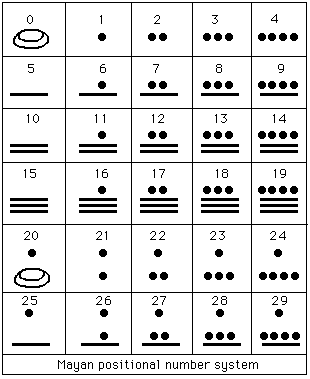
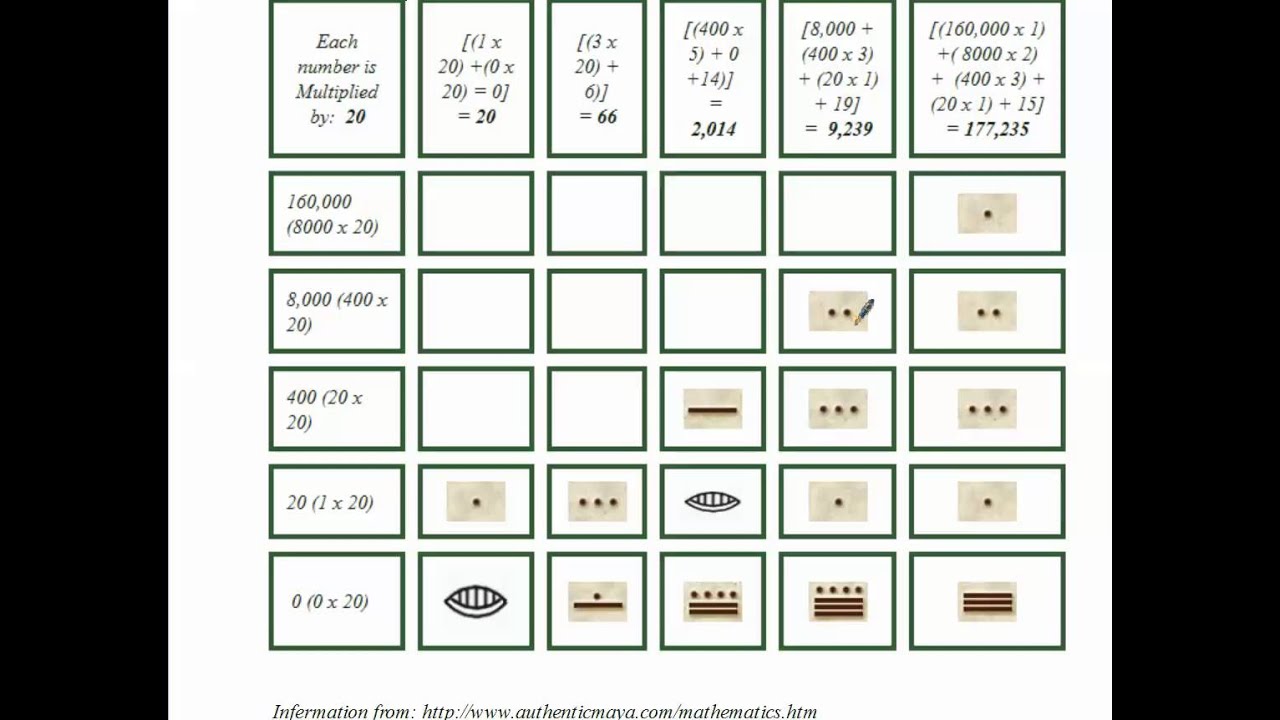
zero, which allowed them to write and calculate large sums. Maya numbers
are written using three symbols, a shell image for zero, a dot representing one,
and a bar for five. Different combinations of bars and dots represent
numbers 6–19. Numbers larger than 19 are represented using powers of 20.
The zero is used in writing to depict zero ones or zero twenties, just as the
Arabic numerals use it to denote zero in each unit. Primo had fun making
us count using this system.
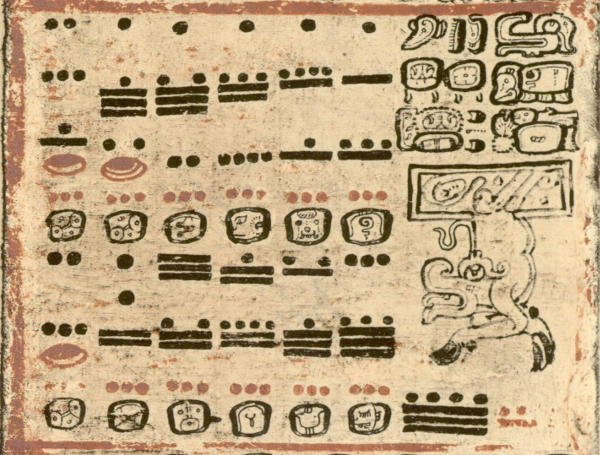
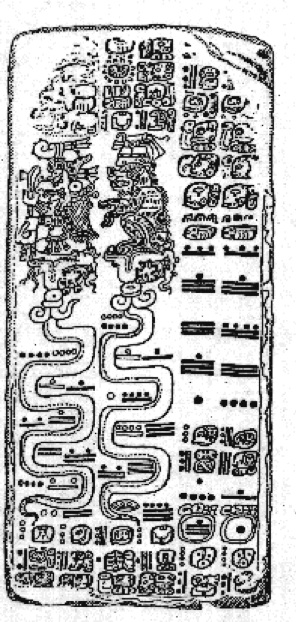
The pre-classic Maya and their neighbors had independently
developed the concept of zero by at least as early as 36 BCE, and there is
evidence of their working with sums up to the hundreds of millions, and with
dates so large it took several lines just to represent them. Despite not
possessing the concept of a fraction, they produced extremely accurate
astronomical observations using no instruments other than sticks and were able
to measure the length of the solar year to a far higher degree of accuracy than
that used in Europe (their calculations produced 365.242 days, compared to the
modern value of 365.242198), as well as the length of the lunar month (their
estimate was 29.5308 days, compared to the modern value of 29.53059).
 After
all of this introduction, we were really looking forward to visiting Chichén
Itzá, one of the largest Maya cities and one likely to have been one of the
mythical great cities. It was a major focal point in the Northern Maya
Lowlands from 600 to 1200 AD. Most agree it was largely
abandoned in the 9th century CE. It was then resettled in the late
10th century by a mix of Maya and Toltec, who had migrated from the central
highlands north of Mexico City. The earliest hieroglyphic date discovered is
equivalent to 832 AD, while the last known date was recorded in the Osario
temple in 998 AD (it is worth noting that all of the dates carved into the rocks
at Chichén Itzá use the short-count cycles only, supporting the idea the Mayans
stopped using the long-count cycle around this time). The site has a
number of architectural styles, including examples of central Mexican themes,
likely from cultural mixing between the peoples. The city may have had the
most diverse population in the Maya world, a factor that could have contributed
to the variety of architectural styles at the site. The site is partially
owned by the Mexican government and several Mayan families. (According to
Wikipedia and Primo) The Maya name "Chichén Itzá" means "At the mouth of the
well of the Itza." This derives from chi', meaning "mouth" or "edge", and chʼen or chʼeʼen,
meaning "well". Itzá is the name of an ethnic-lineage group that gained
political and economic dominance of the northern peninsula. One possible
translation for Itza is "enchanter (or enchantment) of the water,"
from its (itz), "sorcerer", and ha, "water". The site sits at an
intersection of four cenotes, each at cardinal points on the compass (north,
south, east, and west) from the site. Scientists recently determined that
the temple sits over a fifth cenote which no one has yet seen in modern times,
providing a very special arrangement. Of these cenotes, the Sacred Cenote (cenote
sagrado or "sacred well"; alternatively known as the "Well of Sacrifice") is
located to the north of ceremonial area to which it is connected by a 300-metre
(980 ft) sacbe, a raised pathway. Artifacts recovered from this cenote
include gold, jade, pottery, and incense, as well as human remains.
Chichén Itzá was a regional capital and a major trading power, controlling the
surrounding region, and obtaining obsidian from central Mexico and gold from
southern Central America through regular trade. Archeological data
indicates that Chichén Itzá declined as a regional center by 1100, although some
colonial Mayan sources claim it was conquered in the 13th century by the ruler
of Mayapan, a city-state 100 km to the west. Regardless, after the elites
left there was still a thriving community in the area when the Spanish arrived.
After
all of this introduction, we were really looking forward to visiting Chichén
Itzá, one of the largest Maya cities and one likely to have been one of the
mythical great cities. It was a major focal point in the Northern Maya
Lowlands from 600 to 1200 AD. Most agree it was largely
abandoned in the 9th century CE. It was then resettled in the late
10th century by a mix of Maya and Toltec, who had migrated from the central
highlands north of Mexico City. The earliest hieroglyphic date discovered is
equivalent to 832 AD, while the last known date was recorded in the Osario
temple in 998 AD (it is worth noting that all of the dates carved into the rocks
at Chichén Itzá use the short-count cycles only, supporting the idea the Mayans
stopped using the long-count cycle around this time). The site has a
number of architectural styles, including examples of central Mexican themes,
likely from cultural mixing between the peoples. The city may have had the
most diverse population in the Maya world, a factor that could have contributed
to the variety of architectural styles at the site. The site is partially
owned by the Mexican government and several Mayan families. (According to
Wikipedia and Primo) The Maya name "Chichén Itzá" means "At the mouth of the
well of the Itza." This derives from chi', meaning "mouth" or "edge", and chʼen or chʼeʼen,
meaning "well". Itzá is the name of an ethnic-lineage group that gained
political and economic dominance of the northern peninsula. One possible
translation for Itza is "enchanter (or enchantment) of the water,"
from its (itz), "sorcerer", and ha, "water". The site sits at an
intersection of four cenotes, each at cardinal points on the compass (north,
south, east, and west) from the site. Scientists recently determined that
the temple sits over a fifth cenote which no one has yet seen in modern times,
providing a very special arrangement. Of these cenotes, the Sacred Cenote (cenote
sagrado or "sacred well"; alternatively known as the "Well of Sacrifice") is
located to the north of ceremonial area to which it is connected by a 300-metre
(980 ft) sacbe, a raised pathway. Artifacts recovered from this cenote
include gold, jade, pottery, and incense, as well as human remains.
Chichén Itzá was a regional capital and a major trading power, controlling the
surrounding region, and obtaining obsidian from central Mexico and gold from
southern Central America through regular trade. Archeological data
indicates that Chichén Itzá declined as a regional center by 1100, although some
colonial Mayan sources claim it was conquered in the 13th century by the ruler
of Mayapan, a city-state 100 km to the west. Regardless, after the elites
left there was still a thriving community in the area when the Spanish arrived.
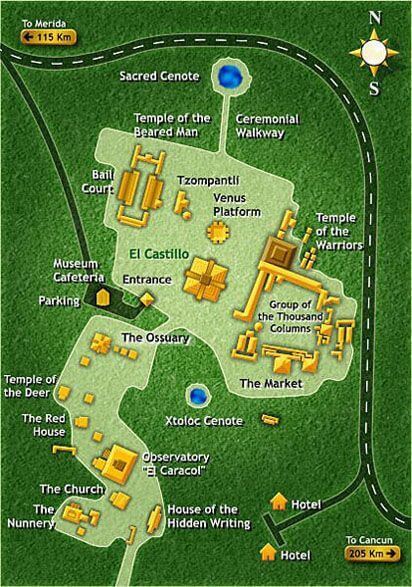
The core ceremonial area of at least 5 square kilometers (2
square miles) is surrounded by a high stone wall (which was apparently covered
in stucco and painted) with only five gates. Smaller scale residential
architecture extends for an unknown distance beyond this. The main area
was artificially leveled and the main buildings a connected by a dense network
of paved causeways, called sacbeob, which also extend in all directions from the
city. The buildings of Chichén Itzá are grouped in a series of
architectonic sets, and each set was at one time separated from the other by a
series of low walls. Many of the stone buildings were originally painted in red,
green, blue and purple colors. The surrounding area, likely a dense urban
development during the city’s peak, is thought to have reached 25sqkm (10sqmi).
The surrounding ruins are not excavated, and are covered by dense forests.

When we finally reached Chichén Itzá due to Flavio's piloting,
we were reminded quickly that it is one of the most popular tourist sites in
Mexico. Even early, it was already crowded. We proceeded into the
visitors center and were surprised to find that in addition to several trinket
and snack shops, there was a Starbucks. Primo just laughed implying they
were everywhere. After getting through the crowd, we headed into the
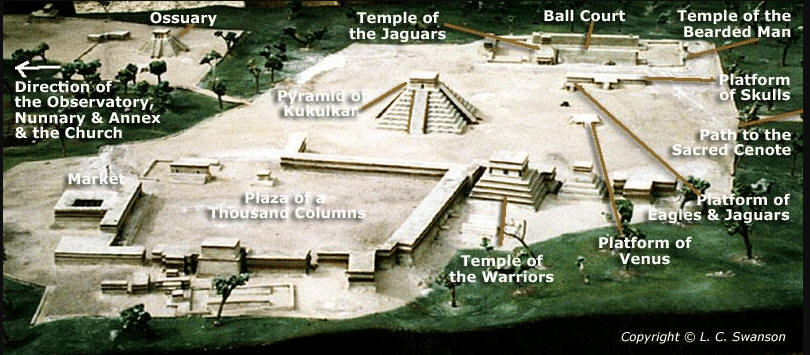
archeological site and arrived at the Great Plaza. Dominating the North Platform of Chichén Itzá is the Temple
of Kukulcán (a Maya feathered serpent deity similar to the Aztec Quetzalcoatl).
The temple was identified by the first Spaniards to see it, as El Castillo ("the
castle"), and it regularly is referred to as such.
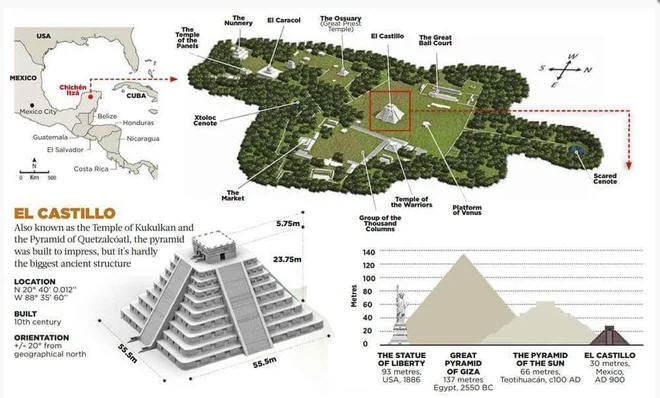
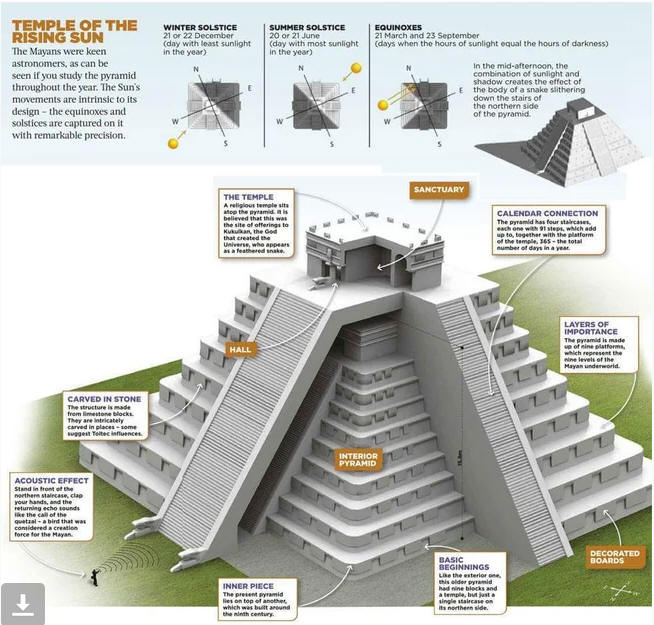
This step pyramid stands about 30 meters (98 ft) high and consists of a
series of nine square terraces, each approximately 2.57 meters (8.4 ft) high,
with a 6-meter (20 ft) high temple upon the summit. The temple has 365
steps—one for each day of the year in the Haab (civil calendar or short
count solar calendar). Each of the temple’s four sides has 91 steps, and the top
platform makes the 365th (note that 91 days is the time span between the fall
equinox to the winter solstice to the spring equinox, and 92 days from then to
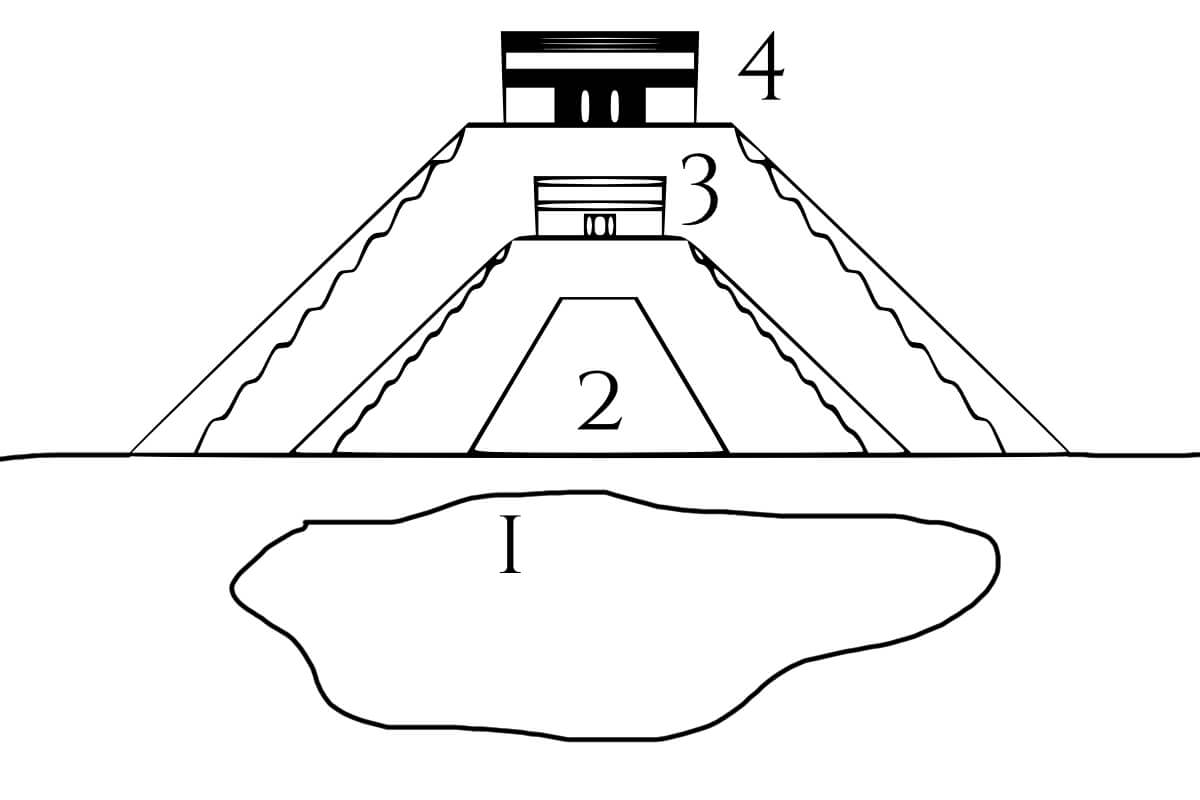
the fall equinox). The temple is actually built over another temple, which
had nine platforms, a single stairway, and a temple containing human remains, a
jade-studded jaguar throne, and a so-called Chac Mool (a sculpture of an
abstract male figure reclining and holding a bowl used as a receptacle for
sacrifices). Researchers theorize that this pyramid was constructed sometime
between 800 and 1000 CE. In the mid-2010s, archaeologists using noninvasive
imaging techniques discovered yet another pyramid buried within the two others.
They theorize that it was probably built between 550 and 800 CE and may have had
a single stairway and an altar. They also discovered a 20 m deep cenote
under all this weight, which increases the risk of the entire structure
collapsing into the cenote. Primo explained that the pyramid steps
represented the nine levels of the Mayan under-world, Xibalba (chi-ball-ba).
He also said that the stones on the altar somehow represent the thirteen levels
of the Mayan upper-world. He also explained that the nine main platforms
of the pyramid (split in two by the steps to make 18) are thought to represent the 18 months of the Haab , and
the 52 flat panels on the temple's facade represent the number of years it takes for a calendar round date
to recur.
The pyramid is aligned with the compass cardinal points
(specifically offset by 20 degrees), with the sun rising and setting directly
over the center of the temple around the spring and fall equinoxes. This
alignment allows the sun to reach the elevated position of the stairs on the
sides while the temple steps cast a shadow along part of the sides of the
stairs, producing a serpent-shaped shadow going down the steps and matching up
with the snake-head statues at the base of the pyramid. The winged-serpent
god Kukulcán (a deity associated with the planet Venus and likely introduced by
the Toltecs who were from northern Mexico and who influenced the Mayans around
the time the temple was built) features strongly in the pyramid, with a glyph
associated with it over each of the doors in the altar (only one is clearly
visible). Note that in the Aztec myth of Quetzalcóatl, their version of
the winged-serpent god who was described as light-skinned and bearded, he was
banished from the Earth and became the morning star, but would return one day to
rule over his people and destroy his enemies (Tezcatlipoca). Thus, when the
Spanish conqueror Hernán Cortés appeared in 1519 shining in gold and metal
armor, the Aztec king, Montezuma II, was easily convinced that Cortés was the
returning god.



/https://www.thestar.com/content/dam/thestar/news/insight/2017/01/22/underneath-chichen-itzas-pyramid/pyramid-for-webjpg.jpg)

Visitors aren't allowed to climb the pyramid or get too close to any of the
structures anymore. They stopped this when people were vandalizing it by
carving initials into the soft sandstone and as a safety measure as people were
getting injured climbing the steps due to the narrow tread. Apparently someone also tried to
steal the inlaid jade eyes of the Jaguar Throne inside the temple which is red
and inlaid with jade

One of the more amazing and interesting features of the
pyramid is its ability to produce a sound that is a good imitation of the
quetzal bird, a spiritually important animal to the 12th century Mayans. The
staccato sound of two hands clapping together gets transformed, in echoes, to
the drawn-out falling tone of the bird. This naturally fascinated us
enough that we had to make a video to record the effect. It also left
Steve clearly perplexed on how the frequency of the echo was apparently
increased, as the echo was distinctly higher pitched. This may have been
the only question that stumped Primo and Steve naturally had to look up an
answer when we got home. According to an article from the Acoustical
Society of America, the steps of the temple form a "Bragg diffraction grating"
also called a "picket-fence effect." The effect on the echo produces two
major features. First the effect produces a long extended echo, persisting
for more than 100 milliseconds (1/10 second). Note that a real quetzal
chirp is even longer, about 200 milliseconds long, or 1/5 second. The echo
lasts longer than the sound, bounced off many steps, each at different distances
from the original clapping sound. Second, the echo is tonal, possessing a
birdlike "chirp" that moves downward in frequency. An explanation is that
echoes arrive first from the lower step-faces near the observer's head level,
while successive echoes come from the upper steps, with the ti me
between them successively increasing as the angle of the steps become nearly
parallel to the angle of staircase's rise. The time between successive
echoes is proportional to the length of the step tread length, T, and the
frequency is roughly f = c/T. In the limit, the time between successive
echoes is proportional to the hypotenuse of the triangle consisting of the tread
length and rise height. Because the hypotenuse is longer than either side of a
triangle, the period of the tone is greater and the frequency is lower.
Because the lower frequencies are produced by the upper steps at a farther
distance, the lower frequencies lag behind higher frequencies, meaning that each
of the "bird calls" starts out high and ends slightly lower. You first
hear the higher pitch, which then falls off, making it appear higher to the ear.
me
between them successively increasing as the angle of the steps become nearly
parallel to the angle of staircase's rise. The time between successive
echoes is proportional to the length of the step tread length, T, and the
frequency is roughly f = c/T. In the limit, the time between successive
echoes is proportional to the hypotenuse of the triangle consisting of the tread
length and rise height. Because the hypotenuse is longer than either side of a
triangle, the period of the tone is greater and the frequency is lower.
Because the lower frequencies are produced by the upper steps at a farther
distance, the lower frequencies lag behind higher frequencies, meaning that each
of the "bird calls" starts out high and ends slightly lower. You first
hear the higher pitch, which then falls off, making it appear higher to the ear.
Even more fascinating, is that several online sites believe
the Mayans intentionally engineered this effect into the temple design,
designing the steps to purposefully echo the voice of the Mayan sacred bird, the
resplendent quetzal (pharomachrus mocinno), viewed by ancient Maya as the
"messenger of the gods." The pyramid was clearly linking to the sacrerd
quetzal. Kukulkan is a Mayan deity whose name shares the same root as the
Mayan word for "quetzal" and who is often depicted with the bird on his back.
There is no evidence the design was altered, so it was inherent in the original
structure. The Mayans manipulated architectural acoustics at several
sites, as other Mayan pyramids and staircases "chirp", although the acoustic
parameters are different. At Chichen Itza, our guide also pointed out the
acoustics in the "ball court", where we could hear him talk in a normal tone
from a long way away. The online analysis stated that a comparison of the
chirped echo and a quetzal call showed that while not identical, there is a
striking similarity is observed in sound quality, frequency, length and harmonic
structure. The intent can also be inferred from the Temple's very name,
which is connected with the quetzal. The pyramid's Mayan name is "Temple
of Kukulkan" where the prefix K'uk has roots in the Mayan name for the quetzal.
Also, the glyph of Kukulkan is represented in human form with a huge quetzal
behind him, hovering like a spirit. There is much evidence that the Maya made
use of quetzal feathers in their ceremonies at Chichen Itza and elsewhere. It is
argued that for ancient man, echoes were voices from a spirit world. It seems
appropriate that the Temple of Kukulkan should echo with the spirit voice of the
quetzal. The assertion that the pyramid was intentionally designed with
the acoustics in mind provides a more plausible explanation for the narrow
treads and high risers on the pyramid steps. According to the acoustical
hypothesis, these parameters were chosen to "tune" the echo to the pitch of the
quetzal. The standard archaeological explanation for short treads is that the
Maya, being short in stature, have small feet. This does not account for the
higher-than-normal risers. Indeed, the "small stature" explanation predicts
shorter risers. Nor does it account for the longer treads found at other Maya
buildings at this and other sites. The online site then states a "striking
conjecture" that the Maya are the only people known to have "coded" a
sound into stone and that the chirped echo at this 1300-year-old pyramid may be
the world's oldest known sound recording!
.JPG)
.JPG)
.JPG)
.JPG)
.JPG)
.JPG)
Had to include our new friend, Primo. He went to college
and studied hotel management, ultimately marrying a Mayan and moving to the area
from his home in northern Mexico. He said he worked at a resort for 6-7
years, then followed his love of history and desire for a more enjoyable job, to
become a tour guide.
.JPG)
.JPG)
.JPG)
.JPG)
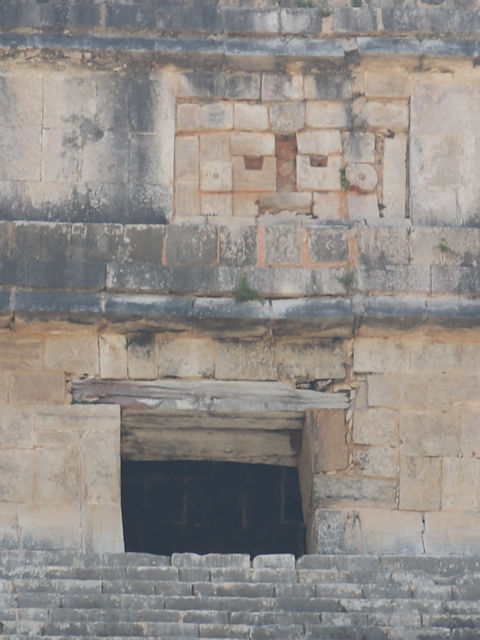
The temple on the top had a face built into the facade just
above each door. The one facing the west side we first saw had
deteriorated more than others.
.JPG)
.JPG)
We headed around the right/southern-most side to get a closer
look (the temple is aligned at a 20 degree offset to the cardinal directions)
.JPG)
.JPG)
.JPG)
.JPG)
.JPG)
.JPG)
.JPG)
.JPG)
.JPG)
When then doubled back to the left/northern-most side.
.JPG)
.JPG)
.JPG)
.JPG)
.JPG)
.JPG)
.JPG)
.JPG)
.JPG)
And finally wound up on the back/eastern-most side.
.JPG)
.JPG)
.JPG)
.JPG)
.JPG)
.JPG)
.JPG)
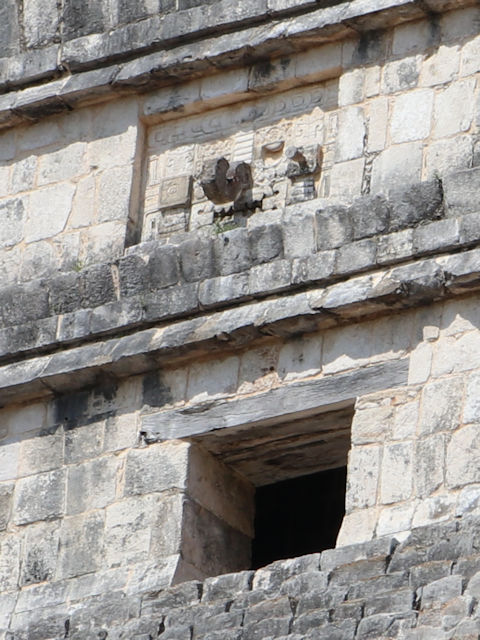
The face on the east side was more intact and had a large hooked nose.
.JPG)
.JPG)
From the east side, you can look back past the castle toward the Temple of the
Jaguars and the ball-court.
.JPG)
.JPG)
.JPG)
There was also an excavated area were archeologists dug down through several
feet of sediment to a large slab which may have formed the surface of the
surrounding area. The excavation was apparently also home to several
iguanas.
.JPG)
.JPG)
.JPG)
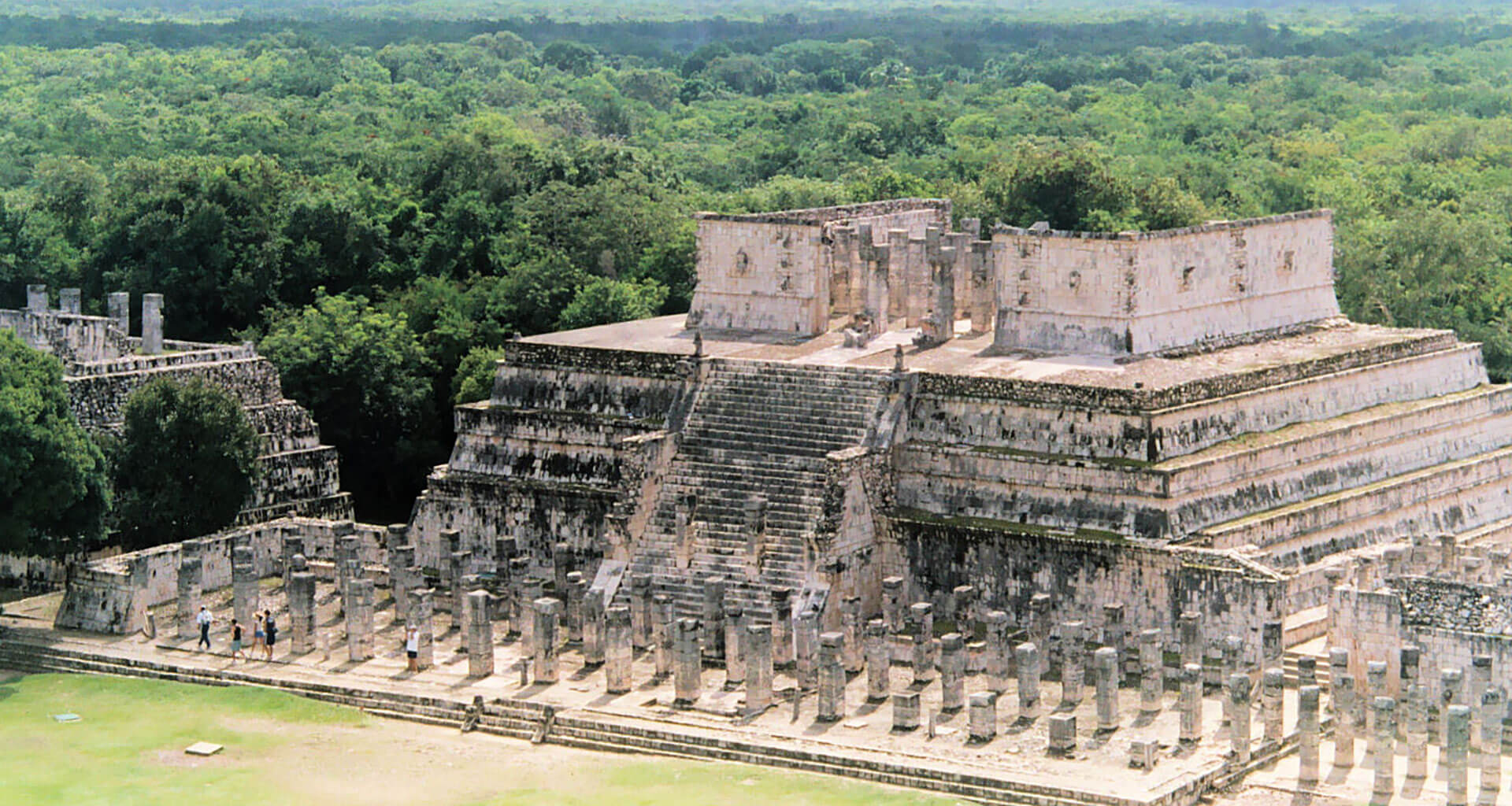
Behind the temple and to the east is the Temple of the
Warriors complex consisting of "a large stepped pyramid fronted and flanked by
rows of carved columns depicting warriors. This complex is analogous to Temple B
at the Toltec capital of Tula, and indicates some form of cultural contact
between the two regions. The one at Chichén Itzá, however, was constructed on a
larger scale. At the top of the stairway on the pyramid's summit (and leading
toward the entrance of the pyramid's temple) is a smaller temple which encases
or entombs a former structure called The Temple of the Chac-Mool. This is a
Mesoamerican sculpture depicting a reclining figure with its head facing 90
degrees from the front, supporting itself on its elbows and supporting a bowl or
a disk upon its stomach. These figures possibly symbolized slain warriors
carrying offerings to the gods; the bowl upon the chest was used to hold
sacrificial offerings. Chac-mools were often associated with sacrificial
stones or thrones.
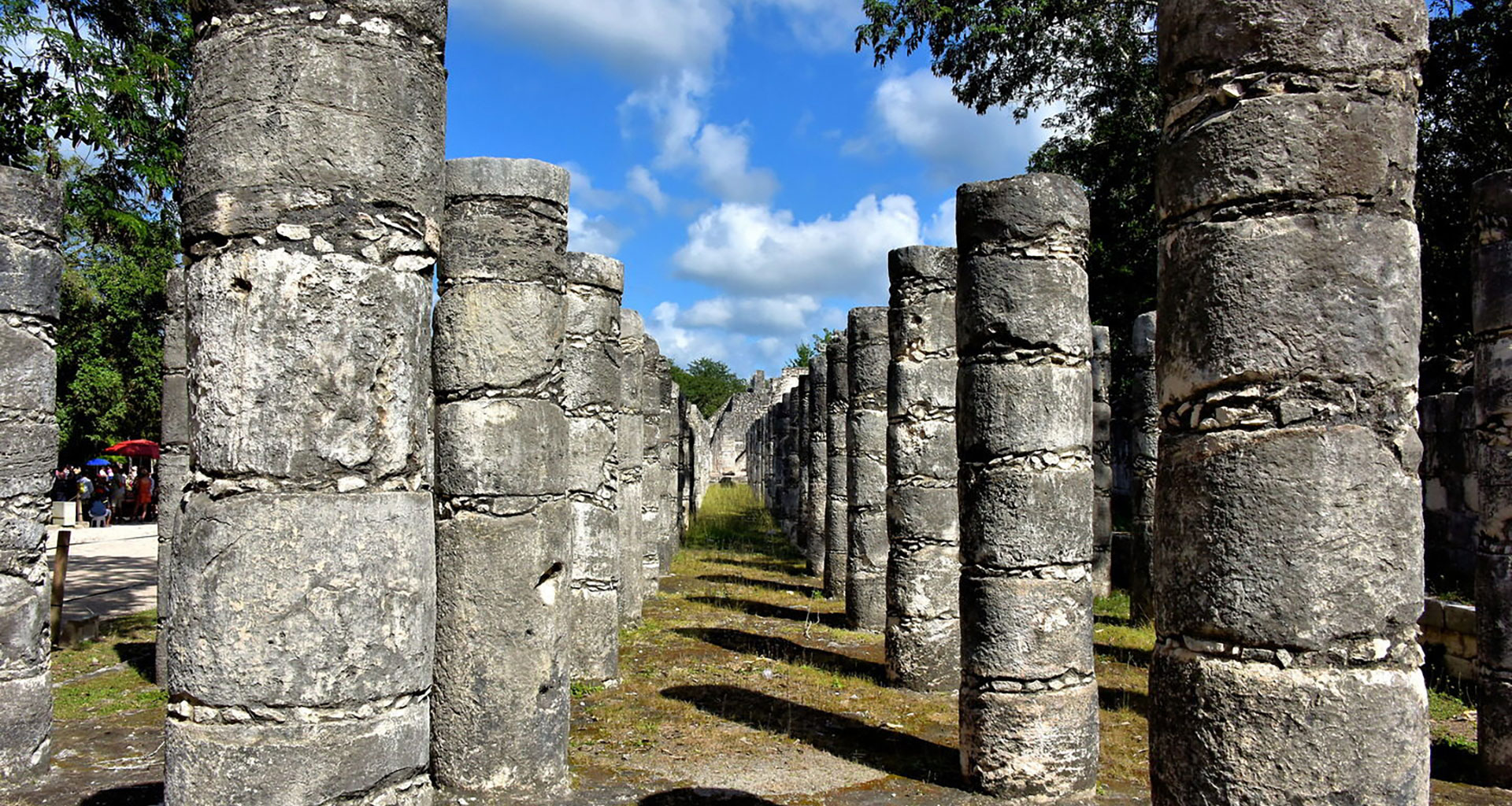
Along the south wall of the Temple of Warriors are a series of
what are today exposed columns called the Thousand Columns, although when the
city was inhabited these would have supported an extensive roof system. The
columns are in three distinct sections: A west group, that extends the lines of
the front of the Temple of Warriors. A north group runs along the south wall of
the Temple of Warriors and contains pillars with carvings of soldiers in
bas-relief; and a northeast group, which apparently formed a small temple at the
southeast corner of the Temple of Warriors, contains a rectangular decorated
with carvings of people or gods, as well as animals and serpents. The northeast
column temple also covers a small marvel of engineering, a channel that funnels
all the rainwater from the complex some 40 meters (130 ft) away to a rejollada,
a former cenote. In reality, they are only around 200 columns in total.
The actual name of “The Thousand Columns” comes by the greatness it inspires.
Behind this structure is the Market, which we never saw.
.JPG)
.JPG)
.JPG)
.JPG)
.JPG)
.JPG)
.JPG)
.JPG)
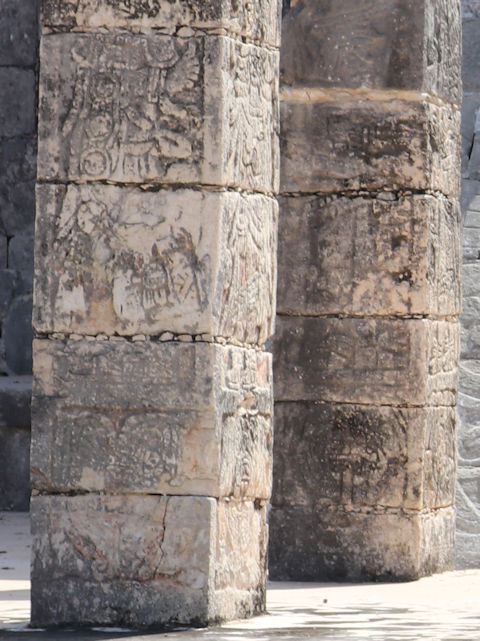
Even from a distance, you could see that the columns were
intricately carved although the carving had significantly deteriorated over
time.
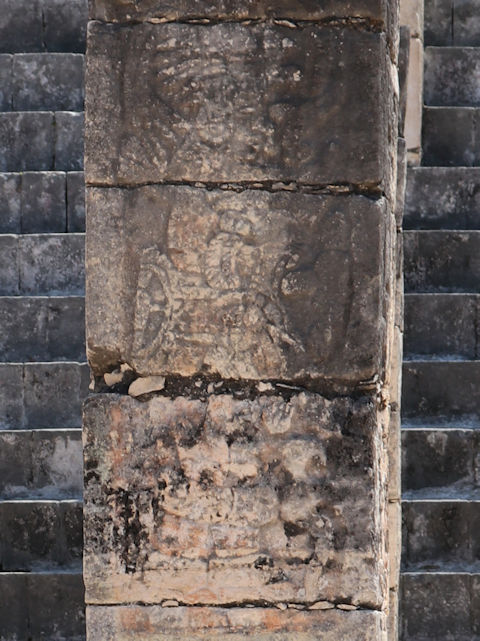
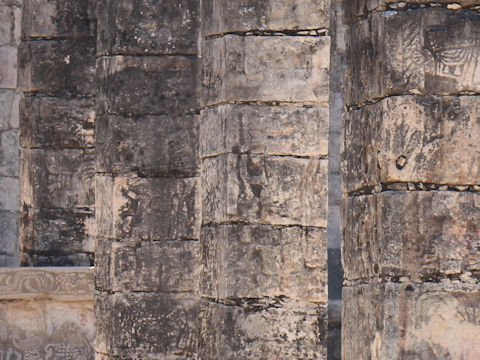
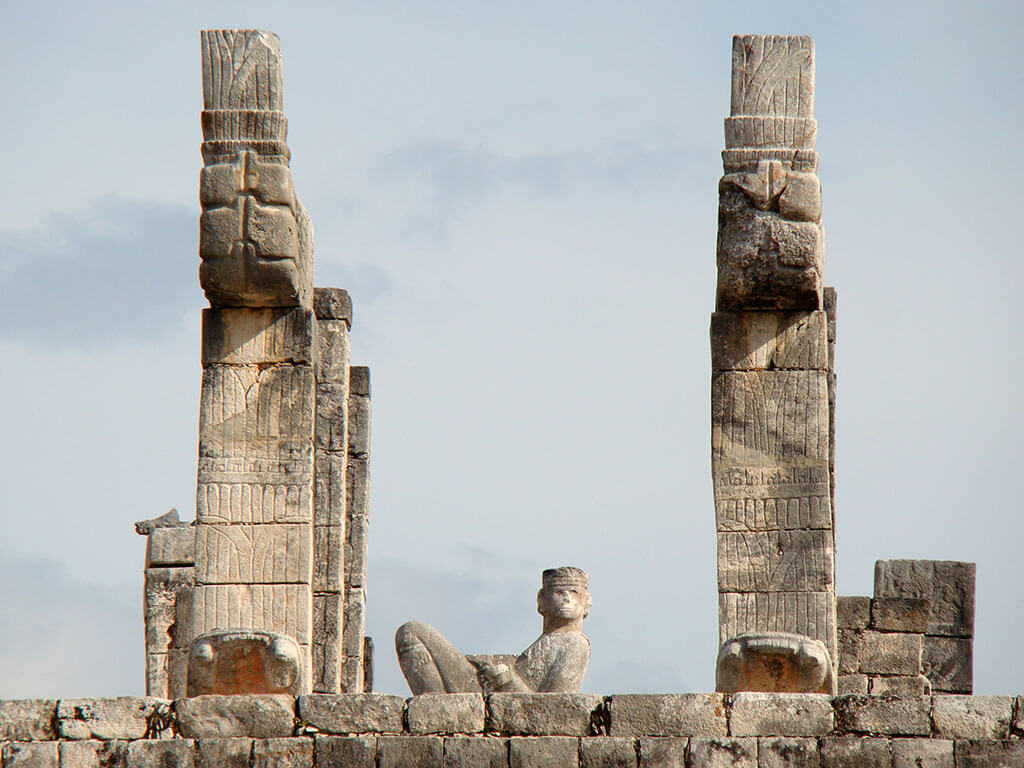
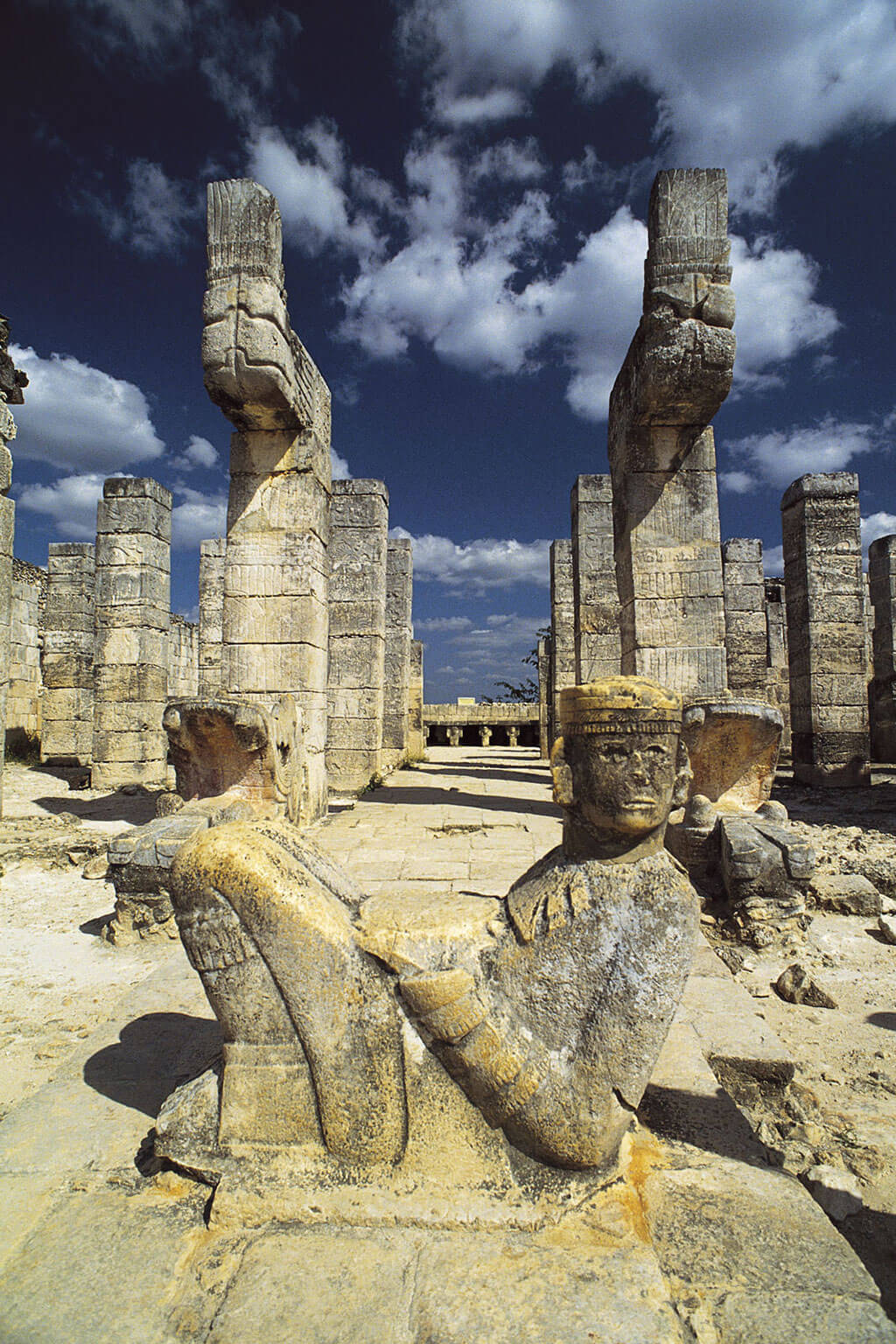
Since you can't see at the top, Primo had pictures to show us
of what was there. I took some information and pictures a website (Wikipedia
and chichenitza.com) to include here. First, the Temple of the Warriors
might be the only known late classic Maya building sufficiently big enough for
really large gatherings. The temple consists of four platforms, flanked on
the south and west sides by 200 round and square columns. All square
columns are carved in bas-relief, with Toltec warriors; in some places they are
cemented together in sections, painted in brilliant colors and covered with
plaster. The Temple of Warriors is approached by a broad stairway with a
plain, stepped ramp on either side, and each ramp has figures of
standard-bearers to hold flags. Before the main entrance a Chaac Mool reclined.
The central temple shows bas-reliefs of warriors, eagles and jaguars devouring
human hearts. A representations of the god Tlalchitonatiuh and Chaac Mool can
also be found in the engravings. On the top, serpent columns which had S
shaped supported wooden lintels above the doorways, these have been gone
throughout the years.
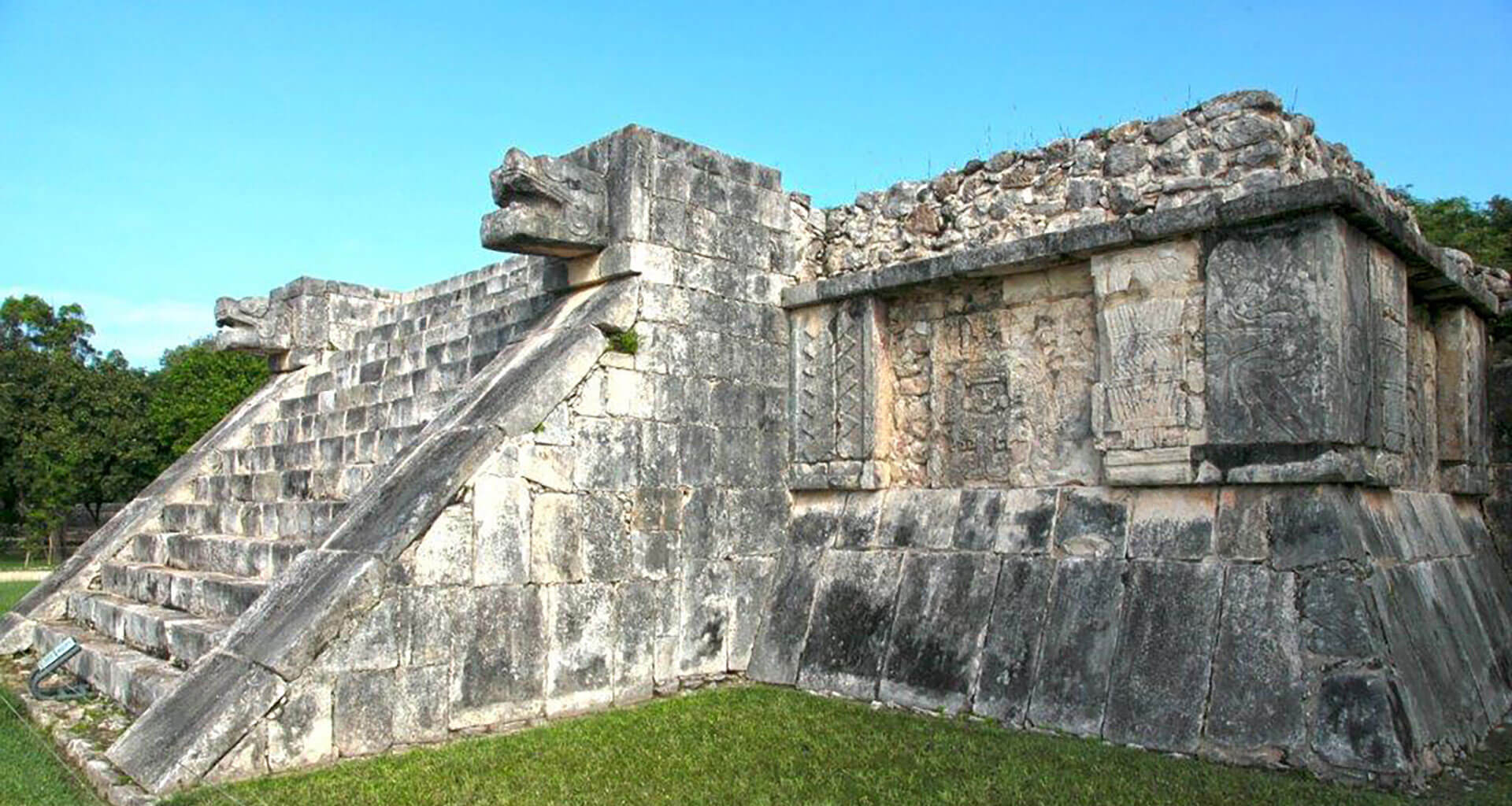
We then headed back north across the Great Plaza past the
Platform of Venus. This is a square platform with stairways on each side.
Primo pointed out the areas where you can still see traces of the red and blue
coloring, as it was originally painted in ochre, blue, red, green, and black.
You can still notice red, blue and yellow left-over paint in the stone
bas-reliefs that decorated the “Morning Star” depiction of Kukulkan (a
Quetzalcoatl’s representation, common in pre-Hispanic cultures). This 4 m
high (13 feet) platform was probably as podiums for rites, ceremonies or dances.
A Web search showed that "on the raised panels there are
bas-reliefs of the planet Venus in the form of a “knot” of years, beside a half
flower with asps on the petals, and the shape of the plaited mat (pop in Maya)
as the symbol of power. In the recessed space Venus is depicted with jaguar
claws emerging from the jaws of a plumed serpent. An offering, consisting
of a skull of a decapitated man, was found in the stairway on east. On the
cornice board, there is a feathered serpent with fish among its undulations
whose head protrudes from the cube of the stair arch."
.JPG)
.JPG)
.JPG)
.JPG)
.JPG)
.JPG)
.JPG)
.JPG)
.JPG)
.JPG)
.JPG)
.JPG)
.JPG)
As none of us managed to capture a good picture of the
full Platform of Venus, here is one off the web (Wikipedia) providing a better
perspective.
We then made our way out of the ceremonial area which is
surrounded by a high wall
.JPG)
We followed the sacbe (a raised pathway) to the Sacred Cenote
(Cenote Sagrado). The path is "guarded" by a number of stalls with native
traders hawking their ware, mostly trinkets, T-shirts, blankets, small models
the pyramid and other items. Some of the handcarved masks and statues were
quite good, but alas none found its way home with us. At the end of the
path, was the centote which is 60 meters (200 ft) in diameter
and surrounded by sheer cliffs that drop to the water table some 27 meters
(89 ft) below. The Cenote Sagrado was a place of pilgrimage for ancient Maya
people who, according to ethno-historic sources, would conduct sacrifices during
times of drought. Archeological investigations support this as thousands
of objects have been removed from the bottom of the cenote, including material
such as gold, carved jade, copal, pottery, flint, obsidian, shell, wood, rubber,
cloth, as well as skeletons of children and men (over 200 bodies in total ... so
far). "To one side of the south bank of the well they built some platforms
on two levels, which perhaps were used as seats for those who witnessed the
ceremonies. Beside this one can see the ruins of a building that was adapted
into a steam bath or temazcal, where it is supposed that the victims were
purified. Placed against this building is another platform that hangs over the
edge of the cenote, from which the offerings would have been made."
.JPG)
.JPG)
.JPG)
.JPG)
.JPG)
.JPG)
.JPG)
Here are some images from the Web to provide perspective
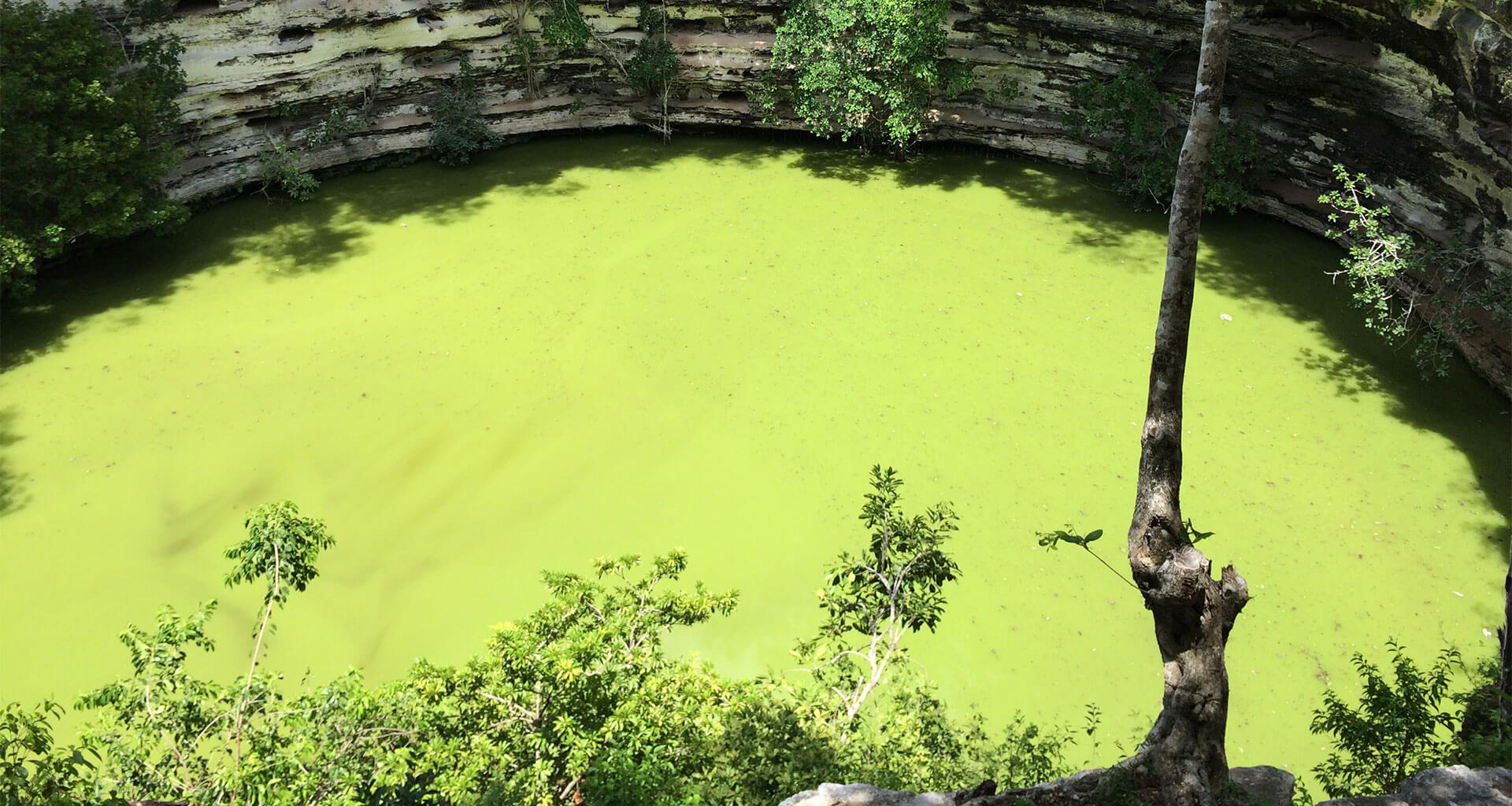
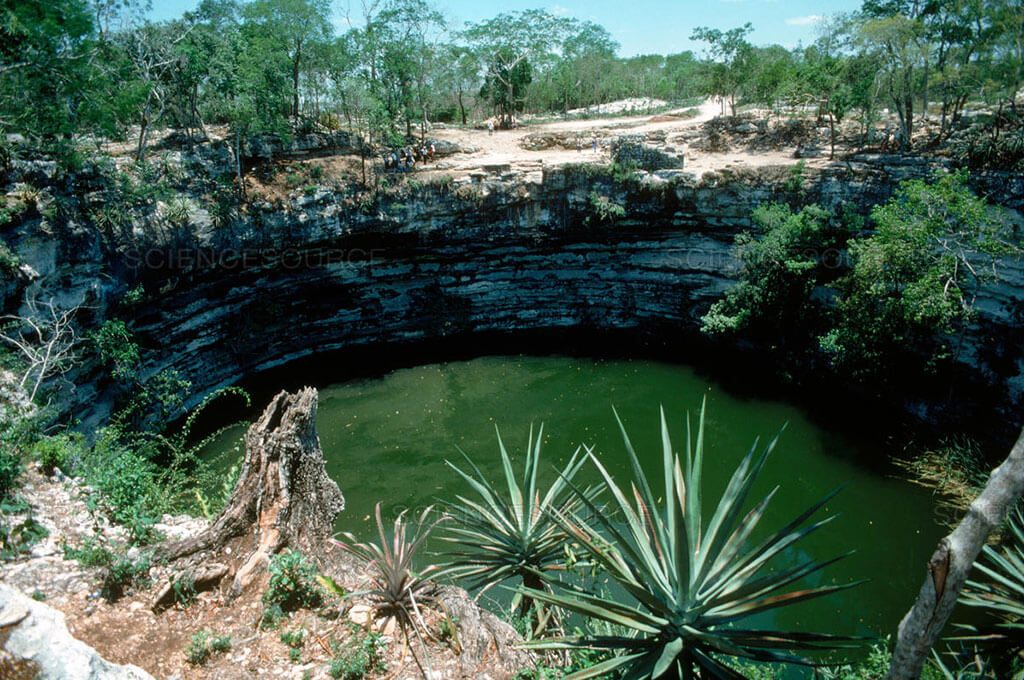
Coming back in, we turned right and headed toward the
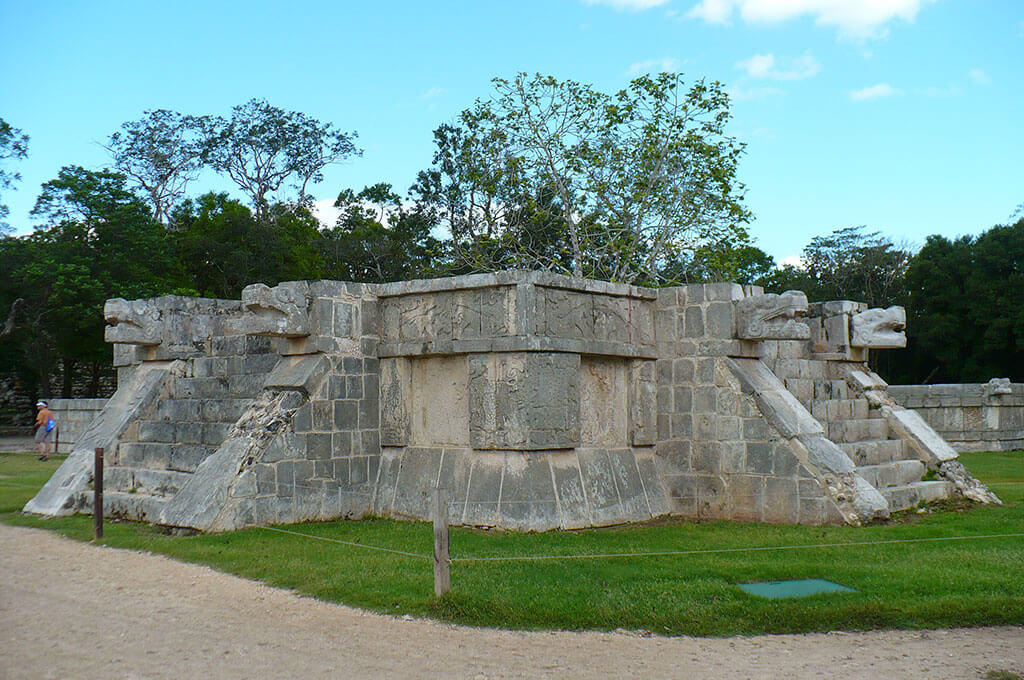
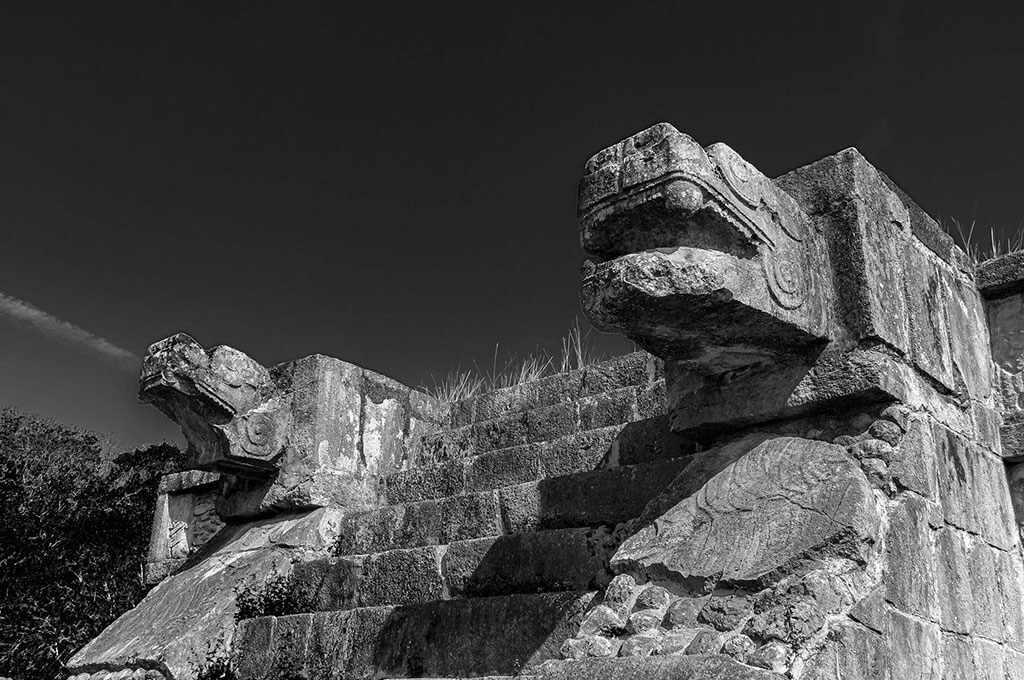
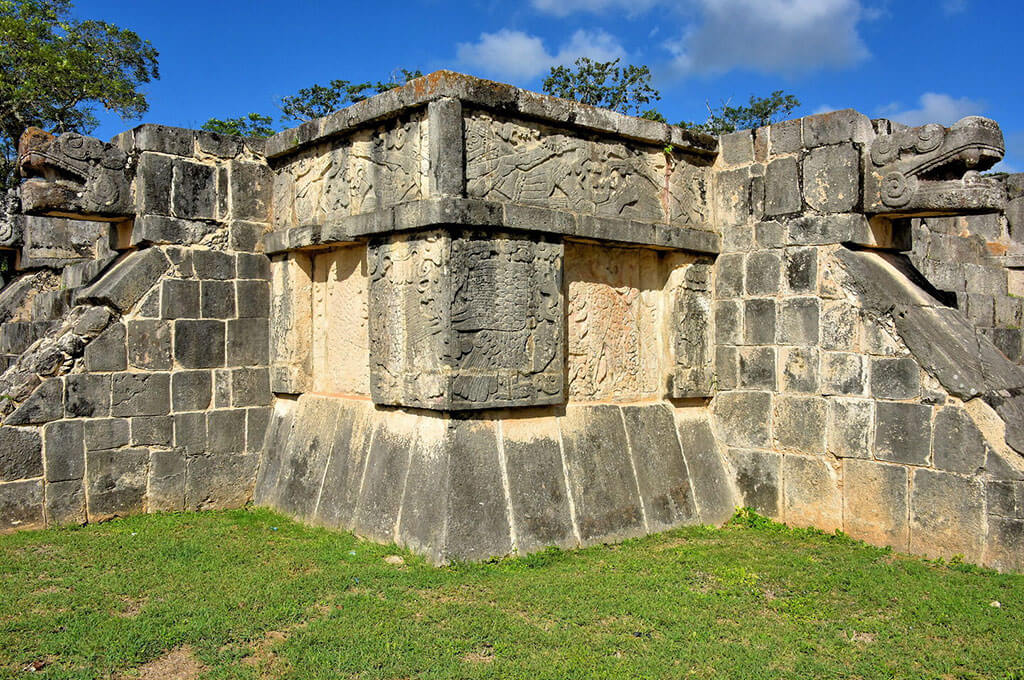
ball court, coming first to the Platform of Eagles and Jaguars (Plataforma de
Águilas y Jaguares). According
to the sign, "this platform resembles that of Venus and other constructions
built in the Maya-Toltec style. It has four, small staircases, one of each
side. The balustrades of these steps represent ascending plumed serpents
which end with serpent figureheads in the upper part of the building."
Similar to the Platform of Venus, this platform has a staircase on each of the
four sides leading to the top of the platform. "The balustrades (stair rail) are
topped with an ascending plumed serpent – the serpent God Kukulcán. On the walls
of the structure are prostrate human figures. Below them are Eagles and Jaguars
gruesomely grasping and consuming human hearts. On the base of the
structure there is a vertical wall with raised panels displaying images which
relate to the course of the sun across the sky during the day and its descent to
the underworld at night, as “Sun of the Earth”. The eagles and jaguars symbolize
the warriors who capture victims to be sacrificed to feed the sun god.
The platform was likely used for religious and ceremonial purposes with a
special emphasis about military superiority."
.JPG)
.JPG)
.JPG)
.JPG)
As the Platform had scaffolding around it, I again looked to
the Web for some information and better images. "The "Eagle Knights" were archers who attacked the enemy before all other
soldiers fought hand to hand. The aggressive eagles which sculpted on the walls
of the platform are the symbol of these elite vip group of archers who stood out
on the battlefield because they wore clothing of feathers from the bird for
which they were named.
The "Jaguar Knights" were believed to be the army fiercest members, modeled
after those found elsewhere in the Central Mexico. They fought hand to hand,
with wooden clubs tipped with obsidian knives. They covered themselves with
armor made of jaguar skins and also helmets of jaguar heads. The figures of
jaguars represented the soldiers who were often charged with obtaining prisoners
for sacrifice to the Gods of city."
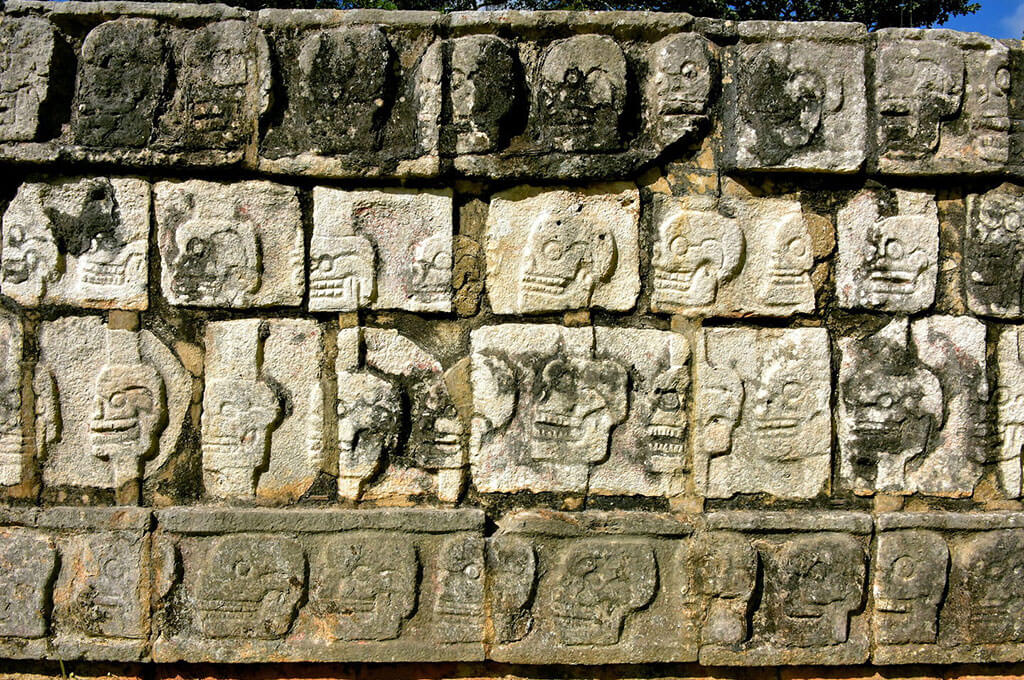
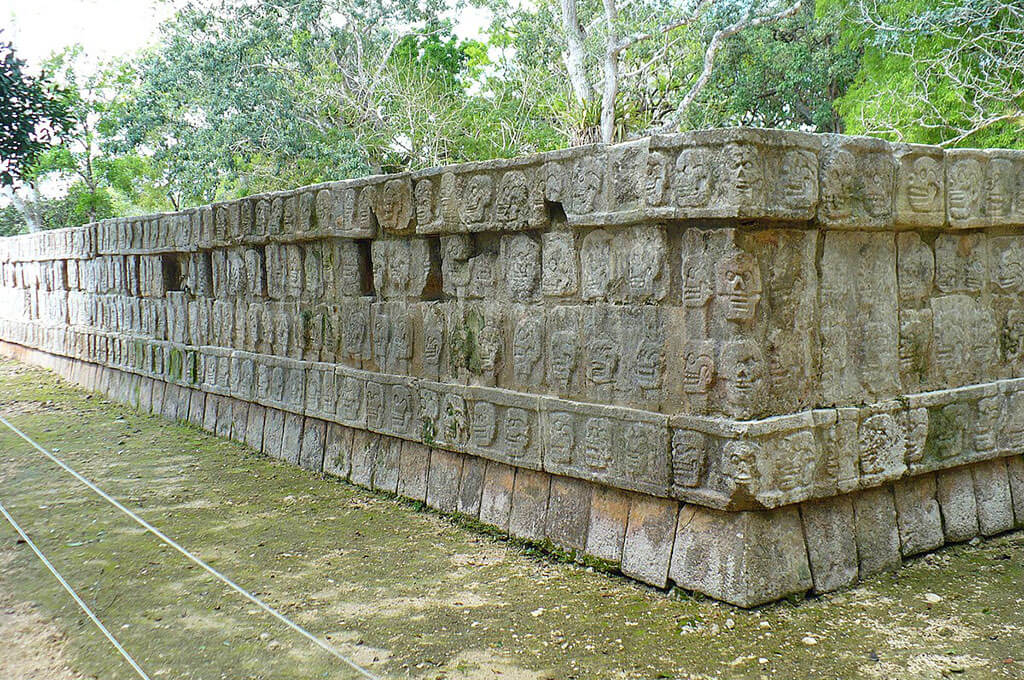
Behind this Platform was the Tzompantli, or Skull Platform (Plataforma de los Cráneos),
a structure dedicated to the dead which gives the clearest testimony to the
practice of human sacrifice, carried out for religious-military ends, by the
rulers of Chichén Itzá. It is a “T” shaped structure 60 meters (197 feet)
ong by 12 meters (39 feet) wide and decorated with over 500 bas-relief skull on
the side panels. There is a very small slope at the bottom, then a central
band decorated with skulls running in three horizontal rows, and at the top, a
slightly tapered band with another row of skulls. The platform walls of
the Tzompantli have carved beautiful reliefs of four different subjects. The
primary subject is the skull rack itself; others show a scene with a human
sacrifice; eagles eating all human hearts; and skeletonized warriors with arrows
and shields. This one is one of the oldest Tzompantli found ever.
Habitants of Chichén Itzá would gather long wooden beams in which they would
hang their enemies' heads vertically (opposed the horizontal strings of skull
racks common in central and northern Mexico which were described by the early
conquistadors). Archaeologists have found buried figures of Chaac Mool in the
Tzompantli of Chichén Itzá, along skull offerings and a broken ring from
the Ball Game court.
.JPG)
.JPG)
.JPG)
.JPG)
.JPG)
.JPG)
.JPG)
.JPG)
.JPG)
.JPG)
.JPG)
.JPG)
Here are a couple more images from the Web.
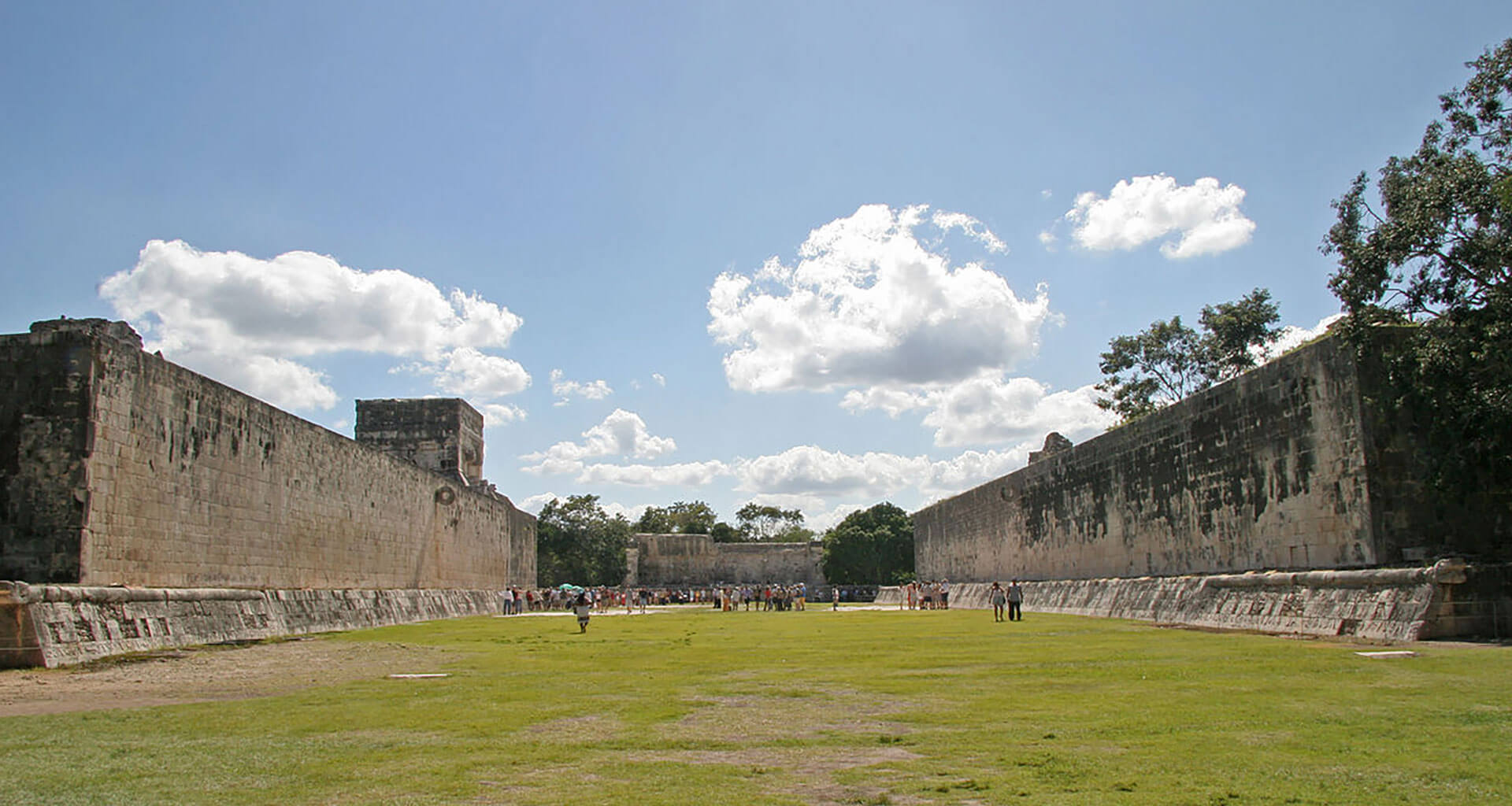
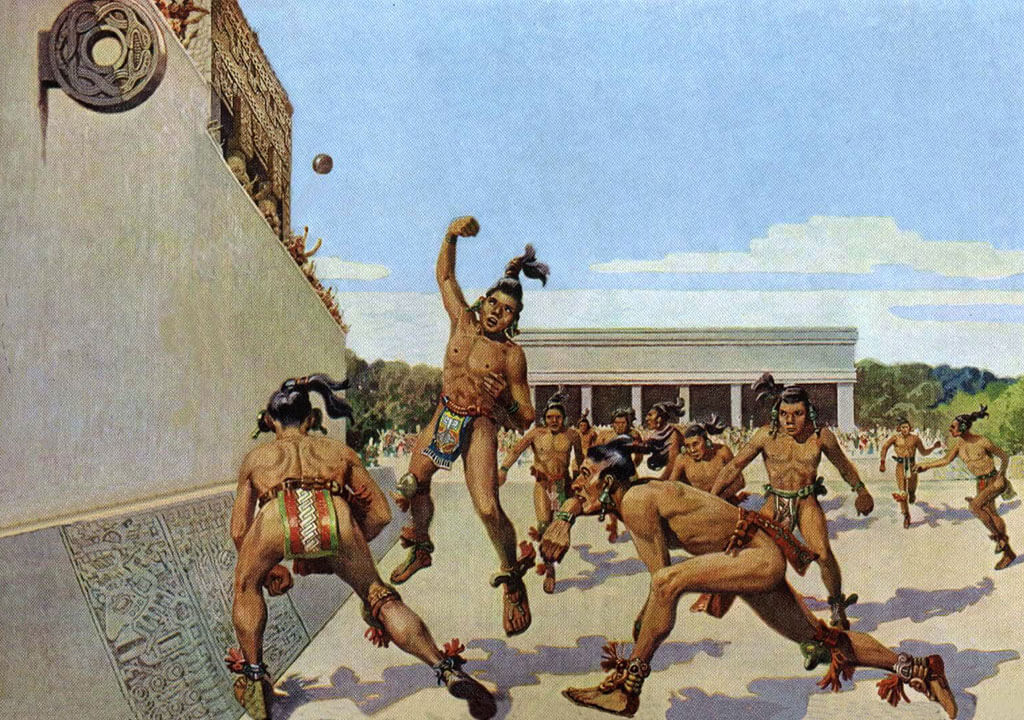
In Chichén Itzá, archeologists have identified thirteen ball courts for
playing the characteristic Mesoamerican ballgame. Chichén Itzá’s ball court is the largest
and best preserved ball court in
Mesoamerica. Its playing field extends over a length of 168m (551ft) and a width
of 70m (230ft). The court was flat with three stone markers down its
length. The parallel platforms flanking the main playing area are each 95
meters (312 ft) long. The walls of these platforms stand 8 meters (26 ft)
high and are set on slanted benches with sculpted panels of teams of ball
players; set high up in the center of each of these walls are rings carved with
intertwined feathered serpents. The game had religious significance
because it played out a scene from Maya mythology. Some of the stone
markers have inscriptions that depicted the underworld.
The Ball Game was more a ceremonial ritual than a sport and
probably represented the symbolic recreation of the mythical combat between
night and day, with the movement of the sun (the ball) through the
underworld (the ball court) each night, or that it may have represented the moon
and the earth. Archeologists have only partially reconstruct the rules of
the ball game, thanks to pictorial representations and stone monuments.
The ball was thrown in the center of the court, could only be touched with the
hips and thighs, and had to go through one of the stone hoops high on the side
wall. We do not know the number of players or if the "teams" had to stay
on their sides or move across the court. The ball varied in size and
weight, weighing between 3 and 5 kg and in size up to slightly larger than a
soccer ball, and was made from liquid latex extracted from rubber trees, formed
from a resin produced when the sap was heated. The players were either professionals or amateurs,
but many of them were war captives who were forced to play after losing battles.
During ritual games, players tried to hit a 5kg rubber ball with their hips and
elbows through high stone scoring hoops. The competition must have been fierce,
as losers may have been put to death (or had a ritual sacrifice made from a
stand-in).
The carved reliefs at Chichén Itzá reveal grisly scenes. They
show two opposing teams of seven members each facing one another. In the middle
of the scene, the first player of the left team has decapitated the first player
from the opposing team, who kneels headless in front of a large ball marked by a
great laughing skull with the wound emitting streams of blood in the form of
wriggling snakes.
In the second amazing example of architectural design
enhancing acoustics, there is a singular acoustic phenomenon peculiar to the
Ball Game Court: if one speaks in the Temple in the Southern end the voice can
be heard at the opposite end, as the sound reverberates along the walls of the
North Temple
.JPG)
.JPG)
.JPG)
Here is one of the panels depicting the player being killed and sacrificed,
along with the stone hoop from the north wall.
.JPG)
.JPG)
.JPG)
.JPG)
.JPG)
.JPG)
Above the outside, western wall was a platform for the referees or spectators.
.JPG)
.JPG)
.JPG)
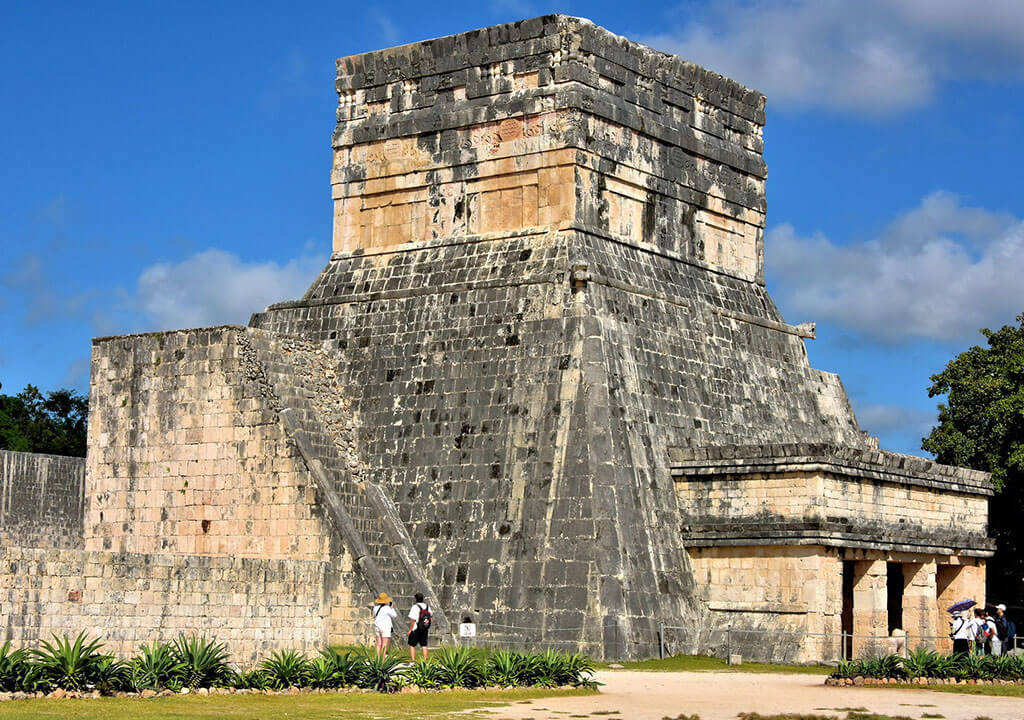
Above and built into the eastern wall is the Temple of the Jaguars.
The Upper Temple of the Jaguar overlooks the ball court and has an entrance
guarded by two, large columns carved in the familiar feathered serpent motif.
Inside there is a large mural, much destroyed, which depicts a battle scene. In the entrance to the Lower Temple of the Jaguar, which opens
behind the ball court, is another Jaguar throne, similar to the one in the inner
temple of El Castillo, except that it is well worn and missing paint or other
decoration. The outer columns and the walls inside the temple are covered with
elaborate bas-relief carvings. An interesting mosaic repeats along the
length of the frieze: two jaguars advance, from different directions, towards a
round shield. The upper tableau is filled in with the bodies of two plumed
serpents, with their heads at the edges of the frieze and the tails interlocked
in the center.
.JPG)
.JPG)
.JPG)
.JPG)
The eastern end of the north wall had a beautiful figure, which had recently
been restored.
.JPG)
.JPG)
.JPG)
Again, a Web photo is helpful for perspective (mostly because they could get to
roped off places to take the picture, then had a wider angle lens). Here
is the ball court taken from the north end (far beyond the current rope) and of
the Temple of the Jaguars from the outside and south of the ball court.
At the southern end of the Great Ball Court is the North Temple, also
known as the Temple of the Bearded Man (Templo del Hombre Barbado). This
small masonry building has detailed bas relief carving on the inner walls,
including a center figure that has carving under his chin that resembles facial
hair. At the south end is another, much bigger temple, but in ruins.
We then headed back to the Great Plaza toward the Temple of Kukulcán,
moving to the right to get some water and admire the iguanas. We again
went through an area with a number of stall selling trinkets and other wares.
Primo commented that since much of the site was and still is owned by Mayan
families, they are allowed to bring family members into the area to set up a
stall and sell what they can. If they don't have family, they are allowed
to hire up to three people to work for them.
.JPG)
.JPG)
.JPG)
.JPG)
.JPG)
We past the entrance and proceeded south-west away from the
Great Plaza, arriving quickly at the Ossuary, which is a container or room where
bones are stored. This is also called the High Priest Temple or High
Priest Pyramid. Similar to the Temple of Kukulcán (El Castillo), this is a
step-pyramid with nine stepped blocks and with a staircase on each of the four
sides, with balustrades carved with interlocking serpents that lead to a temple
at the top, whose entrance proudly displays two serpent columns. The
Ossuary is one of the most complex buildings on site. It is known to be
built over a deep cave which can be accessed from the entrance made in the floor
of the upper temple. It is possible that this cave was considered a door to the
underworld. There are seven tombs in the cavern which contained jade, rock
crystal, shell and copper offerings along with human remains.
The pyramid was designed as a solar observatory, as its
orientation, at 17 degrees from north, allows the sun to shine through a
vertical air intake and illuminate the "mother rock" 10 meters deep, where
several objects were found, such as medium-sized sculptures, bones and
shell-made objects from May 23rd to June 19th, which marks the beginning of the
rainy season.
The most remarkable aspect of the Ossuary is its bust
decoration; it is full of different bas-relief snakes, birdmen, men with
god-like masks and other representations. It also holds 894 AC’s incriptures.
On the upper foundation, 8 interlocked snakes decorate the edge of the
structure. Four of the snakes are covered with turquoise disc and the other four
with earrings. The three panels on the upper foundation are covered by bird
representations. In total, there are 48 panels with fruit, cocoa beans, jewels
and animal bas-relief.
.JPG)
.JPG)
.JPG)
.JPG)
.JPG)
.JPG)
The Stone Corner is displayed in front of the Ossuary.
This was once located on top of the Ossuary as one of a total of 16 of these
stone masks, four at each corner. They may represent rain gods (Chaac)
Kukulkan, or Itzamma, supreme gods and patrons of the lineage. They are
Puuc and fully demonstrate the syncretism that the lords of Chichén Itzá
practiced.
.JPG)
.JPG)
.JPG)
.JPG)
.JPG)
.JPG)
.JPG)
.JPG)
.JPG)
.JPG)
.JPG)
.JPG)
From here, the wide path winds through the trees and a couple
smaller ruins, including the Temple of the Deer which is across from the Xtolac
Cenote.
Further on we past the Chichanchob or Red House, which was
being restored and wasn't accessible although it is one of the best preserved
buildings at Chichén Itzá. Chichanchob translates as "small holes" from
the Maya, which was given due to the small holes in its raised ridge. It
is also commonly known as Casa Colorada or Casa Roja (Red House), due to a strip
painted in red inside the vestibule or first bay. A small ball court is
attached to the back wall or east side of the structure. In one chamber
there are extensive carved hieroglyphs that mention rulers of Chichén Itzá and
possibly of the nearby city of Ek Balam, and contain a Maya date inscribed which
correlates to 869 AD, one of the oldest such dates found in all of Chichén Itzá.
.JPG)
.JPG)
.JPG)
We came out of the path through the trees into a wide lawn and
opening dominated by the Caracol or Observatory. The buildings in his area
(the southern group) are the oldest building in the archeological site and were
constructed between the 7th and the 10th centuries AD and correspond to the Puuc
architectural style, which was widely distributed in the Yucatan Peninsula
between 600 and 1000 AD, whose most notable exponent is the city of Uxmal. After
1000 AD, a style that blends stylistic traditions of the Central Highlands with
the Maya can be seen in the architecture of Chichen Itza, this stylistic
element, among others, was one of the criteria for designating the city of Chichén
Itzá within the list of World.
El Caracol ("the snail" or "the conch") is a round building
with a domed roof on a large square platform (one of the few circular structures
built by the Maya). The Caracol is really built of three superimposed buildings
and gets its name from the stone spiral staircase inside. It includes a
larger circular tower set on a platform with a central staircase. The base is
set on another rectangular platform, decorated with a cornice of rounded corners
on the upper part. The total height of the monument is 75 feet. The
structure was constructed during the first period of the Military city.
This building is constructed following strict measures and responsive to
natural conditions. During the Solstices the sun sets exactly on the window
frame, allowing you to see the sun as a painting with a stone frame. This narrow
windows cut into the outer walls seem to have been designed in order to observe
the irregular movements of Venus, which was considered to be the sun's twin and
held great significance for the Maya, particularly in decisions pertaining to
war.
.JPG)
.JPG)
.JPG)
.JPG)
.JPG)
.JPG)
.JPG)
.JPG)
Just past the Caracol is the Church, a temple dedicated to Chaac,
god of rain. It consists of only one chamber and one door that gives access to
the main part of the building. It’s similar to a rectangular chapel, and that’s
why the Spaniards named it The Church. This building stands out from
others because of its preserved state; you can see the details on the bas-relief
and stone carvings. The most notable motifs of the decoration are the masks of
the rain god with a hooked nose protruding from them, located in the corners.
.JPG)
.JPG)
.JPG)
.JPG)
.JPG)
.JPG)
.JPG)
.JPG)
.JPG)
Immediately next to this is the Nunnery or Las Monjas (The
Nuns), which is one of the most imposing of all the architectural groups in Chichén
Itzá. The main façade of the complex faces north, and comprises three
buildings: The Nuns’, the East Annex and the Southeast Annex. The three date
from different periods of construction. The Nuns’ Building stood on a base
that is now no longer visible, the main section of the building is 33 ft high,
with a central staircase on the north side, which led to the upper temple. The
temple has a profusely decorated façade, in the Chenes style. Owing to the
great number of rooms that divide the upper temples the explorers during the
Colonial Period believed that the building would have served as a cloister for
the training of priestesses (or could have been a royal residence, but since it
resembled a European convent to the Spanish due to its many rooms, it was given
the current name)
.JPG)
.JPG)
.JPG)
Adjacent to the Nunnery is a small ball court and the Annex,
which has some of the most beautiful frieze in Chichén Itzá, with a vast number
of masks of the god Chaac on the sides. All the facades of the Annex are
decorated, in keeping with the Chenes style. The principal façade has a
frieze displaying masks of Chaac in either side of a central medallion above the
entrance. Set onto this is a sculpted figure in stucco, with a
head-dress of beautiful feather and fret patterns.
.JPG)
.JPG)
.JPG)
.JPG)
.JPG)
.JPG)
.JPG)
.JPG)
.JPG)
.JPG)
.JPG)
Across from the Nunnery is the Akab Dzib, which means "dark
writing" in Yucatec Mayan (dark in the sense of mysterious, or obscure
writing). An earlier
name of the building, according to a translation of glyphs in the Casa Colorada,
is Wa(k)wak Puh Ak Na, "the flat house with the excessive number of chambers",
and it was the home of the administrator of Chichén Itzá, kokom Yahawal Choʼ
Kʼakʼ. It consists of one central building and two rooms. Later two
buildings were annexed, each with eight rooms. The three groups are roofed with
the Maya vault or false arch. In total the three buildings have eighteen rooms.
It is relatively short, only 6 meters (20 ft) high, and is 50 meters (160 ft) in
length and 15 meters (49 ft) wide. The long, western-facing façade has seven
doorways. The eastern façade has only four doorways, broken by a large staircase
that leads to the roof. This apparently was the front of the structure, and
looks out over what is today a steep, dry, cenote. The southern end of the
building has one entrance. The door opens into a small chamber and on the
opposite wall is another doorway, above which on the lintel are intricately
carved glyphs—the "mysterious" or "obscure" writing that gives the building its
name today. This may be the oldest structure at the site, with one of the
central chambers dating from the 2nd century.
.JPG)
.JPG)
.JPG)