|
|
Use these navigation links to move between the Year 2023 pages. Specific pages can be accessed at the bottom of this page
May 2023 (Part 17) Greece/Spain Trip - Day 11, May 23 (Part One) - Barcelona, Spain The next morning, we were picked up pretty early by Pablo, who would be our driver and guide for a semi-private, small group van tour. There was another family already in the van, consisting of a grandmother, her granddaughter, a nephew and his wife. They all spoke Spanish, but Steve was sure he heard them say "Penn State" in a conversation with Pablo. He asked and we were delighted and surprised to learn the girl had graduated from Penn State the day after Andy, getting a degree in neuro-psychology. She was headed to medical school in Puerto Rico next. As she spoke English, it was a lot easier to communicate. It was really interesting watching the guide give the tour in both languages, alternating which he began with, then repeating in the other. On the drive into our first stop to walk through the Gothic Quarter, we took a couple pictures out the windows.
Our first stop of the day was at an overlook to the west of the city, near the top of the Barcelona Cable Car. This was just above the Columbus Monument we had seen at the end of our wandering last night.
You could clearly see the old cathedral and La Sagrada Familia which is under construction, along with a distinctive cylindrical building Upon a questioning, we discovered it was La Torre Glòries and was done by the same architects as the similar Gherkin building in London.
Our guide also pointed out the hill in the distance with the radio tower, as we would see it from the other side later in the day from Montserrat.
We then parked in an underground near the cathedral and took some images again of the Escultura Barcino and the Roman gate and aqueduct ruins.
Before leaving the square, our guide pointed out a mural across from the ruins. These are on the side of the building housing the El Collegi d'Arquitectes de Catalunya (COAC) (College of Architecture of Catalan). The bland building is in the modernist style, prioritizing form over function. To provide some decoration, a contest was held in the 1950s for a mural design. The winning design was submitted by an anonymous artist and executed by the Norwegian artist Carl Nesjar in 1955. It was executed by sandblasting away a layer of concrete covering underlying black stone. Later it was announced that there really wasn't a competition, that the Architects College elected Xavier Busquets i Sindreu to decide how the school would decorate the new façades of the new headquarters. His original idea was to ask Miro to produce something, but he also sought out Pablo Picasso (knowing Picasso’s love for the city having moved to the city when he was 13-year old after his sister's death). When Busquets met with Picasso to speak about his idea, Picasso outlined a new technique he had adapted to a Museum in Oslo with the help of the Norwegian artist Carl Nesjar, transplanting some of his drawings with a sandblast technique. It was decided the same technique would be used in Barcelona! The interior of the building still needed to be decorated and Busquets did originally think of Miró, but it was Picasso himself that volunteered to design the interior as well. As, Picasso and Miró were actually quite good friends and even helped one another while the two fellow countrymen were living in Paris, there was little conflict with the selection. The work was done while Picasso was living in Paris during his exile from Spain. He spent almost half his life in exile in France after the Spanish Civil War, during which time the Republic made him director in absentia of the Prado museum. He refused to return to Spain while Franco was alive. And, because he was a member of the French Communist party, he was never allowed to visit America.
We then went in a circle around the cathedral beginning by heading up Carre de Bisbe and under the Bishop's Bridge.
Our loop included a stop in Placa de Sant Jaume. There Pablo pointed out the Catalan flag on top of the Governors Palace, with its red and yellow horizontal stripes representing the autonomous region of Catalonia. He then discussed the other flag used locally to represent the Catalan independence movement, which adds a white star on a blue chevron against the short left side.
Our route behind the cathedral took us to ruins of columns which dated back to the Roman times. They are now enclosed in a building to protect them, and apparently to make the space really loud. The columns are the ruins of the Temple of Augustus, dating back to the first century AD. They temple was incorporated by the Romans into the city's forum for four centuries, where much of the city's administrative and religious events took place. This site also marked the center of the Roman city, standing astride the main east-west and north-south roads. As with many cities, the forum declinef beginning in the 5th century with the rise of Christianity. Much of the forum was dismantled for building material and the administrative center of the city moved to the northern quarter next to the wall. It was still mostly standing in the middle ages, when building design favored the conservation of the temple and simply incorporated it into the buildings, with the columns and pedestals becoming talking points for the occupants right in their rooms.
Our trip around the cathedral allowed us to see the buttresses supporting the structure.
The Placa del Rei (place of the king) is adjacent to the cathedral. Our guide pointed out that the King and Queen resided here when Columbus came to report to them of his finding of the New World.
We also peaked into the cloister where 13 white geese are kept.
We finally made our way back to the front of the cathedral.
The statues of the saints around the facade were amazing. Pablo pointed out the image of Saint Peter (to the left of the main doors), who is recognized by his depiction holding his traditional symbols: a key (keys of the kingdom of heaven, representing Papal authority) and an upside-down cross (when his execution was ordered by the Roman Emperor Nero, who blamed the city's Christians for a terrible fire that had ravaged Rome. Peter requested to be crucified upside down, as he felt unworthy to die in the same manner as Christ). Pablo also pointed out St Eulalia of Barcelona, who is recognized by the X-shaped cross she is holding. Glad to have the better camera with the telephoto lens finally, as we had been here twice before now without it.
Captured this wonderful mural of the highlights of the city's skyline on the way to the La Sagrada Familia cathedral. Think we also passed another Gaudi building.
Our next stop was the La Sagrada Familia cathedral. This time we got to go inside and spend some time. We approached from the northeast side and the right transept. Very glad we had the tour and audio guide (along with some information on the app), as the explanation of what we were seeing allowed us to appreciate the design and overall effect. The La Sagrada Familia (Sacred Family) Basilica is intended as an offering to the people of God's kingdom on Earth, providing a "treasure of spirituality, harmony and reconciliation. The word "peace" appears next to the scene depicting the birth of Jesus on the Nativity Facade. The naming of the Basilica commemorates the family as the main nucleus of society, a place of love for its members. It also depicts the family at work, making it a place that remembers how work dignifies a person. It is the largest unfinished Catholic church in the world and is part of a UNESCO World Heritage Site. Pope Benedict XVI consecrated the church and proclaimed it a minor basilica in 2010. It has been build solely with private donations. Construction has progressed slowly, and was paused during the Spanish Civil War. Much of the original designs could not be built with the technology at the time and are only possible with modern techniques. One century later, his methods are still revolutionary.
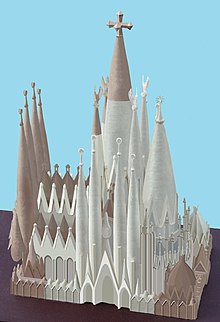
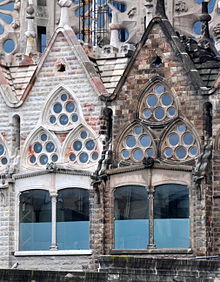
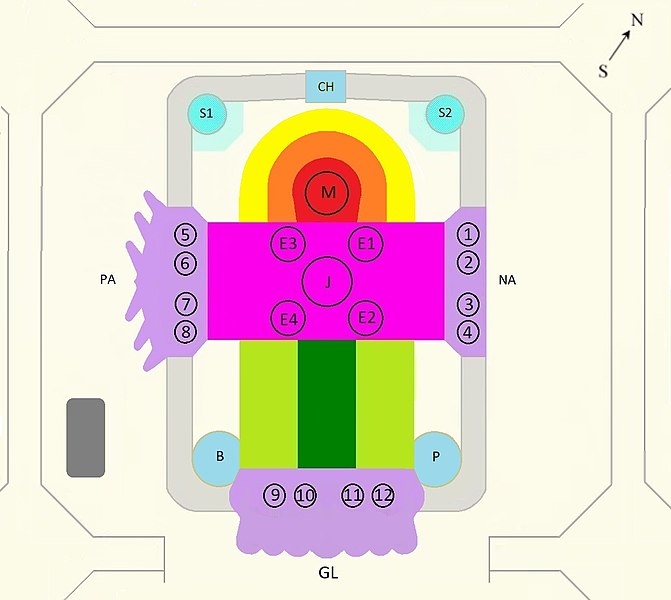
Construction began in 1882 with a Gothic-revival design and under another architect, who resigned a year later. Antoni Gaudí i Cornet took over as chief architect, transforming the project with his architectural and engineering style, combining Gothic and curvilinear Art Nouveau forms. Gaudí devoted the remainder of his life to the project, and he is buried in the church's crypt. At the time of his death in 1926, less than a quarter of the project was complete (although the eastern Nativity Facade was mostly complete, so he had the most direct influence over this side). He remarked beforehand regarding the lengthy construction he remarked that "client is not in a hurry." In July 1936, during the Spanish Civil War and after Gaudi's death, anarchists from the FAI (Iberian Anarchist Federation, a group at the forefront of the anti-Franco forces) set fire to the crypt and broke their way into the workshop, partially destroying Gaudí's original plans (although several models were painstakingly reassembled from fragments, including one for the Glory Facade). In 1939, Francesc de Paula Quintana took over site management, which was able to go on due to the material that was saved from Gaudí's workshop and that was reconstructed from published plans and photographs. Construction is in the final phase of raising six immense steeples. It is hoped that construction would be completed by 2026, the centenary of Gaudí's death, but this has now unlikely with delays due to the COVID-19 pandemic only partially to blame. Construction is now estimated to complete in 2030, 2032, or later. It was recently discovered that the stone from nearby Montserrat was becoming more fragile, so an alternative source had to be found to complete the construction. In 2018, the stone type needed for the construction was found in a quarry in Brinscall, near Chorley, England. The image below (left) shows the completed sections in white and the remaining parts to be built in brown. New stonework at the Sagrada Família (left) is visible against the stained and weathered older sections (right).
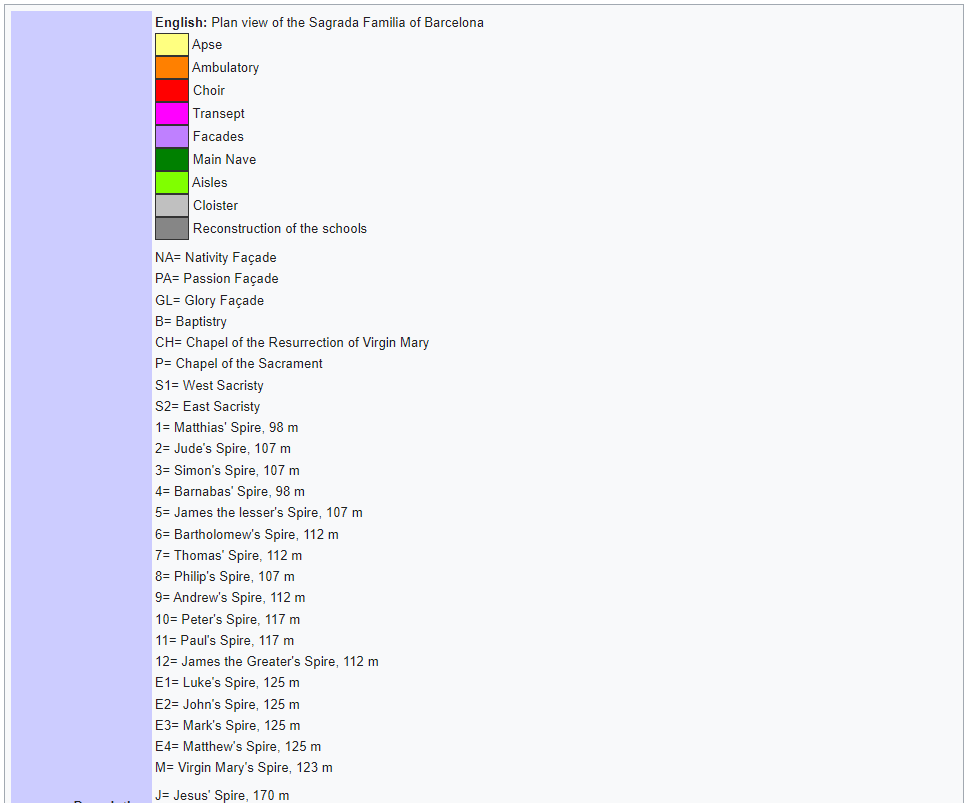
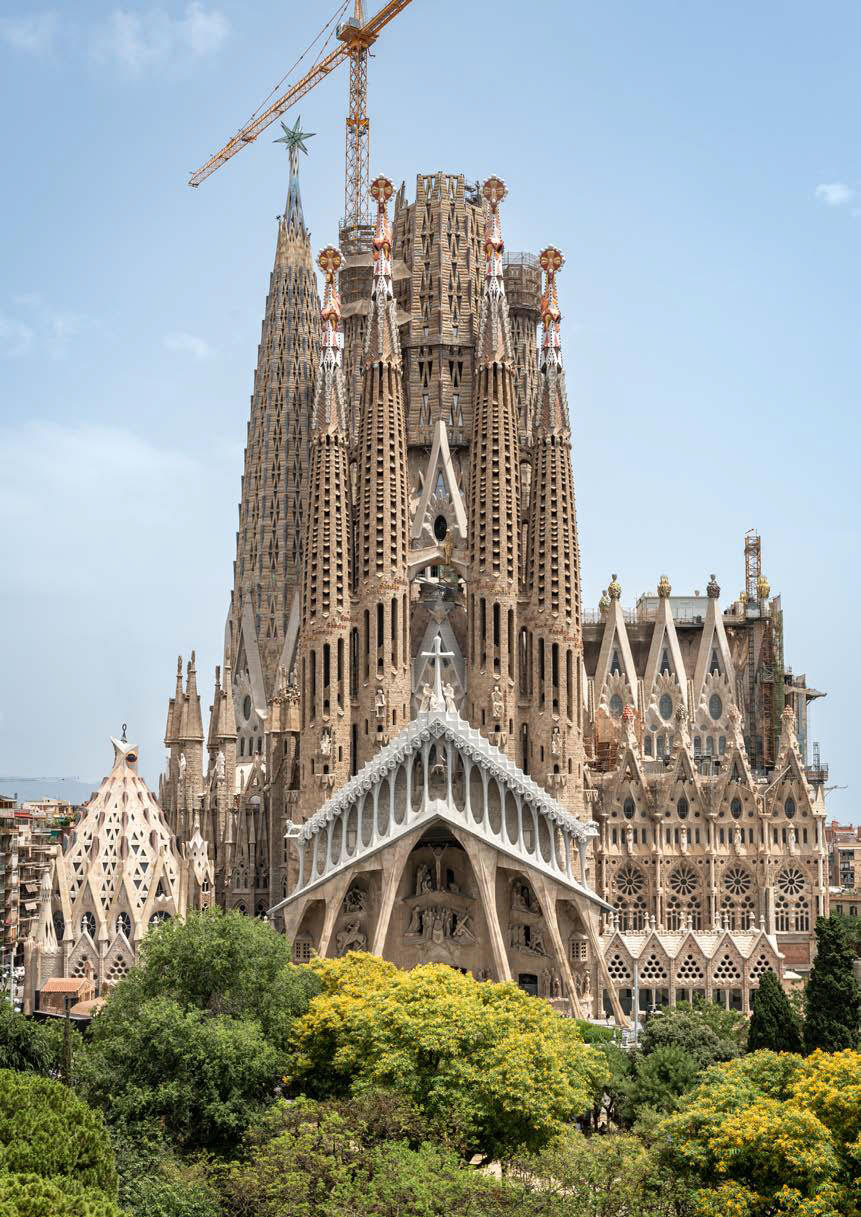
Two of the three facades are complete, the Nativity Facade on the right/east transept and the Passion Facade on the left/west. The Glory Facade and intended main entrance at the bottom of the nave requires demolition of some of the surrounding buildings. Of the spires, eight of the intended twelve representing the apostles are complete, as are two of the four spires representing the Evangelists/Gospels (Luke and Mark), and the Virgin Mary's spire (crowned with a star). The main spire representing Jesus is also incomplete. Current construction is focused on the two remaining Evangelist spires (Matthew and John) and the Jesus spire. The Evangelists' spires will be surmounted by sculptures of their traditional symbols: a winged bull (Saint Luke), a winged man (Saint Matthew), an eagle (Saint John), and a winged lion (Saint Mark). The central spire of Jesus Christ is to be surmounted by a giant cross; its total height (172.5 meters (566 ft)) will be one foot less than that of Montjuïc hill in Barcelona, as Gaudí believed that his creation should not surpass God's. The lower spires are surmounted by communion hosts with sheaves of wheat and chalices with bunches of grapes, representing the Eucharist. Plans call for tubular bells to be placed within the spires, driven by the force of the wind, and driving sound down into the interior of the church. Gaudí performed acoustic studies to achieve the appropriate acoustic results inside the temple. However, only one bell is currently in place. The completion of the spires will make Sagrada Família the tallest church building in the world—11 meters taller than the current record-holder, Ulm Minster in Germany. The spires are laid out in a pyramid, with the tallest spire in the center.
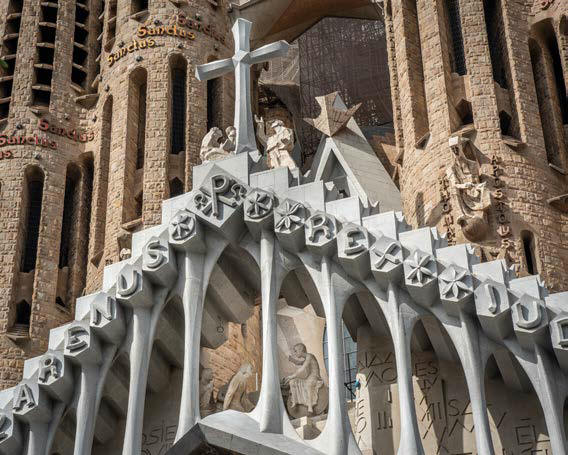
The basilica is intended as a summary in stone of the Christian faith and particularly the teachings of the Roman Catholic Church. The architecture is loaded with Christian symbolism. Themes throughout the decoration include words from the liturgy. The steeples are decorated with words such as "Hosanna", "Excelsis", and "Sanctus"; the great doors of the Passion façade reproduce excerpts of the Passion of Jesus from the New Testament in various languages, mainly Catalan; and the Glory façade is to be decorated with the words from the Apostles' Creed, while its main door reproduce the entire Lord's Prayer in Catalan, surrounded by multiple variations of "Give us this day our daily bread" in other languages. The three entrances symbolize the three virtues: Faith, Hope and Love. Each of them is also dedicated to a part of Christ's life. The Nativity Façade is dedicated to his birth; it also has a cypress tree which symbolizes the tree of life. The Glory Façade is dedicated to his glory period. The Passion Façade is symbolic of his suffering. The apse steeple bears Latin text of Hail Mary. The facades represent the three seminal moments of the life of Jesus Christ, the Son of God: his birth; his passion, death and resurrection; and his glory, present and future. We approached the cathedral from the east, viewing the Nativity Facade first. The audio tour begins by a small model of the basilica. Unfortunately, between the crows and bright sun, it was impossible to get a good picture of the model.
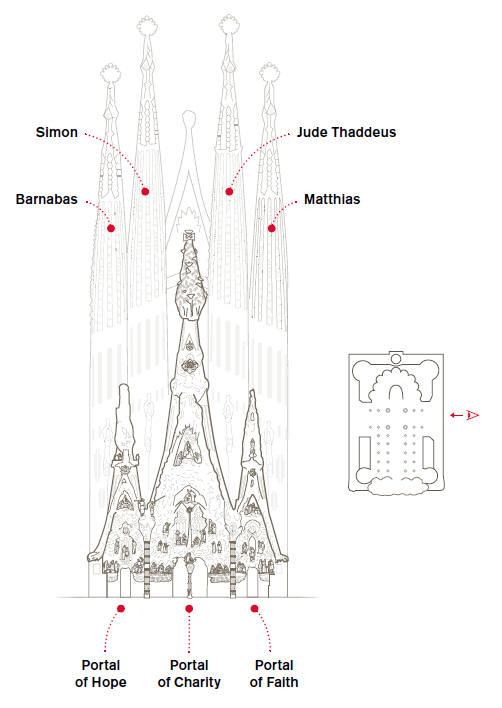
The Nativity Facade is dedicated to the birth of Jesus and is decorated with scenes reminiscent of elements of life. Characteristic of Gaudí's naturalistic style, the sculptures are ornately arranged and decorated with scenes and images from nature, each a symbol in its own manner. The façade faces the rising sun to the northeast, a symbol for the birth of Christ. It is divided into three porticos, each of which represents a theological virtue (Hope, Faith and Charity). The Tree of Life rises above the door of Jesus in the portico of Charity. Four steeples complete the façade and are each dedicated to an apostle (Matthias, Barnabas, Jude the Apostle, and Simon the Zealot). Gaudí chose this façade to embody the structure and decoration of the whole church. He was well aware that he would not finish the church and that he would need to set an artistic and architectural example for others to follow. He also chose for this façade to be the first on which to begin construction and for it to be, in his opinion, the most attractive and accessible to the public. He believed that if he had begun construction with the Passion Façade, one that would be hard and bare (as if made of bones), before the Nativity Façade, people would have withdrawn at the sight of it. Some of the statues were destroyed in 1936 during the Spanish Civil War, and subsequently were reconstructed by the Japanese artist Etsuro Sotoo. This facade is a celebration of the joy of life and the splendor of nature. This is why it is full of representations of animals (scallops, hens, various birds, ducks, eagles, etc.) and plants (roses, almond trees, cherry trees, lilies, passion flowers, etc.) celebrating and praising the birth of Jesus. To make the figures on this façade as life-like as possible, the sculptures were molded from real human and animal models. Once the plaster model had been taken, Gaudí put it on the façade to see how it looked and if he was happy with the results, the final version in stone was made. The side naves are topped with six triangular pediments on each façade (east and west) with various points to let light in. Each pediment has a basket of fruit in ceramic trencadís mosaic, by Etsuro Sotoo, following Gaudí’s models. The twelve baskets, which contain twelve types of fruit laid out according to the time of year (loquats, cherries, plums, peaches, pears, apples, almonds, figs, persimmons, chestnuts, oranges and pomegranates), take us back to New Jerusalem, where the tree of life produced a crop for each month of the year. They represent the fruits of the Holy Spirit, the good deeds carried out with this inspiration. The facades of the central nave are also topped by trencadís mosaic by Sotoo, but the images represent white and red grapes, on which rest a chalice and shafts of wheat with a host on top, as symbols of the Eucharist (of its two elements: the bread and the wine).
Here is the depiction of the Cypress-Tree of Life along with several of the images of fruit.
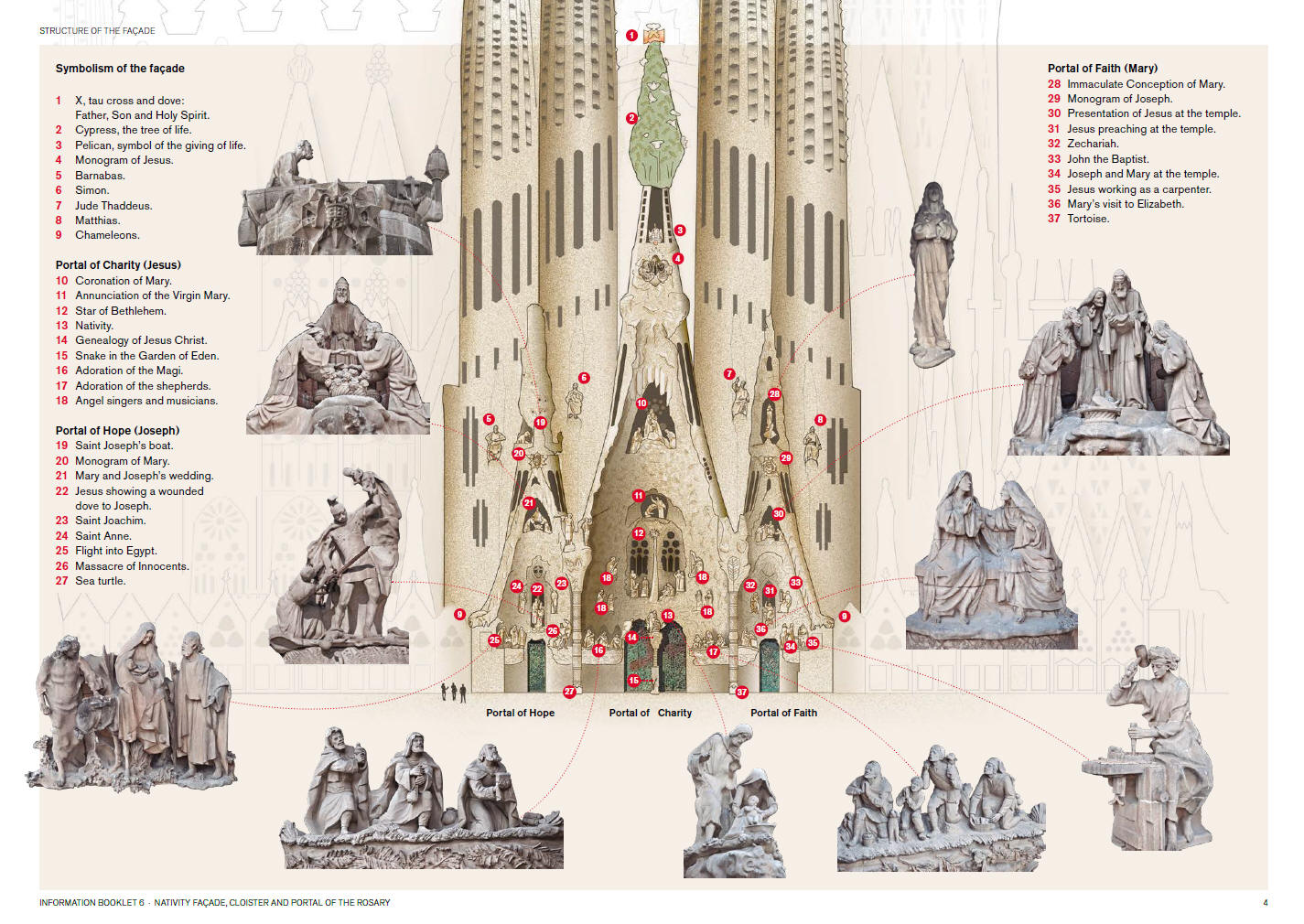
The central Portal of Charity is the largest of the three portals and represents Jesus. At its top, is a depiction of the Coronation of Mary. The lower scene is topped by the Annunciation of the Virgin Mary just over the Star of Bethlehem. At the bottom of the scene is the Nativity. To the left and right of the doors are the Adoration of the Magi and the Adoration of the Shepherds. At the base of the central column between the doors is the Snake in the Garden of Eden. Also above the doors is the Genealogy of Jesus Christ. Surrounding al of this are Angel singers and musicians.
From the top down, here are the Coronation of Mary and the Star of Bethlehem ... ... and the Nativity between the Adoration of the Magi and the Adoration of the Shepherds.
The Portal of Faith on the right is smaller and represents Mary. It has a statue of the Immaculate Conception of Mary at the top and the Presentation of Jesus at the Temple in the center. The bottom section is built around a statue of Jesus Preaching at the Temple with images of Joseph and Mary at the Temple, Jesus Working as a Carpenter, and Mary’s Visit to Elizabeth below, with statues of Zechariah and John the Baptist looking on.
Here is the Presentation of Jesus at the Temple, near the top in the right Portal of Faith.
Here is Jesus Preaching at the Temple along with Jesus Working as a Carpenter and Mary’s Visit to Elizabeth.
To the left is the Portal of Hope, dedicated to Joseph. At the top is Saint Joseph’s boat, above a scene of Mary and Joseph’s Wedding. The lower area is centered on a depiction of Jesus Showing a Wounded Dove to Joseph. To the left and right of the doors are images of the Flight into Egypt and the Massacre of Innocents. Surrounding all of this are Saint Joachim and Saint Anne. Here is Mary and Joseph’s Wedding followed by Jesus Showing a Wounded Dove to Joseph ...
... the Flight into Egypt and the Massacre of Innocents
The three porticos are separated by two large columns, and at the base of each lies a turtle or a tortoise (one to represent the land and the other the sea; each are symbols of time as something set in stone and unchangeable). The one on the left-hand side is a sea turtle, closest to the sea, and this column bears the name Joseph. This is because the portal on the left, the portal of Hope, is dedicated to Joseph. In contrast to the figures of turtles and their symbolism, two chameleons can be found at either side of the façade, and are symbolic of change.
Before entering, the tour led you into the cloister, which is inside of the right Portal of Faith, then to the right. The interior portal to enter, the Portal of the Rosary, is the only portal Gaudi saw finished in his lifetime, providing an example for all the others. The central scene depicted in the portal shows the Virgin with Saint Dominic and Saint Catherine, who spread the word about the prayers of the rosary to Europe.
Gaudi did not leave detailed designs for the doors, so the foundation held an invitation-only contest to find the best solution for these doors. Etsuro Sotoo won the contest with a proposal that aims to stay true to Gaudí’s work method, inspired by nature. Sotoo decided to use plant and animal motifs on the four doors on these three portals.
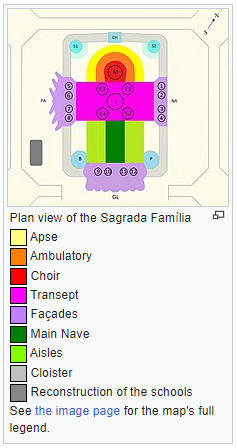
Inside, the church plan is that of a Latin cross with five aisles, with three isles in the transept. The central nave vaults reach forty-five meters (148 feet) high. The central vault above the altar reaches sixty meters (200 ft). The apse is capped by a hyperboloid vault reaching seventy-five meters (246 ft). Gaudí intended that a visitor standing at the main entrance be able to see the vaults of the nave, crossing, and apse; thus the graduated increase in vault loft. The central apse is formed by the columns supporting the four Evangelist spires and the Jesus Spire. The columns of the interior are a unique Gaudí design, branching like trees to support their load. Their ever-changing surfaces are the result of the intersection of various geometric forms. The simplest example is that of a square base evolving into an octagon as the column rises, then a sixteen-sided form, and eventually to a circle. This effect is the result of a three-dimensional intersection of helicoidal columns (for example a square cross-section column twisting clockwise and a similar one twisting counter-clockwise).
Gaudi designed the interior to be magnificent without any complimentary elements like icons and paintings, using only architecture and light to convey the holiness of the sacred space. He wanted the inside to be a space of reflection and prayer, and this is why we find no large altarpieces but instead just a few sculptures with pronounced symbolic importance. Height and depth are very proportional. There are four elevated choir spaces above the apse. There are only four sculptures inside the Temple, and they mark the four ends of the cross in the Basilica’s floor plan. Thus, by walking along the transept from the Nativity door towards the Passion door, you can see the three figures which represent the three members of the Holy Family. In the loge on the Nativity side is Saint Joseph, relating him with Jesus’s childhood and adolescence. Across from it in the loge on the Passion side is the Virgin Mary, a place which associates her with the painful death and resurrection of her son, which she witnessed. The last figure, Jesus on the cross above the altar, is right between the other two sculptures.
The images below begin with a view looking from the east transept across the nave and toward the west transept, with a view of the statue of the Virgin Mary.
These are looking back at the east transept, with the statue of Saint Joseph.
Here is the ceiling and structure at the center of the apse (intersection of the nave and transept)
Here is the view toward the alter and the apse. At the top of the space is a mosaic of gold Venetian glass representing the Holy Trinity (the Father, the Son and the Holy Spirit).
Here are some of the apse chapels, which are located behind and around the altar.
Here is the view toward the south end of the nave and the Glory entrance, with its statue of St George.
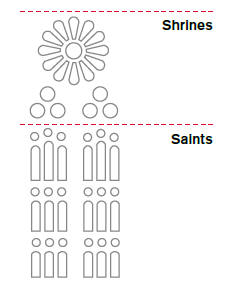
The light from the stained-glass windows permeates the interior. The windows at the Basilica feature stained-glass windows that Joan Vila- Grau has been making since 1999, under the framework of a program carried out according to Gaudí’s guidelines. All the stained-glass windows in the apse have been installed: the ones on the Passion transept, dedicated to water, the resurrection and light; and the ones on the Nativity façade, dedicated to poverty, the Nativity and life. The stained-glass windows have also been installed in the naves: the lower ones dedicated to the saints and shrines (the latter in the rose windows) of Catalonia and Spain, and the upper ones, allusions to Jesus’ parables. Gaudí wanted the light inside the Temple to be harmonious, to highlight the artistry of the nave and, above all, to inspire introspection and spiritual contemplation. So, he said the stained glass windows on the side naves should be darkest at the bottom and more transparent as they moved up, with transparent glass in the windows at the very top of the central nave, instructions that Vila-Grau followed by using different textures of glass. It must be noted that the stained-glass windows on the Nativity façade have bluer tones, corresponding to the morning light, while on the opposite side, facing the west, they are more orangey, like the evening light, while providing a more somber and solemn feel for the subject and providing a courser and harsher feel inside. At midday, the sun coming over the southern, Glory Facade will shine on the narthex and main entrance to the Basilica.
Under the altar is the crypt. This was mostly completed under the original architect, which also helped define the outline of the apse. Gaudi provided portals to view the space and integrated it into the overall building.
At the south end of the nave, we could see the doors intended for the unfinished Glory Facade. In September 2008, the doors of the Glory façade, by Subirachs, were installed. Inscribed with the words of the Our Father, these central doors are inscribed with the words "Give us our daily bread" in fifty different languages. The handles of the door are the letters "A" and "G" that form the initials of Antoni Gaudí within the phrase "lead us not into temptation".
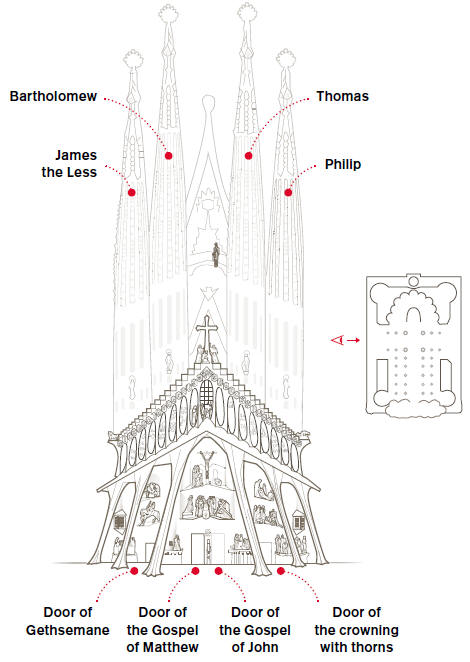
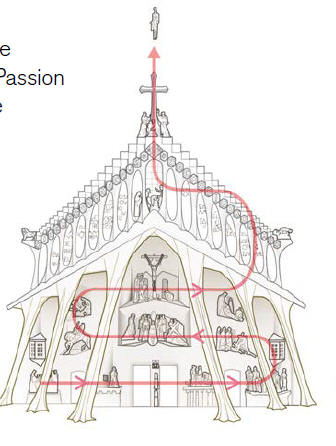
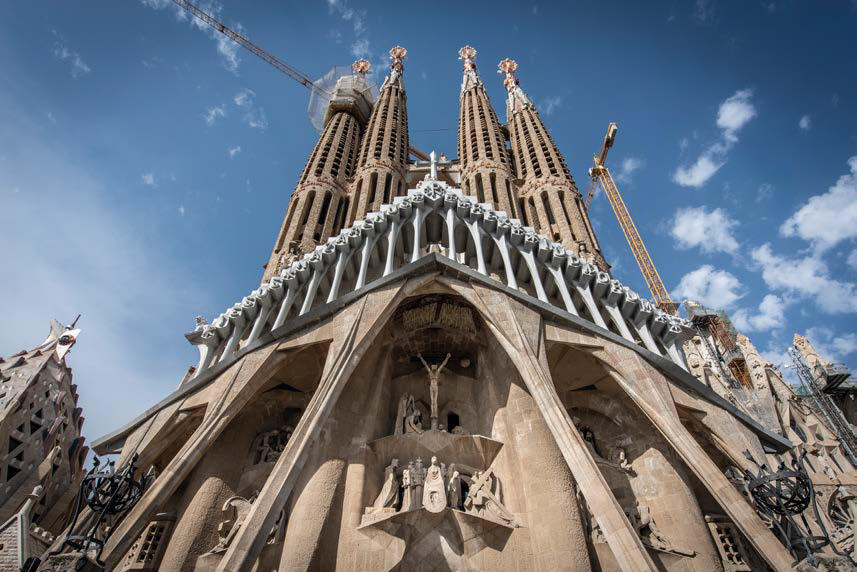
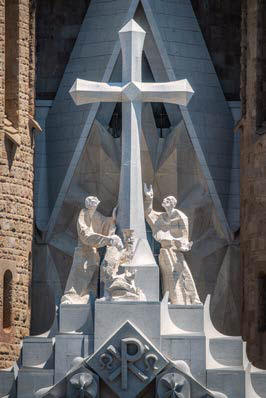
We exited through the western Passion Facade. In contrast to the highly decorated Nativity Façade, the Passion Façade is austere, plain and simple, with ample bare stone, and is carved with harsh straight lines to resemble the bones of a skeleton. It is especially striking for its spare, gaunt, tormented characters, including emaciated figures of Christ being scourged at the pillar; and Christ on the Cross. Dedicated to the Passion of Christ, the suffering of Jesus during his crucifixion, the façade was intended to portray the sins of man. Construction began in 1954, following the drawings and instructions left by Gaudí for future architects and sculptors. The steeples were completed in 1976. In 1987 a team of sculptors, headed by Josep Maria Subirachs (a Spanish sculptor who controversially did not make any concessions to the style of the Antoni Gaudí) began work sculpting the various scenes and details of the façade. They aimed to give a rigid, angular form to provoke a dramatic effect. Gaudí intended for this façade to strike fear into the onlooker. He wanted to "break" arcs and "cut" columns, and to use the effect of chiaroscuro (dark angular shadows contrasted by harsh rigid light) to further show the severity and brutality of Christ's sacrifice. The figures, in travertine and sandstone from La Floresta, feature hard, severe lines, at times Brutalist and at others soft, expressing the course, even gloomy effect that Gaudí wanted to represent the pain of the Passion and death. Above the group of the Crucifixion, like a baldachin, Subirachs placed bronze plaques to represent the veil at the temple of Jerusalem that, according to the Gospels, was torn in two when Jesus died. This eliminated the separation between the holy place and the rest of the tabernacle, opening this section up to everyone. Gaudí left a drawing that describes this façade in great detail, explicitly indicating that it should be “harsh and cruel, as if made of bones” and even noted that some may find it “too extravagant”. The architect wanted it to inspire “fear”, and to do so he said he would use plenty of “chiaroscuro, recesses and protrusions, all of which gives it a gloomy effect.” He also said: “What’s more, I’m willing to sacrifice the building itself, to break arches, cut down columns, in order to give people an idea of how bloody the sacrifice is.” Facing the setting sun, indicative and symbolic of the death of Christ, the Passion Façade is supported by six large and inclined columns, designed to resemble strained muscles. Above there is a pyramidal pediment, made up of eighteen bone-shaped columns, which culminate in a large cross with a crown of thorns. Each of the four steeples is dedicated to an apostle (James, Thomas, Philip, and Bartholomew) and, like the Nativity Façade, there are three porticos, each representing the theological virtues, though in a much different light. In a theological sense, it is considered the façade of redemption. The Nativity façade, on the other end of the transept, represents incarnation, theologically. The scenes sculpted into the façade may be divided into three levels, which ascend in an S form and reproduce the stations of the cross (Via Crucis of Christ). The lowest level depicts scenes from Jesus' last night before the crucifixion, including the Last Supper, Kiss of Judas, Ecce homo (Pontius Pilate presentation of a scourged and flagellated Jesus, bound and crowned with thorns, to a hostile crowd), and the Sanhedrin trial of Jesus. The middle level portrays the Calvary, or Golgotha, of Christ, and includes The Three Marys, Saint Longinus, Saint Veronica, and a hollow-face illusion of Christ on the Veil of Veronica. In the third and final level the Death, Burial and the Resurrection of Christ can be seen. A bronze figure situated on a bridge creating a link between the steeples of Saint Bartholomew and Saint Thomas represents the Ascension of Jesus.
Here is the exit portal with a highly stylized Alpha and Omega over the opening and the depiction of the flagellation of Jesus in front, ensuring people exiting are immediately confronted with the stark reality and pain of the crucifixion. The three portals on the façade that lead into the Basilica have double-leaf bronze doors, also by Subirachs. The central doorway has two doors, with ten thousand letters in relief spelling out fragments of the Passion narrative from the Gospel of Matthew, on the left door, and from the Gospel of John, on the right door. Some bits of bronze in the narration have been polished to highlight particularly meaningful words or phrases, like Pontius Pilate’s question: “And what is the truth?”. The north door, on the left-hand side, represents the garden of Gethsemane with Jesus praying while the apostles sleep. The south door, on the right-hand side, is dedicated to the crown of thorns and when Jesus was taken before Pilate and Herod.
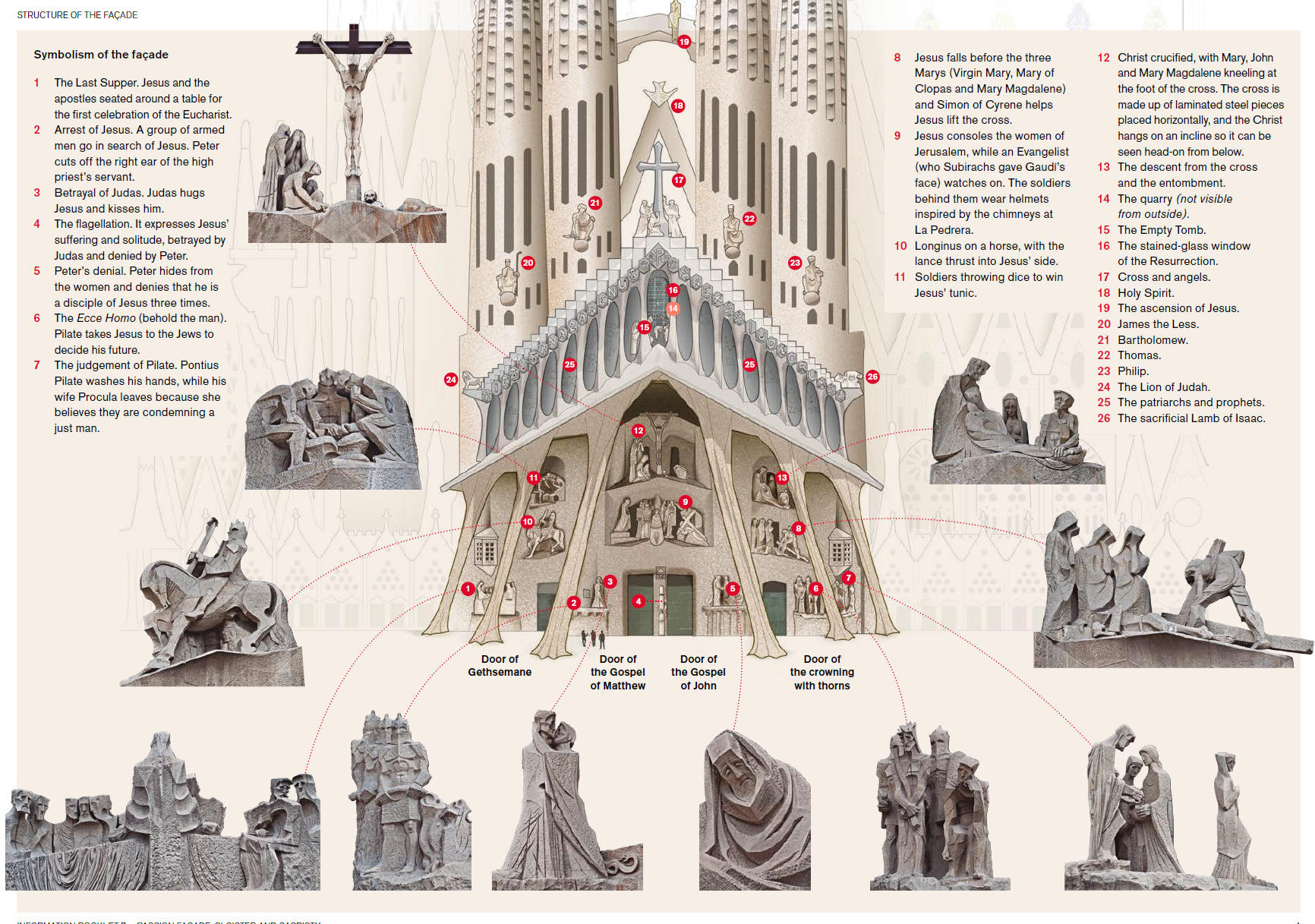
The depiction of the passion story begins at the lower left and follows and S-pattern around the Passion Facade. It begins with the depiction of The Last Supper with Jesus and the apostles seated around a table for the first celebration of the Eucharist.
Next is The Arrest of Jesus where a group of armed men go in search of Jesus. Peter cuts off the right ear of the high priest’s servant. The is followed by The Betrayal of Judas where Judas hugs Jesus and kisses him. This section of the façade contains a 4x4 magic square where all the rows and columns add to 33, which is the age Jesus is traditionally believed to have been executed and is also symbolic of the number 3 in the Christian world, as the symbol of the trinity.
Fourth is the The flagellation. It expresses Jesus’ suffering and solitude, betrayed by Judas and denied by Peter. Fifth is Peter’s denial. Peter hides from the women and denies that he is a disciple of Jesus three times.
Sixth is The Ecce Homo (behold the man). Pilate takes Jesus to the Jews to decide his future. Here Jesus is depicted with a crown of throrns.
Seventh is The judgment of Pilate. Pontius Pilate washes his hands, while his wife Procula leaves because she believes they are condemning a just man.
Eighth is Jesus falls before the three Marys (Virgin Mary, Mary of Clopas and Mary Magdalene) and Simon of Cyrene helps Jesus lift the cross.
Ninth is Jesus consoles the women of Jerusalem, while an Evangelist (who Subirachs gave Gaudí’s face) watches on. The soldiers behind them wear helmets inspired by the chimneys at La Pedrera. Tenth is Longinus on a horse, with the lance thrust into Jesus’ side. Eleventh is Soldiers throwing dice to win Jesus’ tunic.
Twelfth is Christ crucified, with Mary, John and Mary Magdalene kneeling at the foot of the cross. The cross is made up of laminated steel pieces placed horizontally, and the Christ hangs on an incline so it can be seen head-on from below. Thirteenth is The descent from the cross and the entombment.
The later stages including the The Empty Tomb and The ascension of Jesus were not clearly visible without getting farther away as they were higher. Unfortunately, we never got a good picture of them or the full Passion Facade. So, here are a couple images from the booklet or web.
Construction on the unfinished Glory Facade began in 2002. It will be the largest and most monumental of the three facades and will represent one's ascension to God. It will also depict various scenes such as Hell, Purgatory, and will include elements such as the seven deadly sins and the seven heavenly virtues. The Glory Facade is dedicated to the Celestial Glory of Jesus and represents the road to God: Death, Final Judgment, and Glory, while Hell is left for those who deviate from God's will. To reach the Glory Portico the large staircase will lead over the underground passage with the decoration representing Hell and vice. It will be decorated with demons, idols, false gods, heresy and schisms, etc. Purgatory and death will also be depicted, the latter using tombs along the ground. The portico will have seven large columns dedicated to gifts of the Holy Spirit (wisdom, understanding, counsel, fortitude, knowledge, piety and fear of the Lord). At the base of the columns there will be representations of the seven deadly sins (greed, lust, pride, gluttony, sloth, wrath, envy), and at the top, the seven heavenly virtues (kindness, diligence, patience, charity, temperance, humility, chastity). This facade will have five doors corresponding to the five naves of the temple, with the central one having a triple entrance, that will give the Glory Façade a total seven doors representing the sacraments: Baptism, Confirmation, Eucharist, Penance, Holy orders, Marriage, and Anointing of the Sick. On top of the facade, in huge letters, will be "credo in unum deum" (I believe in one God), the Father and creator of the universe and humanity; "in jesum christum" (in one Lord, Jesus Christ), the Son of God, made man like us, who dying gave his life for the world, was resurrected and lives forever; "in spritum sanctum" (in the Holy Spirit), who brings to life the love of the Father and the Son and fills the Earth. These words summarize the Christian and Catholic faith. There is no facade at the other, north end of the cross floor-plan. Instead there is a semicircular apse which encloses the Basilica. The apse lantern depicts three angels symbolizing the Trinity. However, the Holy Spirit is also represented in the apse in the huge candelabrum hanging from the lantern, which will have seven large lamps, representing the seven gifts of the Holy Spirit to humanity. From the candelabrum hangs an image of Christ on the cross. So, when visitors standing at the back of the Basilica look toward the apse and the altar, they see representations of all three divine individuals in the Trinity: the Father, the Son and the Holy Spirit. The Apse Facade shows the transition from the neo-Gothic architecture of Francisco de Paula del Villar to Gaudí’s own style, as seen in other parts of the Sagrada Família. Noteworthy on this façade are the six buttresses that separate the seven polygonal chapels and the pointed pinnacles that are nearly 50 meters tall, crowned with plant motifs, including the wild plants that grew in the fields that once surrounded the spot where the Sagrada Família is being built, and buds on the pinnacles of the apse stairs. We had time for a quick run through the museum, then headed out to meet up with the group for lunch. The museum had several discussions on Gaudi, the history of the basilica, and information on the evolution of the design and structural components. It also had several of Gaudi's models.
|
|
|



.JPG)
.JPG)
.JPG)
.JPG)
.JPG)
.JPG)
.JPG)
.JPG)
.JPG)
.JPG)
.JPG)
.JPG)
.JPG)
.JPG)
.JPG)
.JPG)
.JPG)
.JPG)
.JPG)
.JPG)
.JPG)
.JPG)
.JPG)
.JPG)
.JPG)
.JPG)
.JPG)
.JPG)
.JPG)
.JPG)
.JPG)
.JPG)
.JPG)
.JPG)
.JPG)
.JPG)
.JPG)
.JPG)
.JPG)
.JPG)
.JPG)
.JPG)
.JPG)
.JPG)
.JPG)
.JPG)
.JPG)
.JPG)
.JPG)
.JPG)
.JPG)
.JPG)
.JPG)
.JPG)
.JPG)
.JPG)
.JPG)
.JPG)
.JPG)
.JPG)
.JPG)
.JPG)
.JPG)
.JPG)
.JPG)
.JPG)
.JPG)
.JPG)
.JPG)
.JPG)
.JPG)
.JPG)
.JPG)
.JPG)
.JPG)
.JPG)
.JPG)
.JPG)
.JPG)
.JPG)
.JPG)
.JPG)
.JPG)
.JPG)
.JPG)
.JPG)
.JPG)
.JPG)
.JPG)
.JPG)
.JPG)
.JPG)
.JPG)
.JPG)
.JPG)
.JPG)
.JPG)
.JPG)
.JPG)
.JPG)
.JPG)
.JPG)
.JPG)
.JPG)
.JPG)
.JPG)
.JPG)
.JPG)
.JPG)
.JPG)
.JPG)
.JPG)
.JPG)
.JPG)
.JPG)
.JPG)
.JPG)
.JPG)
.JPG)
.JPG)
.JPG)
.JPG)
.JPG)
.JPG)
.JPG)
.JPG)
.JPG)
.JPG)
.JPG)
.JPG)
.JPG)
.JPG)
.JPG)
.JPG)
.JPG)
.JPG)
.JPG)
.JPG)
.JPG)
.JPG)
.JPG)
.JPG)
.JPG)
.JPG)
.JPG)
.JPG)
.JPG)
.JPG)
.JPG)
.JPG)
.JPG)
.JPG)
.JPG)
.JPG)
.JPG)
.JPG)
.JPG)
.JPG)
.JPG)
.JPG)
.JPG)
.JPG)
.JPG)
.JPG)
.JPG)
.JPG)
.JPG)
.JPG)
.JPG)
.JPG)
.JPG)
.JPG)
.JPG)
.JPG)
.JPG)
.JPG)
.JPG)
.JPG)
.JPG)
.JPG)
.JPG)
.JPG)
.JPG)
.JPG)
.JPG)
.JPG)
.JPG)
.JPG)
.JPG)
.JPG)
.JPG)
.JPG)
.JPG)
.JPG)
.JPG)
.JPG)
.JPG)
.JPG)
.JPG)
.JPG)
.JPG)
.JPG)
.JPG)
.JPG)
.JPG)
.JPG)
.JPG)
.JPG)
.JPG)
.JPG)
.JPG)
.JPG)
.JPG)
.JPG)
.JPG)
.JPG)
.JPG)
.JPG)
.JPG)
.JPG)
.JPG)
.JPG)
.JPG)
.JPG)
.JPG)
.JPG)
.JPG)
.JPG)
.JPG)
.JPG)
.JPG)
.JPG)
.JPG)
.JPG)
.JPG)
.JPG)
.JPG)
.JPG)
.JPG)
.JPG)
.JPG)

.JPG)
.JPG)
.JPG)
.JPG)
.JPG)
.JPG)
.JPG)
.JPG)
.JPG)
.JPG)
.JPG)
.JPG)
.JPG)
.JPG)
.JPG)
.JPG)
.JPG)
.JPG)
.JPG)
.JPG)
.JPG)
.JPG)
.JPG)
.JPG)
.JPG)
.JPG)
.JPG)
.JPG)
.JPG)
.JPG)
.JPG)
.JPG)
.JPG)
.JPG)
.JPG)
.JPG)
.JPG)
.JPG)
.JPG)
.JPG)
.JPG)
.JPG)
.JPG)
.JPG)
.JPG)
.JPG)
.JPG)
.JPG)
.JPG)
.JPG)
.JPG)
.JPG)
.JPG)
.JPG)
.JPG)
.JPG)
.JPG)
.JPG)
.JPG)
.JPG)
.JPG)
.JPG)
.JPG)
.PNG)
.JPG)
.JPG)
.JPG)
.JPG)
.JPG)
.JPG)
.JPG)
.JPG)
.JPG)
.JPG)
.JPG)
.JPG)
.JPG)
.JPG)
.JPG)
.JPG)
.JPG)
.JPG)
.JPG)
.JPG)
.JPG)
.JPG)
.JPG)
.JPG)
.JPG)
.JPG)
.JPG)
.JPG)
.JPG)
.JPG)
.JPG)
.JPG)
.JPG)
.JPG)
.JPG)
.JPG)
.JPG)
.JPG)
.JPG)
.JPG)
.JPG)
.JPG)
.JPG)
.JPG)
.JPG)
.JPG)
.JPG)
.JPG)
.JPG)
.JPG)
.JPG)
.JPG)
.JPG)
.JPG)
.JPG)
.JPG)
.JPG)
.JPG)
.JPG)
.JPG)
.JPG)
.JPG)
.JPG)