


|
|
|
Use these navigation links to move between the Year 2023 pages. Specific pages can be accessed at the bottom of this page
September 2023 (Part 13) Maine Trip - Saturday, Sep 30: Whale Watching and the Sandbar Path So excited the weather on Saturday was good to allow our re-booked whale watching tour to happen. Woke up to a much nicer day. We decided to hit Jeanine's for breakfast again, with everyone ordering the same thing again, although the boys opted for two pancakes instead of three.
Enjoyed some of the sites in the harbor and along the shore as we departed. We saw a couple harbor seals and harbor porpoises, but all of them ducked under so quickly that it was impossible to get a picture of them.
Our route took us past the Egg Rock Lighthouse which is out in Frenchman Bay and the Mount Desert Narrows. There were also a lot of cormorants and other birds on the island, but no seals as it was closer to high tide.
Here it is on the way back in, taken from a bit farther away.
Some interesting shoreline on the north side of the bay along the Schoodic Peninsula, which is also part of Acadia NP.
We could also see the Mark Island Lighthouse along the northern shore.
Some images of the different Porcupine Islands near Bar Harbor as we came back into port, which includes Bald, Sheep, Burnt, and Long Porcupine Island.
We could also see the Petit Manan Lighthouse off in the distance to the north as we headed out. Harder to see on the way back in, as it was hazier.
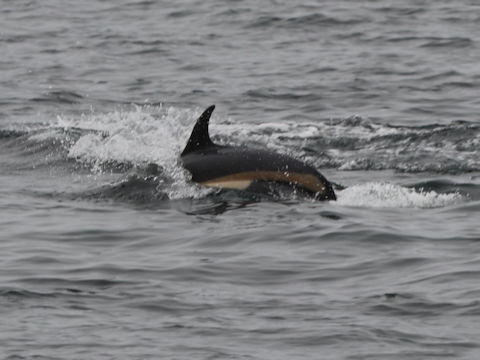
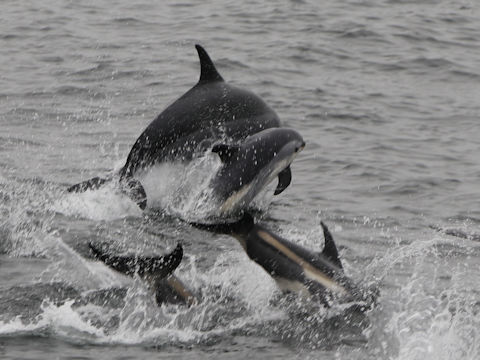
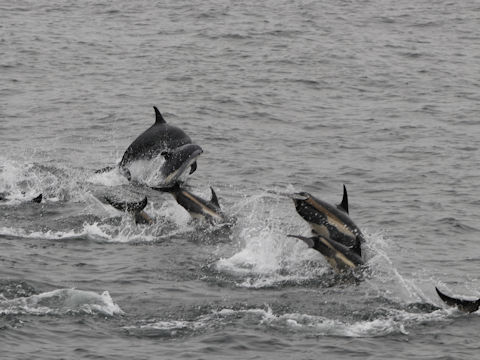
We saw a lot of sealife, and consequently took a lot of pictures. Here are some of the better ones.
We could see something moving in the water ahead of us. It turned out to be a large pod of over 50 Atlantic white-sided dolphin.
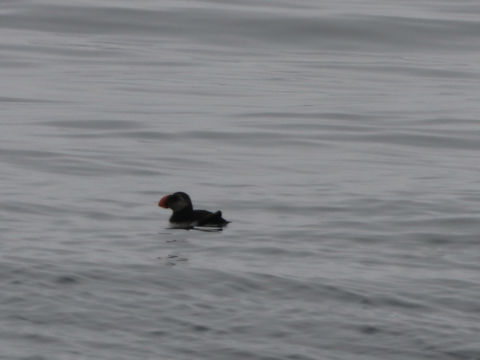
Saw a couple fun birds. There were several puffins on the water. According to the naturalist they have grey beaks most of the year and only get their bright colored beaks when it's mating season.
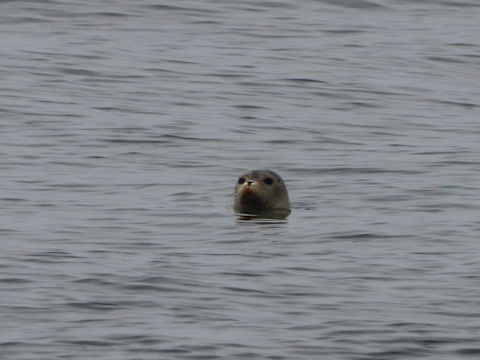
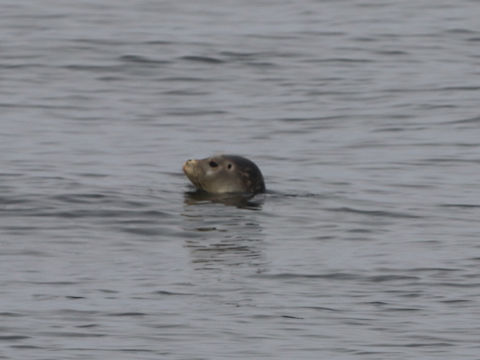
Here is a harbor seal.
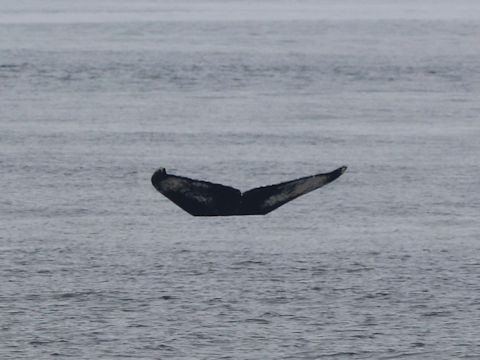
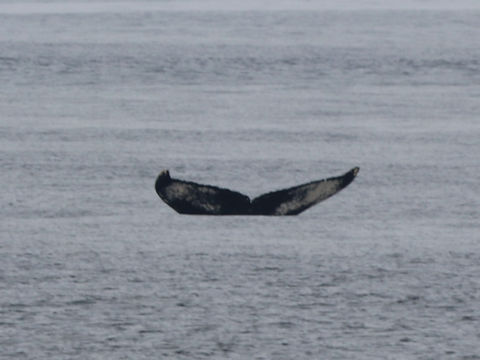
We essentially headed northwest for almost two hours, crossing into Canada while in the Gulf of Maine. We think we headed to Browns Bank, which has a north and south section. This is essentially a shallower spot, which causes the surrounding currents to rise, bringing food up higher and easier to access. Finally a whale sighting, far in front of us.
Somehow from that far off view of the tail as it dived, the naturalist and her assistant determine this whale is Ditto, a 40-ish old male. She explained it is incredibly difficult to tell sex without seeing the whales belly, but this whale has never been seen with a calf, so presumably is male. It will be 15-25 minutes until he comes back to the surface. Some more puffins.
and other birds
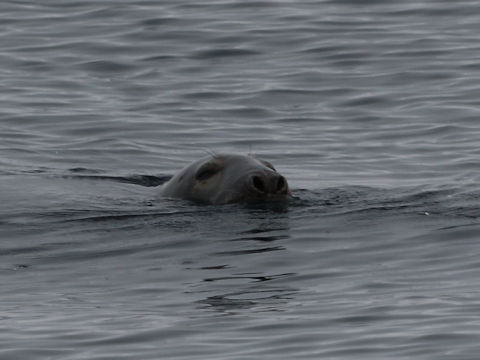
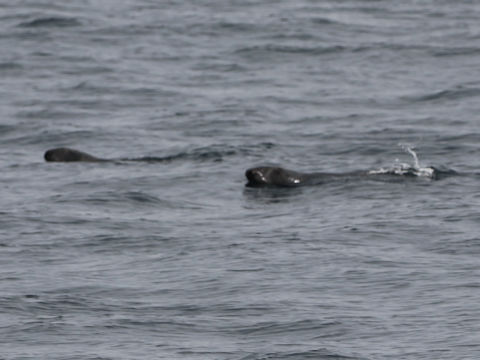
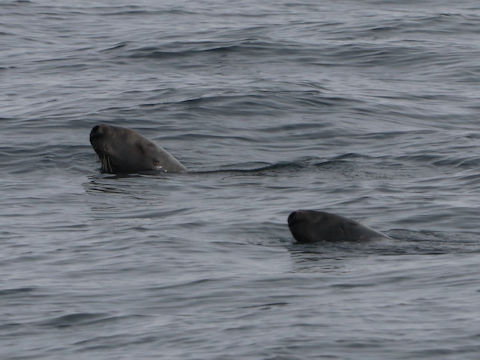
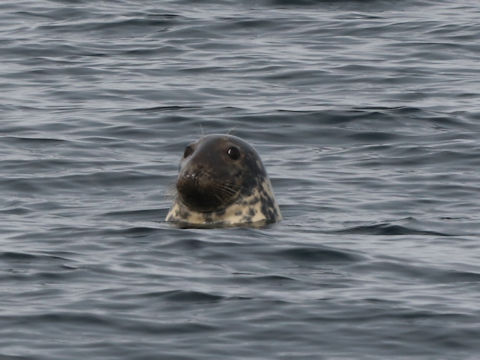
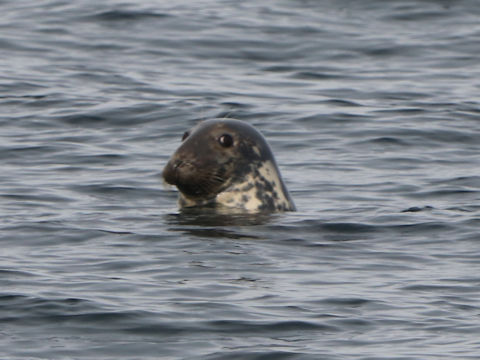
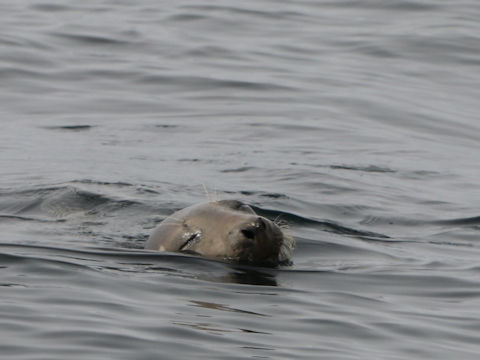
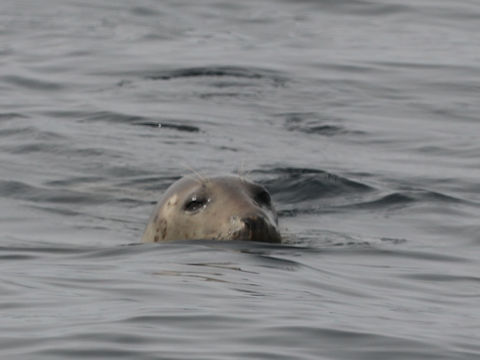
and a couple grey seals, with one staring back at us.
Whale Ho. Ditto is back, announcing his return with a big blow of air as he breaks the surface. He went under and surfaced quickly a couple times, then dove deep again flashing his tail above the surface as he dove.
Another couple grey seals.
Dittos back, this time moving right to left in front of us.
With him down again, another 20+ minute guessing when and where he'll resurface, while spotting birds and seals.
There he is again.
Another pass, this time with him moving right to left in front of us.
Looks like a hawk got blown pretty far out to sea.
Another grey seal
One more sighting.
One more ...
Time for one last visit before we need to move on as apparently there is about an hour limit on how long the boat can shadow a whale.
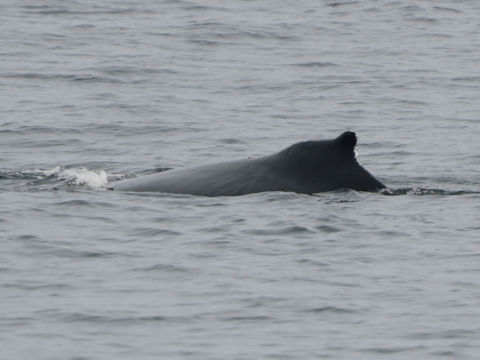
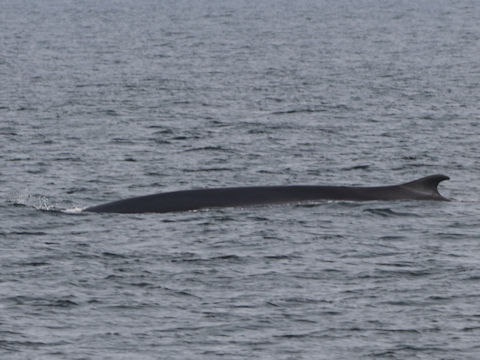
We moved on toward the northern banks, hoping to spot more whales. We found a pair of fin (or finback) whales, which are second-largest whale species on earth (blue whales are the largest). They have very streamlined bodies and are very fast swimmers. They have a tall, hooked dorsal fin, about two-thirds of the way back on the body, that rises at a shallow angle from the back and which gives them their name. With their size and speed, they don't flash their tails above water when they dive. Consequently, it is very difficult to identify them as individuals. If possieble, they can be identified by the colorings and marks on their head and underside. Fin whales have distinctive coloration—black or dark brownish-gray on the back and sides and white on the underside. Head coloring is asymmetrical—dark on the left side of the lower jaw, white on the right-side lower jaw, and the reverse on the tongue. Many fin whales have several light-gray, V-shaped “chevrons” behind their heads; on many of them, the underside of the tail flukes is white with a gray border.
On the way walking back up to the hotel, we took a detour to checkout the sandbar land bridge to Bar Island. This path is accessible a bit before and after low tide, allowing you to walk to the nearby Bar Island. We were surprised at how wide the sandbar was, and how solid it was to walk on. We only went out about halfway as we had to head out to Portland to fly home early, early the next day (really early ... like alarm at 3 AM for a 5:30 flight early).
Here are the images the naturalist took on the boat.
While we had a great trip, it looks like they saw a lot more sealife on the prior two trips, finding a small group of hunchbacks each day. Two days before (9-29) they saw 4 humpback whales! The first two adults were resting at the surface. In the distance, they saw lots of splashing, so they let the sleepy whales rest and went to check out the splashing. There, they saw the humpback whale named Bungee, along with her new calf! The calf put on an amazing show.
The day before that (9-27), they found a small group of hunchbacks.
|
|
|




.PNG)
.JPG)
.JPG)
.JPG)
.JPG)
.JPG)
.JPG)
.JPG)
.JPG)
.JPG)
.JPG)
.JPG)
.JPG)
.JPG)
.JPG)
.JPG)
.JPG)
.JPG)
.JPG)
.JPG)
.JPG)
.JPG)
.JPG)
.JPG)
.JPG)
.JPG)
.JPG)
.JPG)
.JPG)
.JPG)
.JPG)
.JPG)
.JPG)
.JPG)
.JPG)
.JPG)
.JPG)
.JPG)
.JPG)
.JPG)
.JPG)
.JPG)
.JPG)
.JPG)
.JPG)
.JPG)
.JPG)
.JPG)
.JPG)
.JPG)
.JPG)
.JPG)
.JPG)
.JPG)
.JPG)
.JPG)
.JPG)
.JPG)
.JPG)
.JPG)
.JPG)
.JPG)
.JPG)
.JPG)
.JPG)
.JPG)
.JPG)
.JPG)
.JPG)
.JPG)
.JPG)
.JPG)
.JPG)
.JPG)
.JPG)
.JPG)
.JPG)
.JPG)
.JPG)
.JPG)
.JPG)
.JPG)
.JPG)
.JPG)
.JPG)
.JPG)
.JPG)
.JPG)
.JPG)
.JPG)
.JPG)
.JPG)
.JPG)
.JPG)
.JPG)
.JPG)
.JPG)
.JPG)
.JPG)
.JPG)
.JPG)
.JPG)
.JPG)
.JPG)
.JPG)
.JPG)
.JPG)
.JPG)
.JPG)
.JPG)
.JPG)
.JPG)
.JPG)
.JPG)
.JPG)
.JPG)
.JPG)
.JPG)
.JPG)
.JPG)
.JPG)
.JPG)
.JPG)
.JPG)
.JPG)
.JPG)
.JPG)
.JPG)
.JPG)
.JPG)
.JPG)
.JPG)
.JPG)
.JPG)
.JPG)
.JPG)
.JPG)
.JPG)
.JPG)
.JPG)
.JPG)
.JPG)
.JPG)
.JPG)
.JPG)
.JPG)
.JPG)
.JPG)
.JPG)
.JPG)
.JPG)
.JPG)
.JPG)
.JPG)
.JPG)
.JPG)
.JPG)
.JPG)
.JPG)
.JPG)
.JPG)
.JPG)
.JPG)
.JPG)
.JPG)
.JPG)
.JPG)
.JPG)
.JPG)
.JPG)
.JPG)
.JPG)
.JPG)
.JPG)
.JPG)
.JPG)
.JPG)
.JPG)
.JPG)
.JPG)
.JPG)
.JPG)
.JPG)
.JPG)
.JPG)
.JPG)
.JPG)
.JPG)
.JPG)
.JPG)
.JPG)
.JPG)
.JPG)
.JPG)
.JPG)
.JPG)
.JPG)
.JPG)
.JPG)
.JPG)
.JPG)
.JPG)
.JPG)
.JPG)
.JPG)
.JPG)
.JPG)
.JPG)
.JPG)
.JPG)
.JPG)
.JPG)
.JPG)
.JPG)
.JPG)
.JPG)
.JPG)
.JPG)
.JPG)
.JPG)
.JPG)
.JPG)
.JPG)
.JPG)
.JPG)
.JPG)
.JPG)
.JPG)
.JPG)
.JPG)
.JPG)
.JPG)
.JPG)
.JPG)
.JPG)
.JPG)
.JPG)
.JPG)
.JPG)
.JPG)
.JPG)
.JPG)
.JPG)
.JPG)
.JPG)
.JPG)
.JPG)
.JPG)
.JPG)
.JPG)
.JPG)
.JPG)
.JPG)
.JPG)
.JPG)
.JPG)
.JPG)
.JPG)
.JPG)
.JPG)
.JPG)
.JPG)
.JPG)
.JPG)
.JPG)
.JPG)
.JPG)
.JPG)
.JPG)
.JPG)
.JPG)
.JPG)
.JPG)
.JPG)
.JPG)
.JPG)
.JPG)
.JPG)
.JPG)
.JPG)
.JPG)
.JPG)
.JPG)
.JPG)
.JPG)
.JPG)
.JPG)
.JPG)
.JPG)
.JPG)
.JPG)
.JPG)
.JPG)
.JPG)
.JPG)
.JPG)
.JPG)
.JPG)
.JPG)
.JPG)
.JPG)
.JPG)
.JPG)
.JPG)
.JPG)
.JPG)
.JPG)
.JPG)
.JPG)
.JPG)
.JPG)
.JPG)
.JPG)
.JPG)
.JPG)
.JPG)
.JPG)
.JPG)
.JPG)
.JPG)
.JPG)
.JPG)
.JPG)
.JPG)
.JPG)
.JPG)
.JPG)
.JPG)
.JPG)
.JPG)
.JPG)
.JPG)
.JPG)
.JPG)
.JPG)
.JPG)
.JPG)
.JPG)
.JPG)
.JPG)
.JPG)
.JPG)
.JPG)
.JPG)
.JPG)
.JPG)
.JPG)
.JPG)
.JPG)
.JPG)
.JPG)
.JPG)
.JPG)
.JPG)
.JPG)
.JPG)
.JPG)
.JPG)
.JPG)
.JPG)
.JPG)
.JPG)
.JPG)
.JPG)
.JPG)
.JPG)
.JPG)
.JPG)
.JPG)
.JPG)
.JPG)
.JPG)
.JPG)
.JPG)
.JPG)
.JPG)
.JPG)
.JPG)
.JPG)
.JPG)
.JPG)
.JPG)
.JPG)
.JPG)
.JPG)
.JPG)
.JPG)
.JPG)
.JPG)
.JPG)
.JPG)
.JPG)
.JPG)
.JPG)
.JPG)
.jpg)
.jpg)
.jpg)
.jpg)
.jpg)
.png)
.png)
.png)
.png)
.png)
.png)
.png)
.png)
.png)
.png)
.png)
.png)
.png)
.png)
.png)
.png)
.png)
.png)
.png)
.png)
.png)
.png)
.png)
.png)
.png)
.png)
.png)
.png)
.png)
.png)
.png)
.png)
.png)
.png)
.png)
.png)
.png)
.png)
.png)
.png)
.png)
.png)
.png)