Use these navigation links to move between the Year 2023 pages. Specific
pages can be accessed at the bottom of this page



May 2023
(Part 16)
Greece/Spain
Trip - Day 10, May 22 - Barcelona, Spain
We arrived in Barcelona pretty late, getting to our hotel
around 1 AM. We stayed northwest of the city at the AC Victoria Suites
hotel near Camp Nou, the FC Barcelona stadium. We were able to sleep a
bit, but still had a reservation later in the morning for an ebike tour.
Fortunately, the taxi ride there wasn't too long and we made it on time
(barely). The ebike tour was great, allowing us to cover a substantial
area. Lexi was able to get a lot of assist from the electric motor, while
the rest of us varied in the amount we wanted to peddle. The only real
downside was we kept moving past several things Steve would have gladly stopped
to photograph (this may actually have been a plus for the kids).
Barcelona Segway Tours was located on a park, Passeig de Lluís
Companys, just east of the Old Town part of the city. At the north end of
the park is the Arco de Triunfo de Barcelona, a classical archway built as
the main entrance to the Universal Exhibition hosted by the city in 1888.
It is built to resemble a Roman triumphal arch. It was raining a bit when
we started, but it thankfully soon let up.
.JPG)
.JPG)
.JPG)
.JPG)
.JPG)
.JPG)
.JPG)
.JPG)
.JPG)
.JPG)
.JPG)
.JPG)
.JPG)
.JPG)
.JPG)
.JPG)
.JPG)
.JPG)
.JPG)
.JPG)
We headed away from the arch, discovering a monument at the
other end, The Rius i Taulet Monument. Francesc de Paula Rius i Taulet was
the mayor of Barcelona representing the liberal-monarchist party for four terms,
the last of which coincided with the Exhibition.
.JPG)
.JPG)
.JPG)
.JPG)
We kept going south, entering the "Citadel Park," which was
the city's only green space until the mid 1800s. The area was the site of
a Spanish fortress built to control the citizens beginning in 1714 after the War
of Spanish Succession and a 13-month siege by the army of Philip of Spain.
When it was built, it was the largest fortress in Europe, including enough
buildings to house 8,000 people and requiring the destruction of a substantial
part of the nearby district, conscripting hundreds of Catalans as forced labor and
imposing excessive taxes on the city. The surrounding quarter was rebuilt around the fortress
and named Barceloneta. Much of the fortress was razed in the mid 1800s.
It was then turned over the the Catalan government, who demolished some more
buildings, for it was viewed by the citizens as a much-hated symbol of central
Spanish government. The chapel (now the Military Parish Church of
Barcelona), the Governor's palace (now Verdaguer Secondary School), and
the arsenal (now home to the Catalan Parliament) remain, with the rest of the
site being turned into the contemporary park. Nineteen years later, in
1888, Barcelona held the Exposición Universal de Barcelona extravaganza,
inspired by Mayor Rius i Taulet, and the park was redesigned with the addition
of sculptures and other complementary works of art. This marked the conclusion
of the old provincial and unprogressive Barcelona and the establishment of a
modern cosmopolitan city. The zoo, a huge fountain, and several museums
were constructed for the Exposition, including an impressive Castle of the Three
Dragons which was a museum of zoology.
We headed to the Cascada del Parc de la Ciutadella.
This is a classical 2-tier fountain and monument with an arch and central Venus
statue. It was built in phases for the Exposition, primarily designed and
built by Josep Fontserè (with help from a volunteer assistant Antoni Gaudí, who
at that time was still an unknown student of architecture). Fontserè aimed to
loosely make it bear resemblance to the Trevi Fountain of Rome. This is a
multi-tiered fountain or cascade, with a central sculpture (designed by Venanci
Vallmitjana) of Venus standing on an open clam.
.JPG)
.JPG)
.JPG)
.JPG)
.JPG)
.JPG)
.JPG)
.JPG)
.JPG)
.JPG)
.JPG)
We rode pas the zoo, and the Catalan Parliament Building
(which dated to the 1700s, and which had a small water garden with a 'Woman in
Despair' sculpture).
.JPG)
.JPG)
.JPG)
.JPG)
From there, we headed southwest into the Gothic Quarter and
the old part of the city.
.JPG)
.JPG)
.JPG)
.JPG)
.JPG)
.JPG)
.JPG)
.JPG)
.JPG)
.JPG)
We also headed past the Basilica of Santa Maria del Mar
(Saint Maria of the Sea) which was built between 1329 and 1383 at the height
of Principality of Catalonia's maritime and mercantile preeminence. It is an
outstanding example of Catalan Gothic, with a purity and unity of style that is
very unusual in large medieval buildings. Wish we had made it inside to
see the rose window, built in 1459 in the Flamboyant style. Many of its
decorative richness, the images and the Baroque altar were destroyed in a fire
set by anti-clerical rioters at the beginning of the Spanish Civil War in 1936.
The church survived even though it was on fire for 11 days. It is
difficult to see the exterior as it is hemmed in by the narrow streets of the Ribera, but the impression is of "massive severity." Due to the fire, the
interior is almost devoid of imagery of the sort to be found in Barcelona's
other large Gothic churches, In design, it is a straight floor plan with
rounded top around the altar. The basilica has no transept (no arms of the
cross). Its width is about the same as its height (100 medieval feet,
about 33 cm each). On one side is a square over a former cemetery with an
Eternal Flame burning in memory of the fallen of the Catalan War.
.JPG)
We also past the imposing Gothic Cathedral of Barcelona
(the Cathedral of the Holy Cross and Saint Eulalia). The cathedral
was built on the foundations of previous churches, with work beginning on 1 May
1298 and continuing into the fifteenth century, with the principal work done in
the fourteenth century. The cloister, which encloses the Well of the Geese (Font
de les Oques), was completed in 1448. In the late nineteenth century,
the neo-Gothic façade was constructed over the nondescript exterior that was
common to Catalan churches. The roof is notable for its gargoyles,
featuring a wide range of animals, both domestic and mythical.
The cathedral is dedicated to Eulalia of Barcelona, the
co-patron saint of Barcelona. She was a 13-year old noble girl from
outside Barcelona during the persecution of Christians in the reign of Roman
emperor Diocletian. She notably confronted governor Dacian for his
merciless persecution of Christians. Dacian soon had Eulalia stripped
mostly nude and flagellated, followed by bloodier tortures while tied to an
X-shaped frame. She refused to recant her Christianity, resisting to the
end, and was martyred, with her body left on display on the X-shaped cross.
A sudden snowstorm arose, covering her nakedness like a garment, an act of
divine intervention attributed to her as a miracle. The X-shaped cross is
part of her iconography. The body of Saint Eulalia is entombed in the
cathedral's crypt.
The cathedral has a secluded Gothic cloister where 13
white geese are kept, the number explained by the assertion that Eulalia was 13
when she was martyred.
.JPG)
.JPG)
.JPG)
.JPG)
.JPG)
.JPG)
.JPG)
.JPG)
We eventually exited headed northwest on the Passeig de Gràcia,
a two-lane road regarded as the most expensive street in Barcelona and in Spain.
We soon arrived at Illa de la Discòrdia ("Block of Discord"), The block is
noted for having buildings by four of Barcelona's most important Modernista architects, Lluís
Domènech i Montaner, Antoni Gaudí, Josep Puig i Cadafalch and Enric Sagnier, in
close proximity. As the four architects' styles were very different, the
buildings clash with each other and the neighboring buildings. They were all
built in the early years of the 20th century. Our guide stated there was
an architectural prize at stake, but Wikipedia doesn't mention this and it may
be a myth. Either way, the buildings found on the block were remodeled by
different Modernista architects between 1898 and 1915. The last remodel,
by Marcel·lí Coquillat in 1915, was done almost ten years after the others. By
this time, Coquillat had abandoned the ideals of the Modernista and had become
an adherent of Noucentisme, a movement that reacted against Modernisme, and his
renovations of Casa Bonet are in a much more restrained Neo-Baroque style which
is overshadowed by more opulent neighboring properties.
Our guide explained the theme of Gaudi' house, Casa
Batlló, is the myth of Saint George killing the dragon. The local name for
the building is Casa dels Ossos (House of Bones), as it has
a visceral, skeletal organic quality. Gaudi was from Barcelona and chose
the story of its patron saint. Saint George was a Roman soldier and member
of the Praetorian Guard for Roman emperor Diocletian, but was sentenced to death
for refusing to recant his Christian faith. He has been venerated as
a military saint since the Crusades. The legend of the dragon is recorded
in various saints' lives prior to its attribution to St. George specifically.
The story goes that the dragon originally extorted tribute from villagers. When
they ran out of livestock and trinkets for the dragon, they started giving up a
human tribute once a year. This was acceptable to the villagers until a princess
was chosen as the next offering. The saint thereupon rescued the princess and
killed the dragon with his lance.
For his house, Casa Batlló, Gaudi creating a façade with three
distinct sections which are harmoniously integrated. The lower ground floor with
the main floor and two first-floor galleries are contained in a structure of Montjuïc sandstone
with undulating lines. The central part, which reaches the last floor, is a
multicolored section with protruding balconies. The top of the building is a
crown, like a huge gable, which is at the same level as the roof and helps to
conceal the room where there used to be water tanks. The key feature is
the flowing, sculpted stonework and a colorful, organic roof in the form of a
dragon's arched back. At the top is a turret and cross, representing the
lance of Saint George, which has been plunged into the back of the dragon.
The tower is decorated with monograms of Jesus (JHS), Maria (M with the ducal
crown) and Joseph (JHP), made of ceramic pieces that stand out golden on the
green background that covers the façade. These symbols show the deep religiosity
of Gaudí, who was inspired by the contemporaneous construction of his basilica
to choose the theme of the holy family. The central part of the façade
evokes the surface of a lake with water lilies, with gentle ripples and
reflections caused by the glass and ceramic mosaic. In 2005, Casa
Batlló became an UNESCO World Heritage Site.
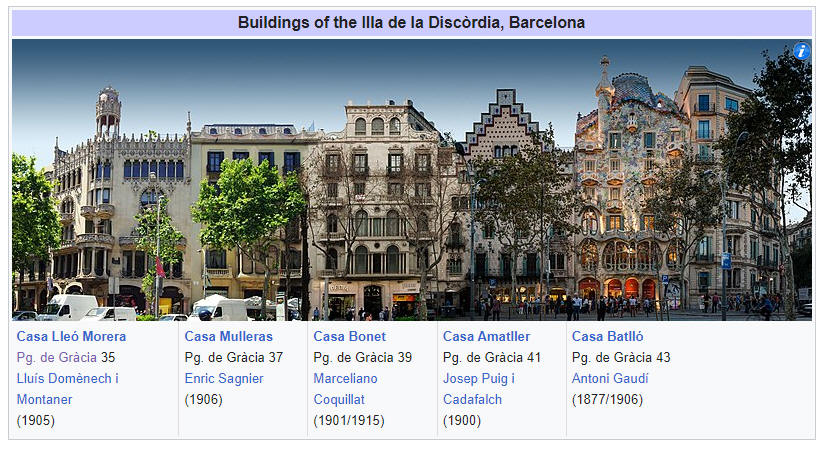
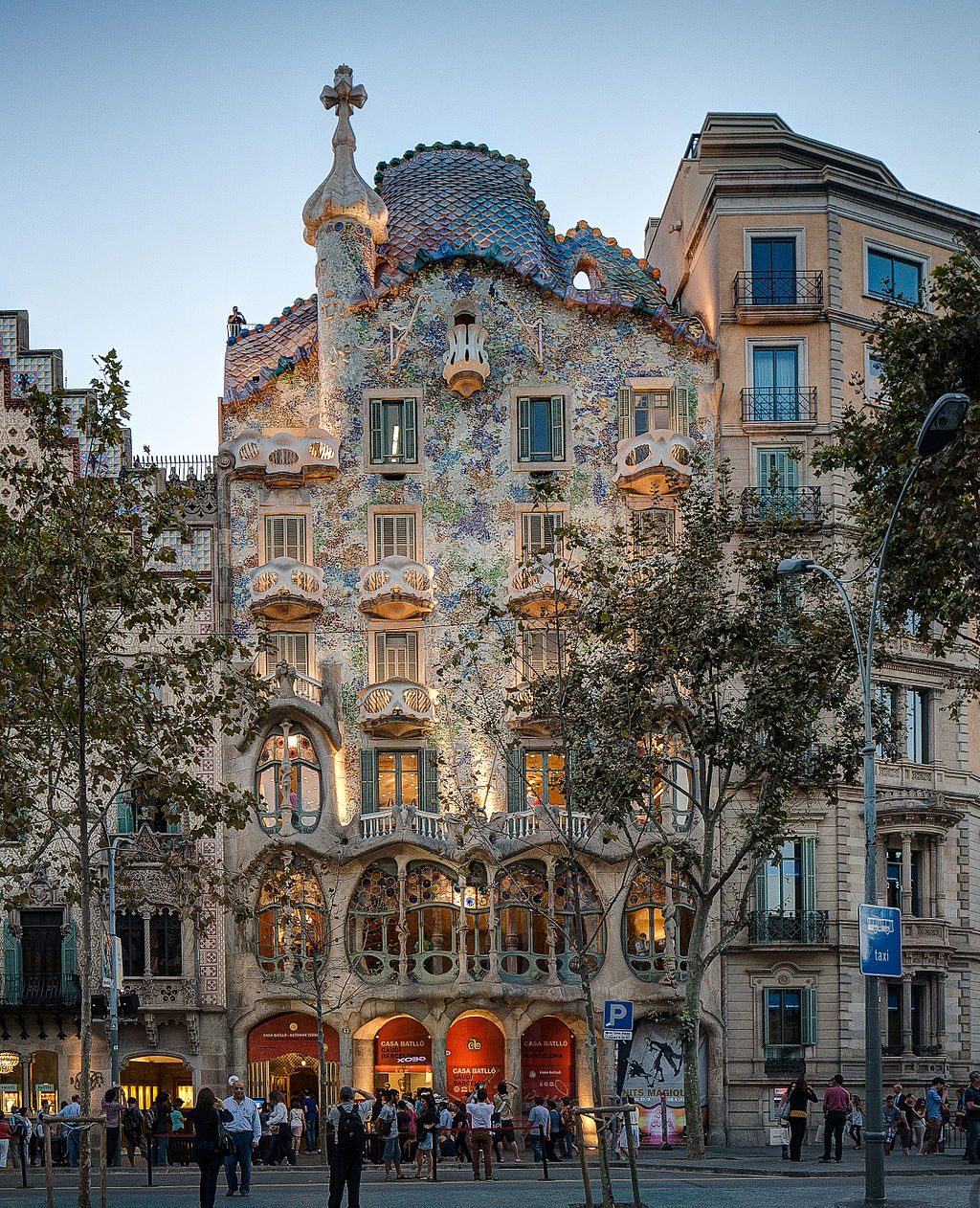
It was extremely difficult to photograph all but the end
buildings due to the trees, crowds, and street traffic.
.JPG)
.JPG)
.JPG)
.JPG)
.JPG)
.JPG)
.JPG)
.JPG)
.JPG)
.JPG)
.JPG)
.JPG)
.JPG)
.JPG)
.JPG)
.JPG)
.JPG)
.JPG)
.JPG)
.JPG)
.JPG)
.JPG)
.JPG)
.JPG)
.JPG)
.JPG)
.JPG)
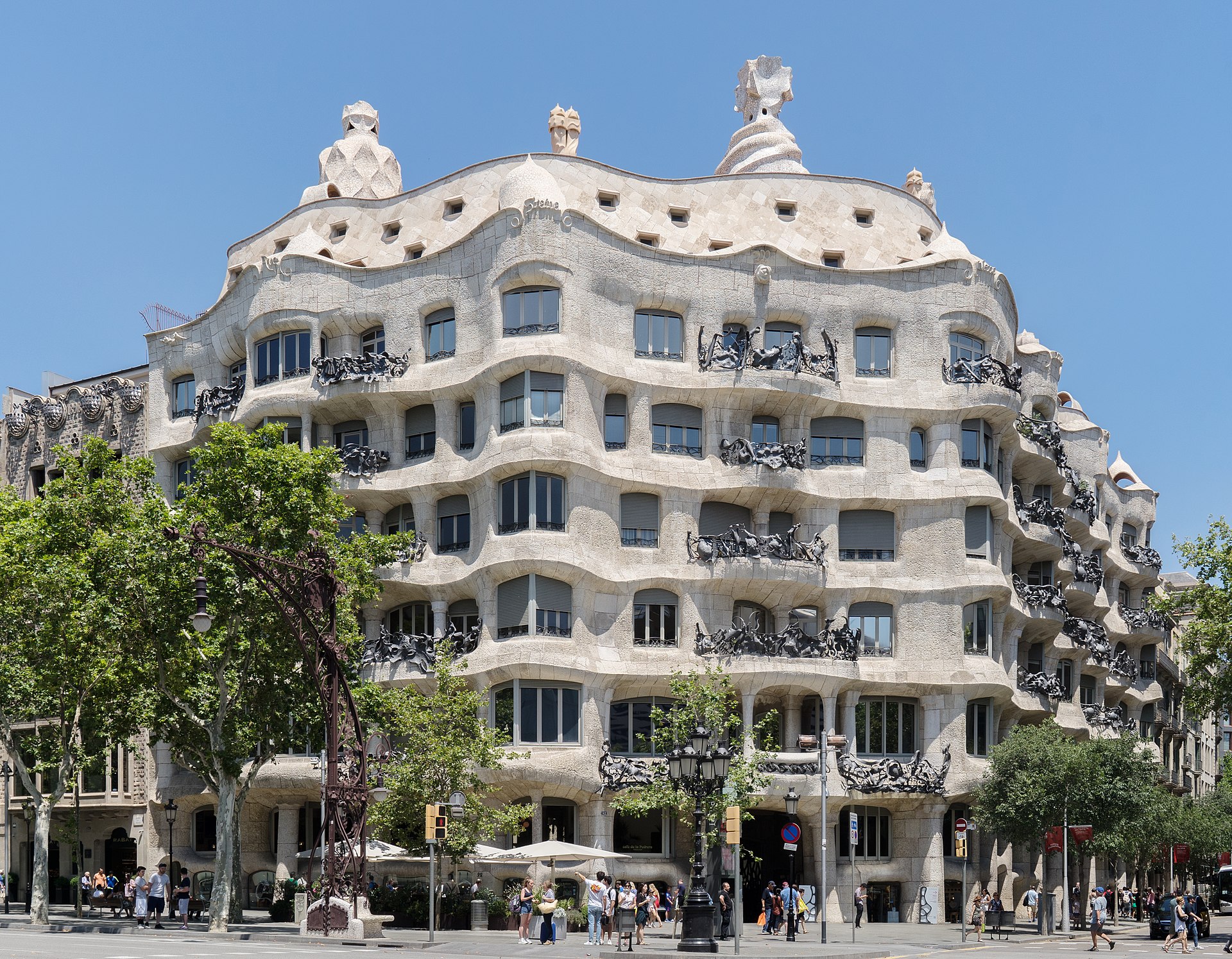
A couple blocks up the road, we came to La Pedrera-Casa Milà,
another of Gaudi's buildings. This is popularly known as La Pedrera (the
stone quary) in reference to its unconventional rough-hewn appearance and
reflected the populations initial, general disapproval of its unconventional
appearance. Our guide explained that Gaudi was referencing the sea and
Barcelona's maritime history, as the facade evokes coral with the balconies
appearing as seaweed. There was a temporary art exhibit with a giant head
in front. (the second image below is from the web, as we couldn't get a
clear image due to traffic and crowds).
.JPG)
.JPG)
.JPG)
.JPG)
.JPG)
.JPG)
.JPG)
Gaudi even designed the tiles used on the sidewalks. As
the family who commissioned the apartment building didn't want to use them, they
were used on the street later.
.JPG)
.JPG)
.JPG)
.JPG)
We also went by the La Sagrada Familia cathedral,
designed by Gaudi, and which is still under construction.
.JPG)
.JPG)
.JPG)
.JPG)
.JPG)
.JPG)
.JPG)
.JPG)
.JPG)
.JPG)
.JPG)
.JPG)
.JPG)
.JPG)
.JPG)
.JPG)
Our guide also pointed out one of the remaining bull-fighting
stadiums, which is now used for concerts and other events, as Catalonia long ago
outlawed bull-fighting.
.JPG)
.JPG)
.JPG)
.JPG)
.JPG)
.JPG)
After the ebike tour, we got lunch at a nearby tapas
restaurant the guide recommended, then grabbed a cab and headed back to the hotel
for a bit. Loved some of the metalwork we saw on the ride back to the
hotel.
.JPG)
.JPG)
.JPG)
We were back a couple hours later for a buffet dinner followed
by a Flamenco show at Tablao Flamenco Cordobes. The "tabloa" was a raised,
wooden platform in a small theater almost like a cellar.
.JPG)
.JPG)
.JPG)
.JPG)
.JPG)
.JPG)
There were three principle dancers, two ladies and one man,
accompanied by several singers and two guitar players. This was so worth
it. Their performance was wonderful, intimate and energetic.
.JPG)
.JPG)
.JPG)
.JPG)
.JPG)
.JPG)
.JPG)
.JPG)
.JPG)
.JPG)
.JPG)
.JPG)
.JPG)
.JPG)
.JPG)
.JPG)
.JPG)
.JPG)
.JPG)
.JPG)
.JPG)
.JPG)
.JPG)
.JPG)
.JPG)
.JPG)
.JPG)
.JPG)
.JPG)
After dinner, we wandered around the Gothic Quarter,
eventually making our way to the harbor. We found ourselves in some
interesting squares. One square had a large crowd watching some street
performers outside an open-air restaurant. They were making human towers and
doing other acrobatic stunts. We then ran into the same troop a bit later
in another square.
The first sculpture below which resembles a paperclip is the
Monument El Tripi in Place de George Orwell (English author of 1984 who lived in
Barcelona during the Spanish Civil War).
.JPG)
.JPG)
.JPG)
.JPG)
.JPG)
.JPG)
.JPG)
.JPG)
.JPG)
.JPG)
.JPG)
.JPG)
Here is the Placa de Sant Jaume which is home to the town hall
& the Palau de la Generalitat. We later learned one side is guarded by the
city police and the other side by the Catalan state police.
.JPG)
.JPG)
.JPG)
.JPG)
.JPG)
.JPG)
We then made our way back to the cathedral, as we really
didn't get many pictures while on the ebike tour, although the light was
starting to fade to dusk. We passed the bishop's gate, which connects the
cathedral with the bishop's offices (Palau Episcopal de Barcelona).
Interestingly, the gate was done in Venetian Gothic design, rather than Spanish.
Apparently the bishop insisted on an Italian architect. While the
cathedral is almost 600 years old, this bridge was built in 1928 in a neo-Gothic
style to connect the Palau de la Generalitat with the Casa dels Canonges.
It was built as part of a huge remodeling the Gothic Quarter in time for the
1929 International Exposition.
.JPG)
.JPG)
.JPG)
.JPG)
.JPG)
.JPG)
.JPG)
.JPG)
.JPG)
This statue is across from this door to the cathedral in a
small square (Place de Garriga i Bachs), and on the side of a small church (Església
de Sant Sever).
.JPG)
.JPG)
.JPG)
.JPG)
.JPG)
.JPG)
.JPG)
.JPG)
.JPG)
As we came closer to the square in front of the cathedral, we
were greeted by the sound of opera singing and found this man in a small street
next to the cathedral taking advantage of the amazing acoustics. Even the
buskers were wonderful.
.JPG)
.JPG)
.JPG)
The street we were on, the Carre de Bisbe, ends in the square
in front of the cathedral exiting through one of the original Roman gates and
the remains of a Roman aqueduct.
.JPG)
.JPG)
.JPG)
.JPG)
In front of this is the Escultura Barcino sculptural display by the visual poet
Joan Brossa created in 1994. He uses letters inspired by popular imagery to
compose the name of Bàrcino, the Roman city that preceded Barcelona.
Fitting that this is in front of the Roman ruins.
.JPG)
.JPG)
.JPG)
The Gothic facade of the cathedral is stunning.
.JPG)
.JPG)
.JPG)
.JPG)
.JPG)
.JPG)
.JPG)
.JPG)
.JPG)
.JPG)
.JPG)
.JPG)
.JPG)
.JPG)
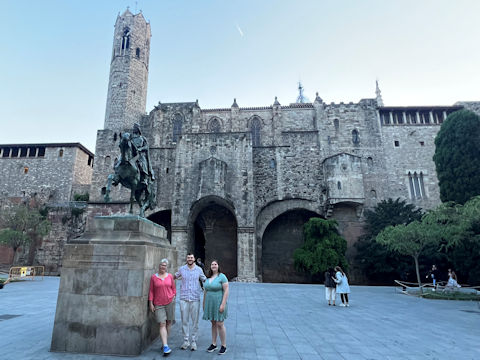
Around to the side is a statue of Ramon Berenguer III (Rodez,
1082-Barcelona, 1131), called the Great, who was count of Barcelona and
Gerona.
.JPG)
.JPG)
.JPG)
.JPG)
.JPG)
.JPG)
.JPG)
.JPG)
We made our way back by the Basilica of Santa Maria del Mar
as we really didn't get any pictures there on the ebike tour earlier.
.JPG)
.JPG)
.JPG)
.JPG)
.JPG)
.JPG)
.JPG)
.JPG)
.JPG)
.JPG)
.JPG)
.JPG)
.JPG)
.JPG)
Unfortunately it was getting darker.
.JPG)
.JPG)
.JPG)
.JPG)
.JPG)
We eventually found our way to the harbor, essentially
deciding we were finally done walking when we reached the Monument a Colom
(Columbus Monument), where we were able to find a cap stand. The monument
was constructed for the Exposición Universal de Barcelona (1888) in honor of
Columbus' first voyage to the Americas. The monument serves as a reminder that
Christopher Columbus came to Barcelona to report to Queen Isabella I and King
Ferdinand V after his first trip to the new continent, as they were at their
residence near the cathedral.
A 7.2 m (24 ft) tall bronze statue stands atop a 40 m (131 ft)
tall Corinthian column. The statue is said to depict Columbus pointing towards
the New World with his right hand, while holding a scroll in the left.
However, the statue actually points south-southeast in an almost a perfect
extension of the direction of La Rambla with his finger pointing somewhere along
the coast of Algeria. To have pointed the statue at the New World to the west or
toward Genoa in northern Italy would have meant it was pointing either inland or
up the coastline. Instead, it is now pointing out to sea, which is said to
emphasize his achievements in naval exploration.
.JPG)
.JPG)
.JPG)
.JPG)