Use these navigation links to move between the Year 2023 pages. Specific
pages can be accessed at the bottom of this page



May 2023
(Part 09)
Greece/Spain
Trip - Day 2, May 14 - Athens, Greece (Second Half - Everything After the Acropolis
Museum)
Michael picked us up outside the Acropolis Museum and we
headed west toward the Ancient Agora of Athens. He dropped us off to the
west along Adrianoy street and we walked past a number of restaurants and shops
overlooking the Agora. The term Agora (pronounced ah-go-RAH) is Greek for
'open place of assembly' and, early in the history of Greece, designated the
area in a city where free-born citizens could gather to hear civic
announcements, muster for military campaigns, or discuss politics. It later
designated the open-air marketplace of a city. The agora was important
because it was where the community congregated to discuss events of the day,
politics, religion, philosophy, and legal matters. The agora served the same
purpose in ancient Athens as the town square and town hall in later societies.
Like the later town centers, the agora was a cultivated area adorned with trees,
gardens, fountains, colonnaded buildings, statues, monuments, and shops selling
assorted goods. The Agora of Athens is especially important and is
regarded as the birthplace of democracy since it was here that political
discussions and arguments gave rise to that concept. While the Acropolis
was the ceremonial showpiece, for eight centuries, the Agora was the true meeting place
and center of the city - "a hive of commerce, politics, and everyday bustle.
Everybody who was anybody in ancient Athens spent time here, from Socrates and
Plato to a visiting missionary named Paul."
By the 6th century BCE, the Agora was already a residential
district with homes built around what would become the marketplace. Written laws
were first instituted in Athens by the statesman Draco (l. 7th century BCE), but
these were considered harsh and restrictive and so were reformed by the lawgiver
and statesman Solon (l. c. 630 - c. 560 BCE) c. 594 BCE who broke the hold of
the upper class on political participation and opened it to all Athenian
citizens. He divided the citizenry into four classes based on their income from
property. The Areopagus (the rock outcrop at the south end of the Agora and next
to the Acropolis, also called the Hill of Ares), which had formerly been the
meeting place of the upper-class Archons, was now open for political discussions
by any male citizen of Athens. Democracy was soon abandoned during several
subsequent periods of tyrannical rule. In the sixth century BCE, the statesman Cleisthenes reformed
the laws of Solon and established democracy in Athens. Democracy already existed
in varied forms elsewhere, but Athenian democracy would become the model for
later governments, giving it the prestigious place it has in history and
honoring Cleisthenes with the title "Father of Athenian Democracy" which, in the
present day, is usually understood as modern democracy even though it is not
(only male citizens were allowed to vote, and there were other stipulations
making Athenian democracy quite different from the modern concept). The
Agora became the center of political and social life in the 6th century BCE and
developed accordingly. The main area became the marketplace surrounded by public
and municipal buildings and carefully beautified with fountains, parks, trees,
and statuary. All of this was destroyed, along with the rest of the city,
during the Persian king Xerxes’ invasion in 480 BCE and was rebuilt by order of
the Athenian statesman Pericles (l. 495-429 BCE). Pericles's
famous "Funeral Oration" given as part of the annual public funeral for the dead
at the end of the first year of the Peloponnesian War (BC 431–404) and recorded
by Thucydides' in his History of the Peloponnesian War described as "a
eulogy of Athens itself..." and is a stirring defense of democracy (with a
structure similar to the Gettysburg Address, which likely borrowed from it), was
given elsewhere, likely at Kerameikos, the public cemetery to the west of
the Agora and against the city walls). Socrates (l. c. 470/469-399
BCE) questioned the citizenry of Athens in the agora on their values and
establishing the type of inquiry that lay the foundation for Western philosophy,
and it was there that the young playwright and aristocrat Aristocles of Athens
first heard him speak, burned his plays, and devoted himself to the development
of Greek philosophy under the name Plato (l. 428/427 - 348/347 BCE). The
Agora
was also the site of the court which condemned Socrates for impiety in 399 BCE
and sentenced him to death. The Athenian Agora played host to later
philosophers after Socrates such as Diogenes of Sinope (l. c. 404-323 BCE) who
actually lived there on the streets, Crates of Thebes (l. c. 360-280 BCE) and
his wife Hipparchia of Maroneia (l. c. 350-280 BCE), who did the same, and Saint
Paul (l. c. 5 - c. 64 CE), who preached there at the Areopagus. According to the
biblical Book of Acts 17:16-33, Paul encountered the Stoics and the Epicureans
at the Athenian Agora and preached the news of the gospel of Jesus Christ to
them there. The Greek tragedy playwrights Aeschylus (l. c. 525 - c. 456
BCE), Sophocles (l. c. 496 - c. 406 BCE), and Euripides (l. c. 484 - 407 BCE),
and Greek comedy playwright Aristophanes (l. c. 460 - c. 380 BCE) all produced
the first staging of their plays in and around the agora of Athens. The agora
continued as an important site of commerce, public discourse, and social life
through the early Roman period, but was destroyed in 267 CE by the Germanic Heruli and in 396 CE by the Visigoths. In the 7th century CE, some buildings –
like the Temple of Hephaestus – were converted into churches and so preserved. The
site has been excavated by the American School of Classical Studies at Athens (ASCSA)
since 1931, with some initial funding provided through the Marshall Plan after
World War II.
The route used during the Panathenaic Festival (c. 566 BCE -
3rd century CE), honoring the goddess Athena, and entered the agora at the
northwest corner, exited at the southeast, and went up to the temples on the
Acropolis.
.JPG)
.JPG)
.JPG)
.JPG)
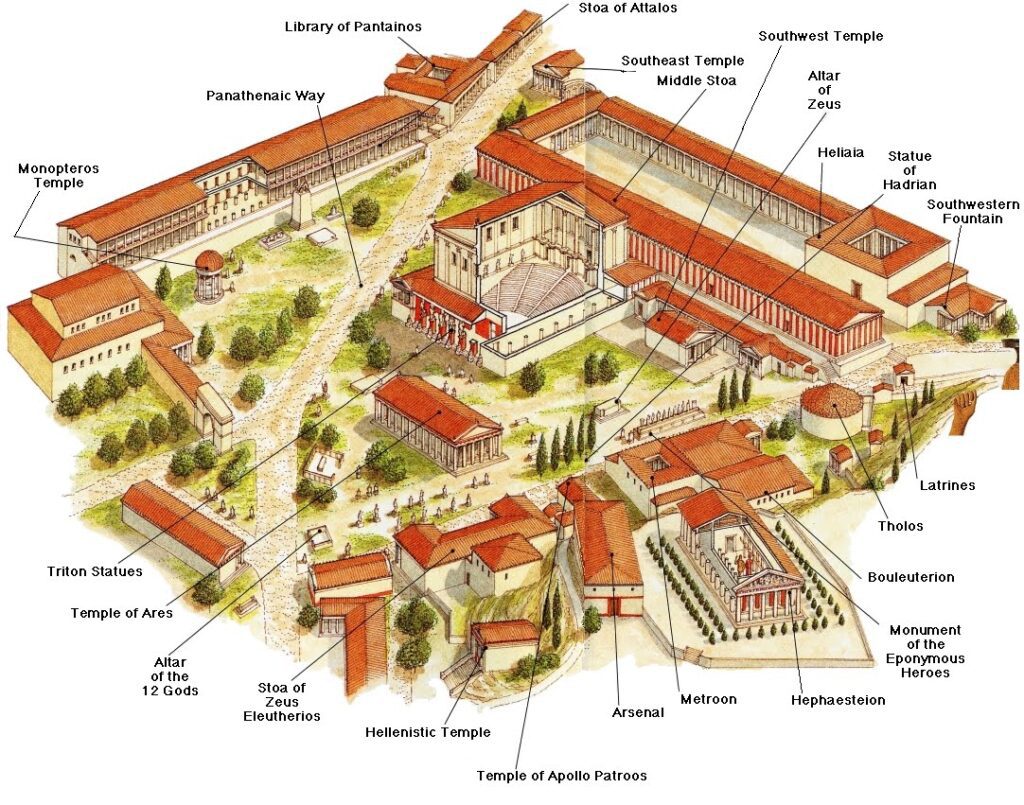
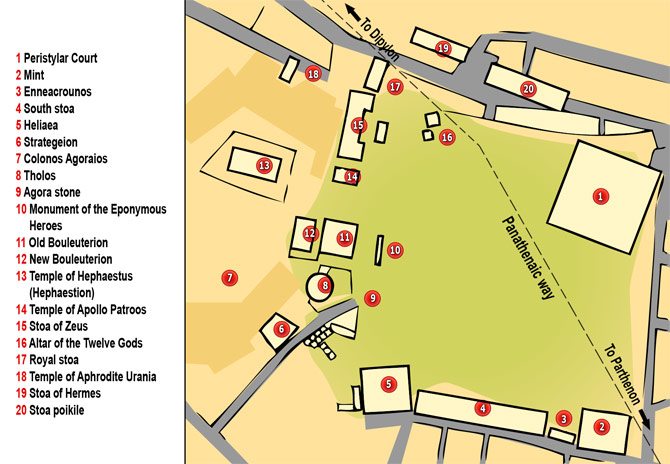
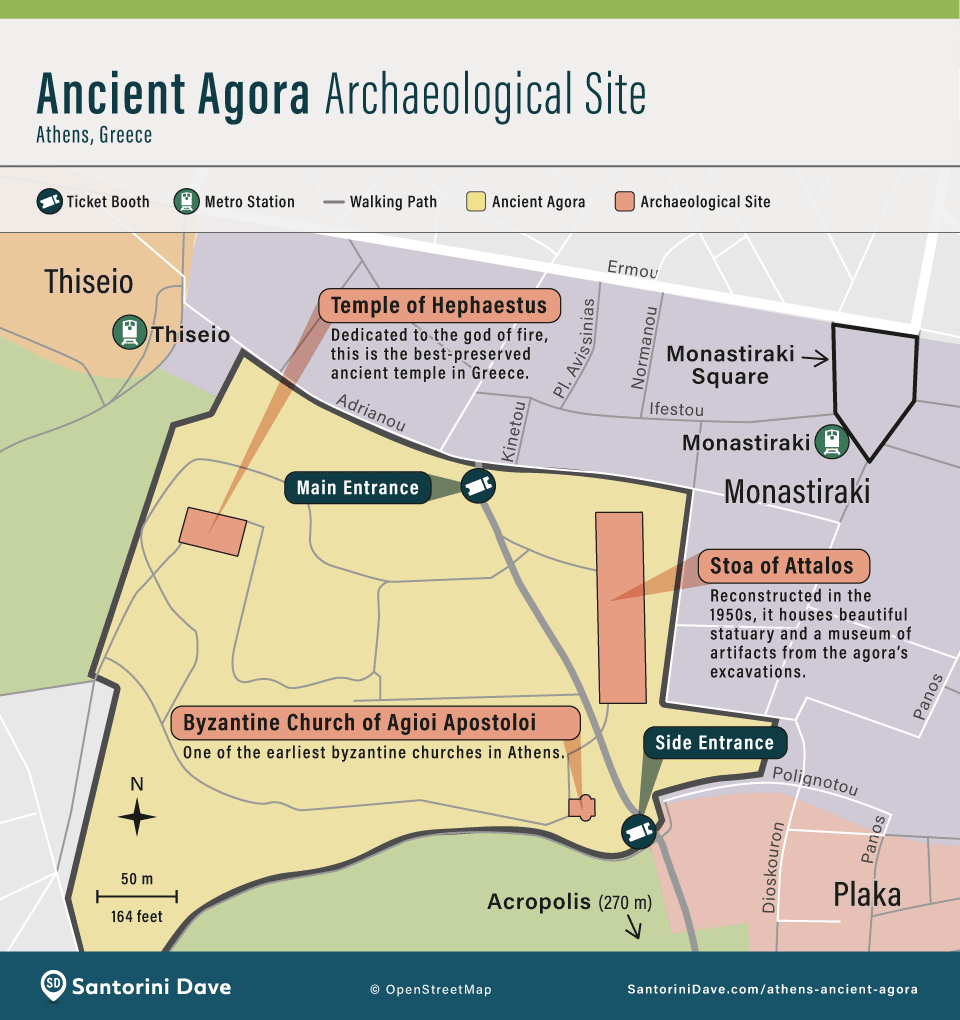
As you enter from the north, you immediately come to the site of the Altar of
the Twelve Gods. This altar was built in 522-1 BCE and marked the
central point from which distances from Athens were measured. While
uncertain, the identities of the twelve gods were substantially the same as
the twelve Olympian gods represented on the east frieze of the Parthenon: Zeus, Hera, Poseidon, Demeter, Apollo, Artemis, Hephaestus, Athena, Ares, Aphrodite, Hermes,
and Dionysus, though there are reasons to suppose that Hestia may have been one
of the twelve.
There are ruins covering the open area with the Acropolis in
the background, the remains of centuries of buildings. There were once numerous fountains and temples in the
area, including the Temple and Altar of Ares, the Temple of Aphrodite Urania,
the Temple of Apollo Patroos, the Temple of Zeus Phratrios and Athena Phratria
(dating to the 300s BCE), and several Roman Temples. There were also at
least five Stoas (two sided colonnades covered and providing space for stores
and stalls). To the west, is the Monument of the Eponymous Heroes, a
monument for the ten heroes of the tribes of Athens which was also used as a
notice board for new legislation, public events and military conscription.
It also held a law court, the Peristyle Court, and a mint used for minting of
bronze coinage in the 2nd and 3rd centuries B.C. (although there is no evidence
for it being used for the minting of Athenian silver coinage). Finally,
there was a speakers platform, called the Bema, located near the Stoa of Attalos.
There are several statues at the entrance to the Odeon of
Agrippa. These were the front of a theater/concert hall which was the
centerpiece of the Agora during the Roman era.
.JPG)
.JPG)
.JPG)
.JPG)
.JPG)
Steve, of course, had to take a picture of the site of a water
clock.
.JPG)
.JPG)
.JPG)
.JPG)
.JPG)
.JPG)
.JPG)
.JPG)
.JPG)
.JPG)
There is also a statue depicting an imaginary meeting and
conversation between Socrates and Confucius, who were contemporaneous.
Socrates, an Athenian philosopher of the late 5th century BC, is widely regarded
as a founder of Western philosophy and the first moral philosopher of the
Western ethical tradition of thought. His impact on later Greek
philosophers was immense, notably Plato and Aristotle, and almost all
philosophical currents traced their roots to him. Likewise, the teachings
of Confucius, a Chinese philosopher and politician of the late 6th and early 5th
century BCE, formed the basis of East Asian culture and society, and remains
highly influential today.
.JPG)
.JPG)
.JPG)
There are only three intact buildings in the area. To
the back is the Holy Church of the Holy Apostles of Solaki, which dates to the
10th century, and was built to commemorate St. Paul's teaching in the Agora.
.JPG)
.JPG)
.JPG)
.JPG)
.JPG)
.JPG)
To the west is the Temple of Hephaestus, which is one of the best
preserved of any temple from the Golden Age of Athens. It is on top of the Agoraios Kolonos hill overlooking the Agora. Hephaestus is the Greek god
of blacksmithing, metalworking, carpentry, craftsmen, metallurgy and fire.
He is the Greek counterpart to the Roman god Vulcan. In Greek mythology,
he was the son of Zeus and Hera, but was cast off Mount Olympus because of a
congenital lameness. As a the blacksmith of the gods, Hephaestus made all
the weapons of the gods in Olympus, and was worshipped in the manufacturing and
industrial centers of Greece, particularly Athens. Hephaestus's symbols
are a smith's hammer, anvil, and a pair of tongs. There were numerous
potters' workshops and metal-working shops in the vicinity of the temple, as
befits the temple's honoree.
The temple was constructed during the building program
initiated by Pericles which built the temples on the Acropolis.
Construction started in 449 BC, but it was not completed for at least three
decades as resources were prioritized for temples on the Acropolis. It was
eventually completed during the Peace of Nicias (421–415 BC) when the roof
was completed and the cult images were installed. The temple is built
with the same marble from the nearby Mt. Penteli as the Parthenon, excepting the
bottom step of the krepis or platform. The temple has six doric columns on the short
east and west sides and thirteen columns along the longer north and south sides
(with each of the four corner columns being counted twice - providing the same
proportions as the Parthenon although it is half the size). There is also
an inner Doric colonnade with five columns on the north and south side and three
across the end (with the corner columns counting twice). It has an inner
chamber, a cella, at the center of the structure housing cult images and
once contained large bronze statues of Hephaistos and Athena. It
has ionic friezes and statues in the pediments, which depict the Birth of Athena
(east) and the Return of Hephaistos to Olympos (west). The temple's
entrance was on the east end facing the Agora, and the friezes on the other side
were blank and undecorated.
The sanctuary would have been closed during the persecution of
pagans in the late Roman Empire. From the 7th century until 1834, it
served as the Greek Orthodox church of Saint George Akamates and was
given the vaulted ceiling that survives today. During the Ottoman occupation,
the Turks kept the church open but permitted services to be held only once a
year, on St George feast day. The building's
condition has been maintained due to its history of varied use.
.JPG)
.JPG)
.JPG)
.JPG)
.JPG)
.JPG)
.JPG)
.JPG)
.JPG)
.JPG)
.JPG)
.JPG)
.JPG)
.JPG)
.JPG)
.JPG)
.JPG)
.JPG)
.JPG)
.JPG)
.JPG)
.JPG)
.JPG)
.JPG)
.JPG)
.JPG)
.JPG)
.JPG)
.JPG)
.JPG)
.JPG)
.JPG)
.JPG)
.JPG)
.JPG)
.JPG)
.JPG)
.JPG)
.JPG)
.JPG)
Surprised to see several turtles out and about, which was
notable apparently as three of us took pictures of them.
.JPG)
.JPG)
.JPG)
.JPG)
.JPG)
.JPG)
.JPG)
.JPG)
To the east side is the Stoa of Attalos, which dates back to
the 2nd century, and was a gift to the Athenians from the king of Pergamum Attalus II
(in modern-day Turkey). It was a typical two-story stoa, with Doric
columns for the outer layer and Ionic columns inside those, to provide stalls
and cover to stores. It was restored in the 1950s with funding provided by John
Rockefeller, Jr. and several others, and now houses the Archaeological Museum of
the Ancient Agora of Athens. Its exhibits are connected with the Athenian
democracy. The collection of the museum includes clay, bronze and glass objects,
sculptures, coins and inscriptions from the 7th to the 5th century BC, as well
as pottery of the Byzantine period and the Turkish occupation. The exhibition
within the museum contains work of art which describes the private and public
life in ancient Athens. In 2012, new sculpture exhibition was added to the
museum which includes portraits from Athenian Agora excavation. The new
exhibition revolves around portraits of idealized gods, officially honored
people of the city, wealthy Roman citizens of the 1st and 2nd century AD,
3rd-century citizens and finally on work of art from private art schools of late
antiquities.
.JPG)
.JPG)
.JPG)
They had several exhibits discussing the Agora and two pinhole
cameras set up to look at the view projected on a wall of the small enclosure.
.JPG)
.JPG)
.JPG)
.JPG)
.JPG)
.JPG)
.JPG)
.JPG)
.JPG)
After the museum, we headed out of the Agora and got lunch at
one of the nearby restaurants. Michael then loaded us up and took off to
the east and the Monument to the Unknown Soldier which is located in front of
the Hellenic Parliament, which is held in the Old Royal Palace. We arrived about five minutes before the changing
of the guard ceremony. Mora cautioned us to watch our wallets and
valuables, as the jostling and tight crowd was a haven for pickpockets.
She admitted they could be bad, and went along with the number of beggars we had
seen (including one who walked into a restaurant patio and asked to finish our
meal on the first day - we gave him our bread, much to the dismay of the waiter
who came rushing over). She did joke that it wasn't worse than many places
in Europe and they were simply training them to go to Rome, which was the worst.
The tomb is actually a cenotaph, meaning it is an empty tomb
erected in honor of someone whose remains lie elsewhere. The tomb,
completed in 1932, is in the French urban and classical tradition,
combined with the modern spirit of Art Deco and with symbolic references
to Ancient Greece. The rectangular raised grave is on the dais below the
sculpture in the center of the wall; it is positioned between two decorative
staircases. The sculpture represents the naked male figure of a dead
warrior lying on the ground. He holds a circular shield in his left hand and
wears an Ancient Greek-style helmet. The representation of the body gives the
impression that the Unknown Soldier is ready to arise at any moment. It is
inspired by the statue of a dying nude from the ancient Aphaia temple on the
island of Aigina, very close to Athens (which we would see in a couple days,
although the statue isn't there and is in an unnamed museum). On
the wall, to the left and right of the sculpture are etched famous phrases from
Thucydides' History of the Peloponnesian War: (left) "There's one empty bier
made up for the unidentified [fallen] ones") and (right) "The whole earth is the sepulchre of famous men". Over the main sculpture in smaller writing, one reads
"ΕΙΣ ΑΦΑΝΗ ΣΤΡΑΤΙΩΤΗ" ("To an unknown soldier"). The names of battles
where many Greek people died after Greek independence in 1821 are written into the limestone
walls around the sculpture. To the left and right of the figure of the
dead soldier are the names of the major Greek battles locations of World War II and later
engagements in which Greeks died, like Crete, Al Alamein, Korea, and
Cyprus. To the left of the monument, descending by the steps, are
inscribed the names of battle locations of the First and Second Balkan
War and World War I. To the right of the monument, descending by the
steps, are inscribed the names of battle locations of the Russian Civil
War and Greco-Turkish War
.JPG)
.JPG)
.JPG)
.JPG)
The tomb's ceremonial guards are "Evzones" (also known
colloquially as a Tsoliás), representing several historical elite light
infantry and mountain units of the Greek Army (the word Evzones dates back to
Homer's Illiad). Evzones are known for their distinctive uniform,
which evolved from the clothes worn by the klephts
who fought the Ottoman occupation of Greece as insurgents in the mountains.
The most visible item of this uniform is the fustanella, a knee-length kilt-like
garment. The number of pleats of the fustanela is rumored to be equal to
the number of years of Ottoman occupation i.e. 400. Their distinctive dress
turned them into a popular image for the Greek soldier, especially among
foreigners. On top of this is a belt of cotton in blue and white stripes
and a jacket decorated with two rows of twelve yellow metal buttons on the
chest, and eight on the sleeves. They also wear tsarouchia (Greek footwear
dating back to the Byzantine era which are made from a number of layers of stiff
leather, have upturned toes, and a large woolen pompon) with white wool leggings
and garters; the former decorated in dark blue embroidery.
A formal changing of the guards ceremony occurs every hour,
with a less formal "crossing of the guard" on the half-hour. The replacement guards arrived with a detail leader. The
sentries change hourly, so the motions are carried out in elaborate slow motion,
ostensibly to allow the troops circulation to resume after standing absolutely
motionless. The current guards then executed an elaborate, high-stepped
walk with their shoes scrapping along the ground after being kicked up.
All four guards paid homage to the tomb, then returned to the posts while
exchanging places before the out-going guards marched away.
.JPG)
.JPG)
.JPG)
.JPG)
.JPG)
.JPG)
.JPG)
.JPG)
.JPG)
.JPG)
.JPG)
.JPG)
.JPG)
.JPG)
.JPG)
.JPG)
.JPG)
.JPG)
.JPG)
.JPG)
.JPG)
.JPG)
.JPG)
.JPG)
.JPG)
.JPG)
.JPG)
.JPG)
.JPG)
Despite the crowd, Michael was able to stay parked on the curb
nearby with a number of other tour surreys, so we were able to hop right back
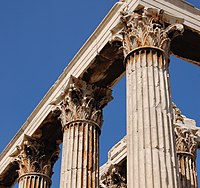
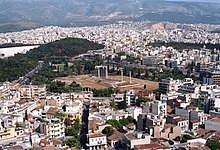
in. We next headed a bit south the the Temple of Olympian Zeus
which is dedicated to "Olympian" Zeus, a
name originating from his position as head of the Olympian gods. Construction
began in the 6th century BC during the rule of the Athenian tyrants, who
envisaged building the greatest temple in the ancient world, but it was not
completed until the reign of Roman Emperor Hadrian in the 2nd century AD, some
638 years after the project had begun. During the Roman period, the temple,
which included 104 colossal Corinthian columns, was renowned as the largest temple in
Greece and housed one of the largest cult statues in the ancient world.
The temple's glory was short-lived, as it fell into disuse after being pillaged
during a barbarian invasion in 267 AD, just about a century after its
completion. It was probably never repaired and was reduced to ruins thereafter.
In the centuries after the fall of the Western Roman Empire (a slow decline from
376 to 476 AD), it was extensively quarried for building materials to supply
building projects elsewhere in the city. However a substantial part of the
temple remains today, notably 16 of the original gigantic columns, and it
continues to be part of a very important archaeological site in Greece
.JPG)
.JPG)
.JPG)
.JPG)
.JPG)
.JPG)
.JPG)
.JPG)
.JPG)
.JPG)
.JPG)
.JPG)
.JPG)
.JPG)
.JPG)
At the end of the clearing is Hadrian's Arch or Hadrian's
Gate, which is a monumental gateway, similar to a Roman triumphal arch through
which conquering Roman legions marched in honor (the arch on the bottom is
similar to the genre, but the top does not allow for statues or other major
decorations). It spanned an ancient road leading from the center of
Athens. It was likely built by the people of Athens to celebrate
the adventus (arrival) of the Roman emperor Hadrian and to honor him for his
many benefactions to the city, on the occasion of the dedication of the nearby
temple complex in 131 or 132 AD (especially as Hadrian had become an Athenian
citizen nearly two decades before). The entire monument is made of
Pentelic marble, the same type used for the Parthenon and mined about 18 km
away. The arch was constructed without cement or mortar from solid marble,
using clamps to connect the cut stones.
Two inscriptions are carved on the architrave of the arch’s
lower level, one centered over the arched opening on either side. On the
northwest side (towards the Acropolis), the inscription was:
ΑΙΔ' ΕΙΣΙΝ ΑΘΗΝΑΙ ΘΗΣΕΩΣ Η ΠΡΙΝ ΠΟΛΙΣ (this is Athens, the
ancient city of Theseus).
The inscription on the southeast side (facing the Olympeion)
reads:
ΑΙΔ' ΕΙΣ' ΑΔΡΙΑΝΟΥ ΚΟΥΧΙ ΘΗΣΕΩΣ ΠΟΛΙΣ (this is the city of
Hadrian, and not of Theseus).
It is unclear if this is meant to represent the boundary of
the old and the new areas of Athens, based on an effort by Hadrian to expand the
city, creating a new urban section on the eastern side of Athens termed Hadrianopolis.
This newer, Roman section of the city was thought to have been added to the
ancient Greek city during the period of the Pax Romana (Roman peace).
Alternatively, it can be interpreted as claiming the entire city as a
refoundation by the emperor. In this view, the inscriptions should be
read: this is Athens, once the city of Theseus; this is the city of Hadrian, and
not of Theseus. One option claims a part and the other the whole of Athens for
the emperor.
Unfortunately, Maro stated we needed to leave, so we did not
walk down closer ... a mistake, as it turned out we had a lot of time ... oh
well.
.JPG)
.JPG)
.JPG)
With the scaffolding obscuring much of the ruins, I found a
couple pictures online to clarify what we were able to see.
_(30776483926).jpg)
Our last stop was at the Panathenaic Stadium, site of the first modern Olympic
games in 1896. It is the only stadium in the world built entirely
of marble. The stadium was built on the site of a racecourse built in
330 BC, primarily for the Panathenaic Games. It was rebuilt in marble by an
Athenian Roman senator and by 144 AD it had a capacity of 50,000 seats. After
the rise of Christianity in the 4th century, it was largely abandoned. The
stadium was excavated in 1869 later refurbished to host the opening and closing
ceremonies of the first modern Olympics in 1896 and was the venue for 4 of the 9
contested sports. It was used for various purposes in the 20th century and was
once again used as an Olympic venue in 2004. It is the finishing point for the
annual Athens Classic Marathon. It is also the last venue in Greece from
where the Olympic flame handover ceremony to the host nation takes place.
.JPG)
.JPG)
.JPG)
.JPG)
.JPG)
.JPG)
.JPG)
.JPG)
.JPG)
.JPG)
Maro headed off and Michael took us to the Alimos Marina to meet our captain and
sailboat for the next part of our trip. We wound up arriving way, way too
early. Fortunately, the meeting place was at a harbor-side restaurant
called Dia Noche Cafe and
we eventually picked up our bags and got a table, stacking the bags in the
corner. The wait allowed Lexi to befriend a stray cat.
.JPG)
.JPG)
.JPG)
.JPG)
After getting settled, we had a bit of time to walk along the harbor and enjoy
the view out over the Aegean Sea. Andy took the opportunity to do some
pull-ups at an outdoor gym.
.JPG)
.JPG)
.JPG)
.JPG)