

|
|
Use these navigation links to move between the Year 2023 pages. Specific pages can be accessed at the bottom of this page
May 2023 (Part 18) Greece/Spain Trip - Day 11, May 23 (Part Two) - Montserrat and Barcelona, Spain After lunch, we loaded up and Pablo headed us out of town to Montserrat. It was a reasonably short trip (under an hour), but some of us still managed to take a short nap as we were a bit groggy after lunch. Once we got into the mountains, it was impossible not to be fascinated by the scenery. As Pablo explained, Montserrat is a multi-peaked mountain range which is part of the Catalan Pre-Coastal Range. The area is named for the serrated impression of the range, looking almost like a toothed saw. The mountain is composed of strikingly pink conglomerate, a form of sedimentary rock. Montserrat was designated as a National Park in 1987.
Our destination was the the Benedictine abbey of Santa Maria de Montserrat, which hosts the Virgin of Montserrat sanctuary, also known as La Moreneta ("the little tan/dark one" in Catalan). The monastery was founded in the 11th century and rebuilt between the 19th and 20th centuries, and still functions to this day with over 70 monks. There have always been roughly 80 monks in residence. Initial construction of the basilica of Montserrat began in the 16th century, and its complete reconstruction began in the year 1811, after being burned down and sacked twice by Napoleon's troops in the Peninsular War when many of its treasures were lost. It was restored by 1844. In 1880, Montserrat celebrated 1000 years of existence. On 11 September 1881 to coincide with the Catalan national day, Pope Leo XIII proclaimed the Virgin of Montserrat patron of Catalonia. The mountain of Montserrat has been of religious significance since pre-Christian times, when the Romans built a temple to honor the Roman goddess Venus. It is Catalonia's most important religious retreat and groups of young people from Barcelona and all over Catalonia make overnight hikes here at least once in their lives to watch the sunrise from the heights of Montserrat. The Virgin of Montserrat is Catalonia's favorite saint, and is located in the sanctuary of the Mare de Déu de Montserrat, next to the Benedictine monastery nestling in the towers and crags of the mountain. The Escolania, Montserrat's Boys’ Choir, is one of the oldest in Europe, and performs during religious ceremonies and communal prayers in the basilica. They provide a short concert every day, but we arrive too late in the day. Once there, Steve and Andy ran up to an observation deck to get a better view, then caught up with the group. The monastery is nestled into an amazing valley up against the mountain.
We headed up and into the monastery and church.
On the way in, we passed the statue of Sant Jordi, de Josep Maria Subirachs (Saint George by Josep Maria Subirachs). This was done by the same sculptor as much of the Passion Facade at Sangrada Familia and shows some of the reverse imaging used there also.
As we approached the church, there were several buildings and the monastery against the mountain to the left.
To the right was a series of archways and statues, allowing a view back out to the mountain and over the valley.
After the Spanish Civil War, a new external façade of the church was built (between 1942 and 1968), the work of Francesc Folguera i Grassi and decorated with sculptural reliefs of Joan Rebull (St. Benedict, Proclamation of the dogma of the Assumption of Mary by Pius XII and St. George, with a representation of the monks who died during the Spanish Civil War), as well as the inscription Urbs Jerusalem Beata Dicta Pacis Visio ("Blessed city of Jerusalem, called the vision of peace"). At the foot of the frieze with the relief of St. George is sculpted the phrase "Catalonia will be Christian or it will not be", attributed to the bishop Josep Torras i Bages, which has been assumed as a political motto of Catholic root.
This facade precedes the church proper, which is access by entering through the doors and then across a small atrium. Here there are 16th century sepulchres (tombs in the rock face) and more recent 20th century sculptures. The square that precedes the church (called del Abat Argeric, built in 18th century) is decorated with sgraffitos (layered tinted plaster) decorations.
Before entering the church, we ducked into small chapel on the left side built into the mountain.
The church is of a single nave, 68.32 meters long and 21.50 wide, with a height of 33.33 meters. It is supported by central columns, carved in wood representing the prophets Isaiah, Jeremiah, Ezekiel and Daniel. At the head is the main altar, decorated with enamels (1928) depicting various biblical scenes, such as The Last Supper, The Weddings of Cana and The Multiplication of Loaves and Fishes. The cross on the alter is from the 15th century. Just above the main altar is located the room of the Virgin.
There were several small chapels lining the walls, each with amazing stained glass windows, and a row of different and amazing lights in front of them. There were signs explaining that the lights were donated by individuals, groups and churches from the surrounding area.
Steve and Andy were amused to discover one donated by the Football Club Barcelona, which is pictured.
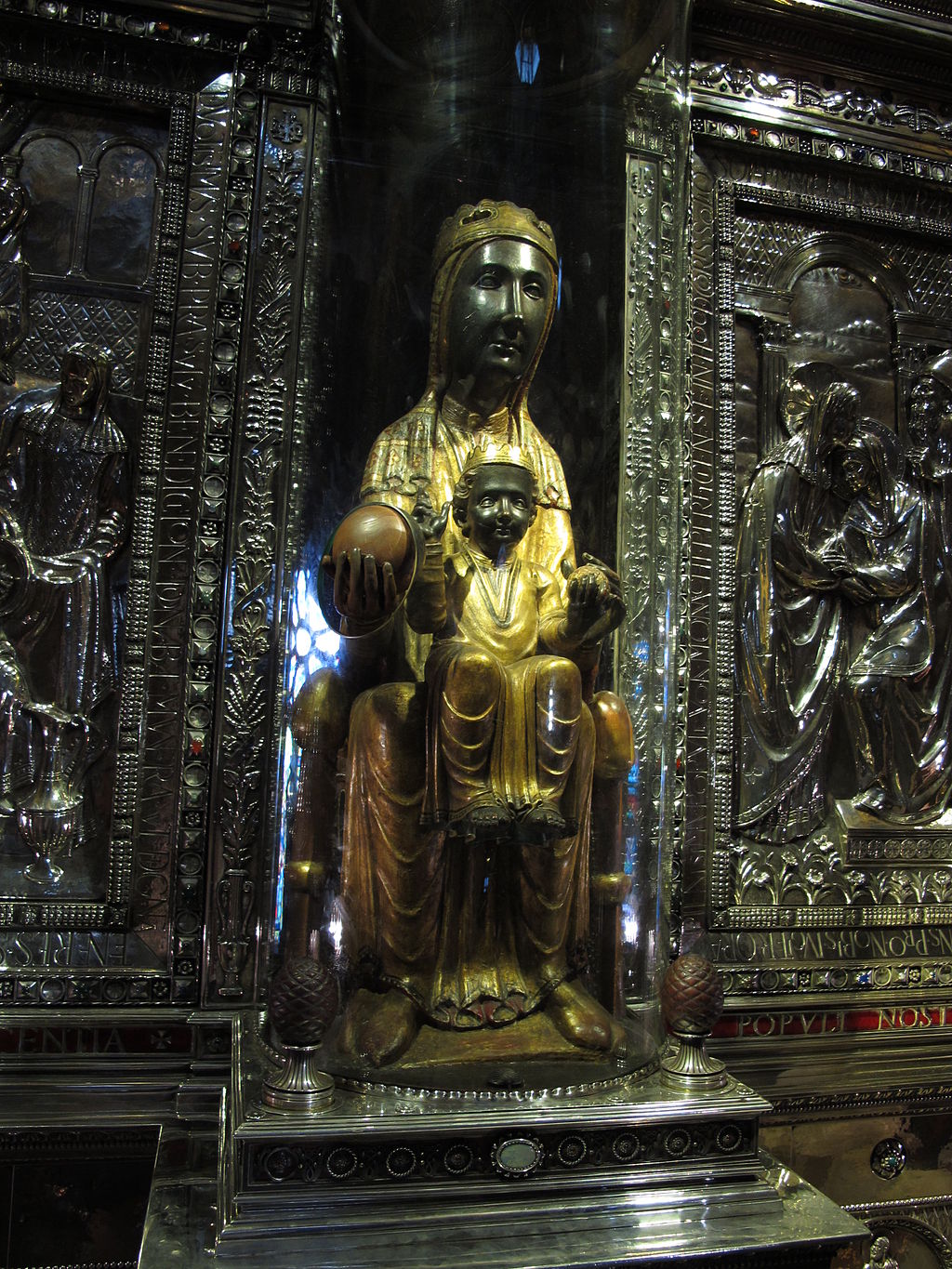
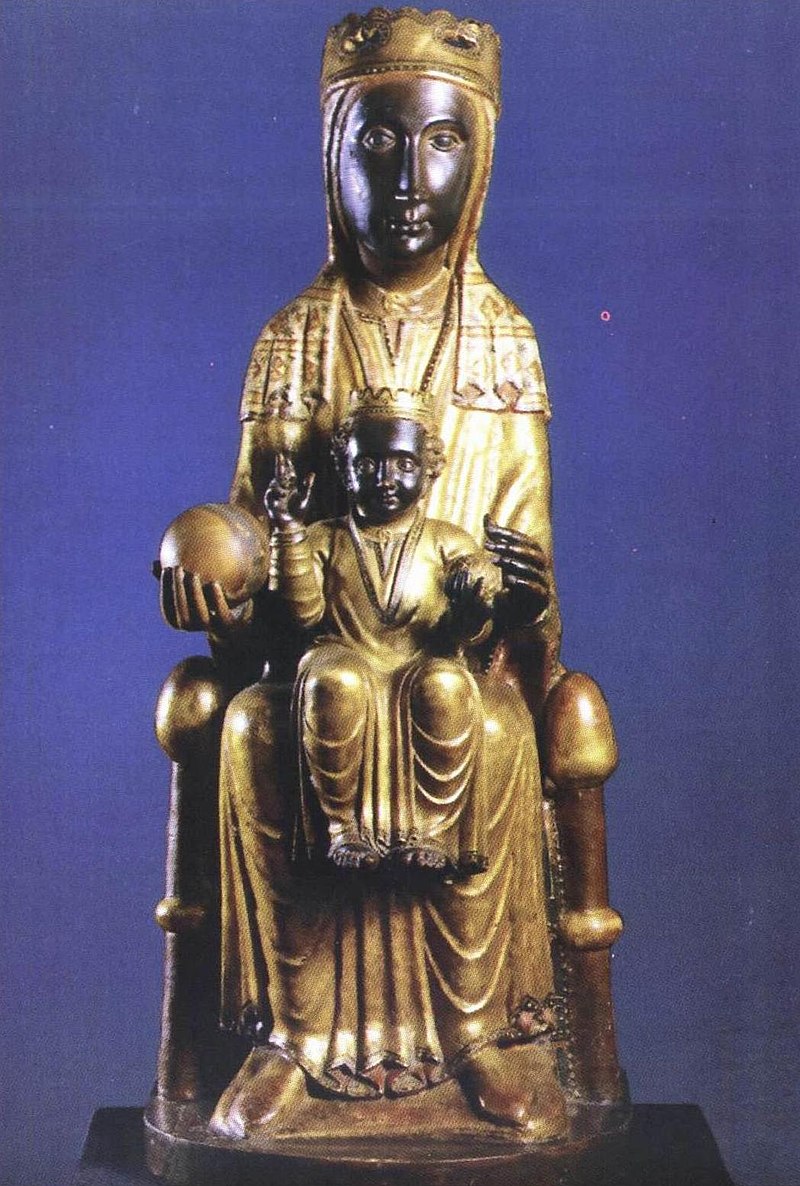
The church was built to house Our Lady of Montserrat or the Virgin of Montserrat (Catalan: Mare de Déu de Montserrat), the Marian title associated with a statue of the Madonna and Child. She is the Patron Saint of Catalonia, an honor she shares with Saint George (Sant Jordi in Catalan). Miracles have been attributed to the statue. Pope Leo XIII granted the image a Canonical coronation on 11 September 1881. The image is one of the Black Madonnas of Europe, hence its familiar Catalan name, La Moreneta ("the little dark-skinned one" or "the little dark one"). Believed by some to have been carved in Jerusalem in the early days of the Church (and potentially brought to the mountain by Crusaders), it is more likely a Romanesque sculpture in wood from the late 12th century The legend places the finding of the statue of the Virgin of Montserrat around 880, while the origin of the monastery is uncertain, records of it date back to 1100. By one account, the image of the Madonna was moved to Montserrat in 718, to avoid the danger posed by invading Saracens. Legend has it that the Benedictine monks could not move the statue to construct their monastery, choosing to instead build around it. The statue's sanctuary is located at the rear of the chapel, where an altar of gold surrounds the icon, and is now a site of pilgrimage. The Throne of the Virgin is embossed silver. The statue itself is 95-cm (38-inch) tall and shows evidence of Byzantine conventional and stylized form. It is painted in polychrome. The body is thin and the face is elongated. She holds an orb of the earth in her right hand. The Child's hand is raised in a formalized and traditional Eastern blessing. In 2001, renovators working for the government observed that the black hands and face of La Moreneta had over the centuries undergone a change in color. They attribute the change—from a lighter tone to black—either to prolonged exposure to candle smoke or a chemical reaction caused by a varnish used as a paint sealant. The statue was repainted black by successive generations of restorers. A series of tests, including X-rays, revealed the statue's original color and also showed that the last repainting took place at the turn of the 18th century. As we didn't visit the shrine, here are two images from the web.
There are two funiculars, one connecting with Santa Cova (a shrine and chapel lower down the mountain) and the other connecting with the upper slopes of the mountain. We had all voted to ride the Funicular de Sant Joan (Saint Joan Funicular) to the top of the mountain. At 1,236 meters (4,055 ft) above the valley floor, Montserrat is the highest point of the Catalan lowlands, and stands central to the most populated part of Catalonia. Montserrat's highest point, Sant Jeroni, can be reached by footpaths leading from the monastery. From Sant Jeroni, almost all of Catalonia can be seen, and on a clear day the island of Mallorca is visible. Andy and Steve got into the top compartment and watched the uphill journey, while Nancy and Lexi were in the bottom compartment. We all had fun watching the other car come down, while we ascended, providing a counter-weight. When the two cars meet, the track splits apart a bit to allow them to pass.
The view from the top was spectacular and so worth the visit. Our one complaint was that we didn't have time to hike down, especially when we learned too late that it was about 2.6 km and would have taken less than 45 min to walk. Had we known when we got up, Andy (and maybe his parents) might have been able to attempt it.
Andy ran a "bit" ahead at one point.
The views of both the rock formations and looking back down into the valleys were amazing.
Time to head down and meet Pablo
Need to stop for some pictures of flowers and other items of interest on the way out to find Pablo.
Also noticed the funicular was about to cross behind us.
On the way home, Nancy managed to catch a quick picture of a hole in the side of the mountain, which Pablo had discussed saying several wing-suit jumpers had managed to fly through.
Once back in Barcelona, we decided to set out on foot from our hotel. Across the street was the Güell Pavilions, the ruins of a grand complex built in the late 1880s for Count Güell, with an elaborate gate & gardens. The gate was designed by Gaudi. We had passed this several times and decided we needed to visit for a closer view. Unfortunately the grounds were already closed for the day.
We then headed a couple blocks away to Camp Nou, the home stadium for FC Barcelona, and visited their logo store. We then found a local place for dinner before heading back to the hotel and getting ready to head home the next morning (and Andy departing for Lisbon to meet up with his friends). Unfortunately, dinner wasn't that good and likely contributed to Andy being sick the next evening.
|
|
|




.JPG)
.JPG)
.JPG)
.JPG)
.JPG)
.JPG)
.JPG)
.JPG)
.JPG)
.JPG)
.JPG)
.JPG)
.JPG)
.JPG)
.JPG)
.JPG)
.JPG)
.JPG)
.JPG)
.JPG)
.JPG)
.JPG)
.JPG)
.JPG)
.JPG)
.JPG)
.JPG)
.JPG)
.JPG)
.JPG)
.JPG)
.JPG)
.JPG)
.JPG)
.JPG)
.JPG)
.JPG)
.JPG)
.JPG)
.JPG)
.JPG)
.JPG)
.JPG)
.JPG)
.JPG)
.JPG)
.JPG)
.JPG)
.JPG)
.JPG)
.JPG)
.JPG)
.JPG)
.JPG)
.JPG)
.JPG)
.JPG)
.JPG)
.JPG)
.JPG)
.JPG)
.JPG)
.JPG)
.JPG)
.JPG)
.JPG)
.JPG)
.JPG)
.JPG)
.JPG)
.JPG)
.JPG)
.JPG) v
v.JPG)
.JPG)
.JPG)
.JPG)
.JPG)
.JPG)
.JPG)
.JPG)
.JPG)
.JPG)
.JPG)
.JPG)
.JPG)
.JPG)
.JPG)
.JPG)
.JPG)
.JPG)
.JPG)
.JPG)
.JPG)
.JPG)
.JPG)
.JPG)
.JPG)
.JPG)
.JPG)
.JPG)
.JPG)
.JPG)
.JPG)
.JPG)
.JPG)
.JPG)
.JPG)
.JPG)
.JPG)
.JPG)
.JPG)
.JPG)
.JPG)
.JPG)
.JPG)
.JPG)
.JPG)
.JPG)
.JPG)
.JPG)
.JPG)
.JPG)
.JPG)
.JPG)
.JPG)
.JPG)
.JPG)
.JPG)
.JPG)
.JPG)
.JPG)
.JPG)
.JPG)
.JPG)
.JPG)
.JPG)
.JPG)
.JPG)
.JPG)
.JPG)
.JPG)
.JPG)
.JPG)
.JPG)
.JPG)
.JPG)
.JPG)
.JPG)
.JPG)
.JPG)
.JPG)
.JPG)
.JPG)
.JPG)
.JPG)
.JPG)
.JPG)
.JPG)
.JPG)
.JPG)
.JPG)
.JPG)
.JPG)
.JPG)
.JPG)
.JPG)
.JPG)
.JPG)
.JPG)
.JPG)
.JPG)
.JPG)
.JPG)
.JPG)
.JPG)
.JPG)
.JPG)
.JPG)
.JPG)
.JPG)
.JPG)
.JPG)
.JPG)
.JPG)
.JPG)
.JPG)
.JPG)
.JPG)
.JPG)
.JPG)
.JPG)
.JPG)
.JPG)
.JPG)
.JPG)
.JPG)
.JPG)
.JPG)
.JPG)
.JPG)
.JPG)
.JPG)
.JPG)
.JPG)
.JPG)
.JPG)
.JPG)
.JPG)
.JPG)
.JPG)
.JPG)
.JPG)
.JPG)
.JPG)
.JPG)
.JPG)
.JPG)
.JPG)
.JPG)
.JPG)
.JPG)
.JPG)
.JPG)
.JPG)
.JPG)
.JPG)
.JPG)
.JPG)
.JPG)
.JPG)
.JPG)
.JPG)
.JPG)
.JPG)
.JPG)
.JPG)
.JPG)
.JPG)
.JPG)
.JPG)
.JPG)
.JPG)
.JPG)
.JPG)
.JPG)
.JPG)
.JPG)
.JPG)
.JPG)
.JPG)
.JPG)
.JPG)
.JPG)
.JPG)
.JPG)
.JPG)
.JPG)
.JPG)
.JPG)
.JPG)
.JPG)
.JPG)
.JPG)
.JPG)
.JPG)
.JPG)
.JPG)
.JPG)
.JPG)
.JPG)
.JPG)
.JPG)
.JPG)
.JPG)
.JPG)
.JPG)
.JPG)
.JPG)
.JPG)
.JPG)
.JPG)
.JPG)
.JPG)
.JPG)
.JPG)
.JPG)
.JPG)
.JPG)
.JPG)
.JPG)
.JPG)
.JPG)