
|
|
Use these navigation links to move between the Year 2023 pages. Specific pages can be accessed at the bottom of this page
March 2023 (Part 05) Spring Break in Cancun, Mexico: Day 5: Tulúm We had another excursion planned for Thursday, leaving early in a group of twelve to head to the Mayan ruins at Tulúm, which was located about 2 hours south along the coast, right on 40 foot high cliffs along the shore and over an offshore reef. Tulúm was one of the last cities built and inhabited by the Maya, reaching its height between the 13th and 15th centuries. It was still occupied for almost 70 years after the arrival of the Spanish conquistadors before being finally abandoned by the end of the 16th century. It is the only Mayan city built on a coast, and was one of the few protected by a wall. One sign said the offshore reef along the Yucatan is the second longest in the world and is still growing. When Juan-d-Grijalva sailed past in 1518, he was amazed by the sight of the walled city with its building painted a gleaming red, blue and yellow and a ceremonial fire flaming atop its seaside watchtower. One sign talked about the history of the site and that it played a part in an 1847 rebellion by the indigenous Mayan peoples against exploitation, called the Caste Wars which also involved a new religion known as the Cult of the Talking Crosses. The rebel capital was near the "present-day Carillo Puerto, with smaller centers like Tulum adjutant to the military and religious headquarters. When the capital fell, the Villa Grande de Tulum became an important center, directed by Maria Uicab, known as the Queen of Tulum. The rebels recognized that the ruins were sacred and placed a cross in the temple known as El Castillo (the Castle). At the beginning of the 20th century, the Mexican army put down the rebellion, although worship of the cross was maintained at Tulum's El Castillo. Archeological excavations were initiated at that time. In the mid-19030s, the Mexican government took charge of the site and assumed responsibility for investigation, conservation, and tourism. We met our guide Christina and headed out toward Tulum. The site was also called Zama, meaning City of Dawn, because it faces the sunrise. Tulúm is also the Yucatán Mayan word for fence, wall, or trench, likely referring the the extensive walls surrounding the site which would have allowed it to be defended against invasions (as one side was protected by sea cliffs). Tulúm acted as a regional port and trading center, especially for turquoise, jade, and obsidian (volcanic glass), supporting an extensive Mayan trade along the coast which reached all the way into Belize. From numerous depictions in murals and other works around the site, Tulúm appears to have been an important site for the worship of the Diving or Descending god (depicted upside down, also the god of bees and honey). The building architecture at Tulúm is typical of Maya in the Yucatán Peninsula, featuring a step running around the base of the building which sits on a low substructure. Doorways of this type are usually narrow with columns used as support if the building is big enough. As the walls flare out there are usually two sets of molding near the top. The room usually contains one or two small windows with an altar at the back wall, roofed by either a beam-and-rubble ceiling or being vaulted. It is similar to nearby Chichén Itzá, just on a much smaller scale.
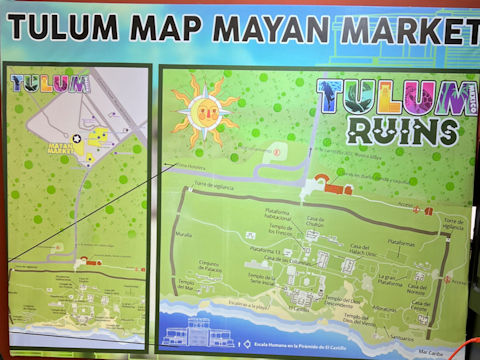
As we arrived at Tulum, Christina led us through a long gauntlet of stalls selling trinkets and other items, then make our way through a small market area at the entrance. Once inside, it was a bit under a mile to the site, where we then went left along the outer wall before turning toward the see to get a look at the site from the outside.
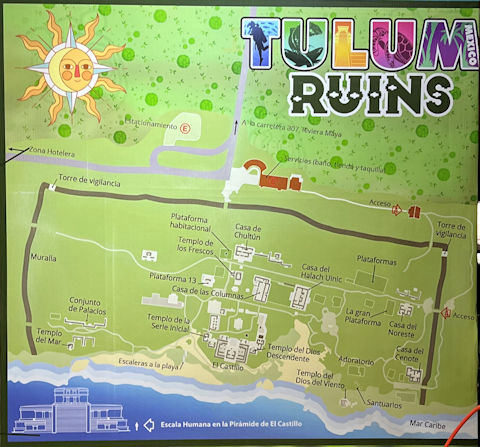
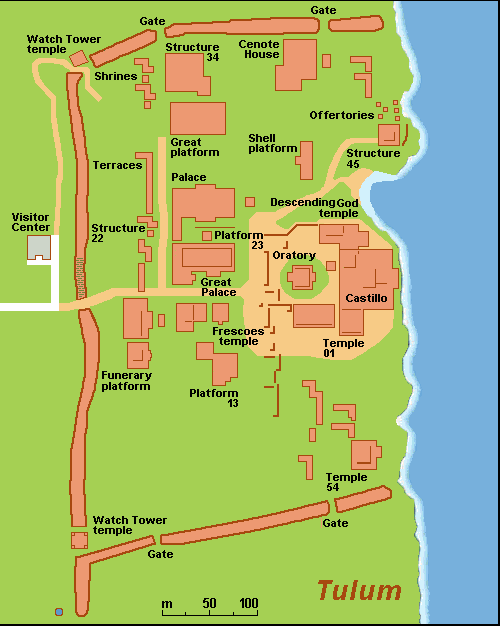
We then proceeded through a small passage through the huge stone wall made of limestone (noting the Mayans must have been rather short). The boundary wall averaged about 3–5 meters (9.8–16.4 ft) in height, with walls about 8 m (26 ft) thick and 400 m (1,300 ft) long on the side parallel to the sea and 784 m long in total along the three sides. There are small structures to act as watch or guard towers on the outer southwest and northwest corners, showing again how well defended the city was. Alternatively, while they resemble turrets, they may simply have been small temples and not for defensive purposes. There are five narrow gateways in the wall with two each on the north and south sides and one on the west. While Christina asserted the wall was to segregate the ceremonial area designated for the elites of prists and nobility from surrounding commoners and peasants, online sites showed it is unclear and the wall may have helped protect the entire population of 600 or so people in the immediate area from invaders. Although there is no specific data about its population at its height, estimates put it between 1,000 and 1,600.
Once inside, we were immediately greeted by the Cenote House (Casa del Cenote) or Priest's House which is situated over a small cenote which provided fresh water to the elites allowed access to the ceremonial area. This is one of the few Mayan structures that appears to have both ceremonial and residential uses, as there is a platform just to the east to allow the priest to greet the rising sun.
On the rise along the shore in front of us was the small Templo del Dios del Viento (Temple of the Wind God).
Clearly the dominant structure in the site is the El Castillo (the castle) pyramid or The Palace, which is 7.5 m (25 ft) tall. The Castillo was built on a previous building that was colonnaded and had a beam and mortar roof. The lintels in the upper rooms have serpent motifs carved into them. The construction of the Castillo appears to have taken place in stages. A small shrine appears to have been used as a beacon for incoming canoes. This shrine marks a break in the barrier reef that is opposite the site. Here there is a cove and landing beach in a break in the sea cliffs that would have been perfect for trading canoes coming in. This characteristic of the site may be one of the reasons the Maya founded the city of Tulum exactly here, as Tulum later became a prominent trading port.
According to a sign, "buildings at Tulum were organized along streets or avenues. Along their side, the buildings were grouped, especially residential platforms on which there were wooden houses with palm roofs, which because of their fragility are no longer there." Another sign said, "although in Tulum, major rulers and priests may have lived in buildings made of stone, like the Palace, the important people of the city frequently also lived in houses made of perishable materials (wood, palm and other materials) that were built on these platforms with stairs. The common people had more modest houses, on the outskirts of the area. Their houses were of perishable materials such as wood, vines, and palm roofs, very similar to some of those currently used in teh region."
In the plaza below and in front of the pyramid is the Temple of the Frescoes, one of the best preserved buildings and which includes a lower gallery and a smaller second story gallery. The Temple of the Frescoes was used as an observatory for tracking the movements of the sun. A mural can still be seen on the eastern wall that resembles that of a style that originated in highland Mexico, called the Mixteca-Puebla style, though visitors are no longer permitted to enter. Inside is a mural painted in three sections: the first level represents the Mayan world of the dead, the middle is that of the living, and the final, highest piece, is of the creator and rain gods. Interestingly, in the middle of the living section is a god astride a four-legged animal believed to be a horse. If in fact this is a horse, it would mean Mayans still occupied Tulum in 1518 when they would have seen the animals for the first time with the arrival of the Spanish. Chiseled above the doorway of the temple is a figure with what appears to be bird’s wings and a tail. This diving god is believed to represent a Mayan Venus deity who protected the people and is particularly well-preserved on various buildings around the site.
Yes, there were iguanas everywhere here too, along with some beautiful flowers.
We headed up the path to the right of the Palace toward the cliffs.
Pretty view over the cliffs of the sea and reef. Unfortunately, much of the eastern seaboard of Mexico (and Florida) was currently covered with swaths of sargassum, a nasty brown seaweed that floats on the surface and then rots once washed ashore.
The Temple was pretty impressive, and surprisingly intact, from the seaward side.
Exiting the site involved another tunnel through the wall.
Saw a beautiful woodpecker as we walked back to the entrance.
Also saw the "cotton" from the pods of the Ceiba tree
|
|
|




.PNG)
.JPG)
.JPG)
.JPG)
.JPG)
.JPG)
.JPG)
.JPG)
.JPG)
.JPG)
.JPG)
.JPG)
.JPG)
.JPG)
.JPG)
.JPG)
.JPG)
.JPG)
.JPG)
.JPG)
.JPG)
.JPG)
.JPG)
.JPG)
.JPG)
.JPG)
.JPG)
.JPG)
.JPG)
.JPG)
.JPG)
.JPG)
.JPG)
.JPG)
.JPG)
.JPG)
.JPG)
.JPG)
.JPG)
.JPG)
.JPG)
.JPG)
.JPG)
.JPG)
.JPG)
.JPG)
.JPG)
.JPG)
.JPG)
.JPG)
.JPG)
.JPG)
.JPG)
.JPG)
.JPG)
.JPG)
.JPG)
.JPG)
.JPG)
.JPG)
.JPG)
.JPG)
.JPG)
.JPG)
.JPG)
.JPG)
.JPG)
.JPG)
.JPG)
.JPG)
.JPG)
.JPG)
.JPG)
.JPG)
.JPG)
.JPG)
.JPG)
.JPG)
.JPG)
.JPG)
.JPG)
.JPG)
.JPG)
.JPG)
.JPG)
.JPG)
.JPG)
.JPG)
.JPG)
.JPG)
.JPG)
.JPG)
.JPG)
.JPG)
.JPG)
.JPG)
.JPG)
.JPG)
.JPG)
.JPG)
.JPG)
.JPG)
.JPG)
.JPG)
.JPG)
.JPG)
.JPG)
.JPG)
.JPG)
.JPG)
.JPG)
.JPG)
.JPG)
.JPG)
.JPG)
.JPG)
.JPG)
.JPG)
.JPG)
.JPG)
.JPG)
.JPG)
.JPG)